You need to create your own Facebook group because it gives you full control over a community you own, unlike posting to other people's groups where you're always at someone else's mercy. Groups have dramatically higher organic reach than Pages in 2026, they build the kind of trust that makes selling natural rather than pushy, and they provide direct access to your audience without the algorithm unpredictability of a Page feed. The compounding effect kicks in after 6 to 12 months: a group of 5,000 engaged members is a marketing asset that produces consistent results indefinitely.
Creating a Facebook group might seem like extra work when you already have a Page, a website, and are already posting to other people's groups (perhaps with a tool like PilotPoster). The question of why you should add group ownership to that is legitimate.
The honest answer goes beyond the typical "you get better reach" framing. This guide covers the structural case for why owning a group changes your marketing position in ways that posting to other groups cannot, the timeline for what to actually expect when you build one, and what group ownership looks like paired with an automated posting strategy.
Owned Audience vs Rented Audience: The Core Distinction #
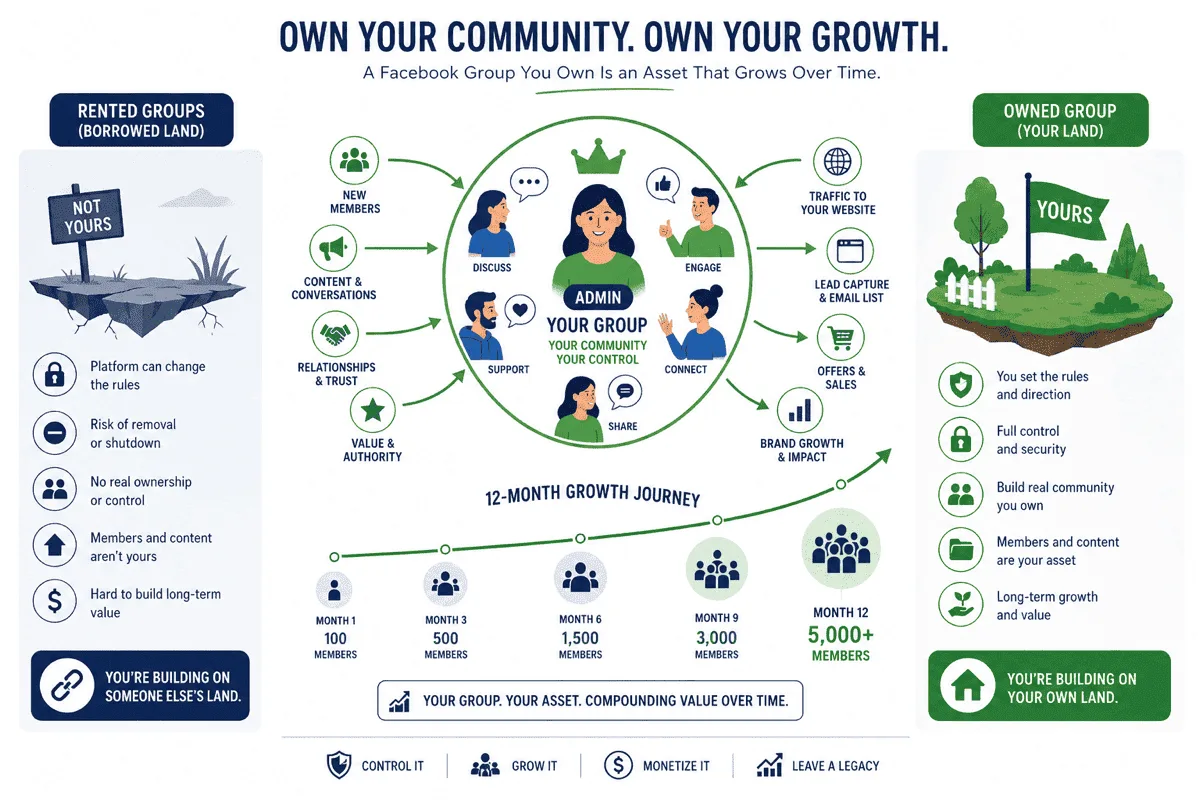
Most of your current Facebook presence is on rented land. Your Facebook Page is subject to algorithmic reach decisions by Meta. Your posts in other people's groups are subject to admin moderation, group rules, and removal at any point. Your ad-driven reach disappears the moment you stop paying.
A Facebook group you admin and own is closer to owned land. You cannot be banned from your own group. Your posts don't go through an admin approval queue. You set the rules. You define who can join and what gets posted. The community accumulates around your leadership over time and the asset grows regardless of what you spend on any given month.
This distinction matters especially as organic Page reach has declined significantly. Facebook Pages in 2026 typically see organic reach of 1 to 3% of their follower count per post. Facebook Groups, by contrast, regularly see 10 to 30% of members engaging with group content, because the algorithm prioritizes group activity as part of its "meaningful social interactions" model.
The same post to a 10,000-follower Page and to a 10,000-member group will almost always get 5 to 10 times more organic engagement in the group. Not because the group audience is better, but because the platform treats group content differently.
The 6 Structural Benefits of Owning Your Facebook Group #
1. Post Without Permission. You're the Admin #
When you post to other people's groups, you're always managing someone else's rules. Posts can get stuck in approval queues, be rejected for arbitrary reasons, be deleted after going live, or result in your removal from the group entirely. Admin decisions vary widely and are inconsistent by definition.
When you own the group, none of these friction points exist. You can post whatever you want, whenever you want, at whatever frequency your content strategy calls for. Your posts go live immediately. Your marketing calendar is entirely yours to control.
This doesn't mean you should ignore what members want. A group that feels like a one-way broadcast loses members quickly. But it does mean that when you have something to say, the channel is open.
2. Build Compounding Trust and Authority #
A Facebook group isn't just a marketing channel. It's a context in which you are visibly the person in charge: the one who answers questions, moderates discussions, welcomes new members, and sets the tone for how the community operates.
This creates a specific type of authority that is hard to build through any other channel. Members who join a niche group and consistently see you providing value, facilitating conversations, and solving problems begin to view you as the trusted expert in that space, not because you claimed the title but because you demonstrated it over time.
A group with 5,000 engaged members positions you as a genuine leader in your niche in a way that 5,000 Page followers simply doesn't, because in the group context you are the organizer and the authority figure. People have joined your community specifically.
3. Promote Products and Services Organically #
There is a well-known principle in marketing: people buy from people they know, like, and trust. A Facebook group is one of the most effective environments for building all three simultaneously.
In your own group, members see you regularly. They read your posts, see you respond to others, watch how you handle disputes or difficult questions. They form a real picture of who you are. By the time you mention a product or service, the recommendation comes from someone they've observed consistently, not from an advertiser they don't know.
This is why group-based product launches consistently outperform cold ad campaigns. The audience isn't starting from zero trust. The work of building that trust happened in the weeks and months before the launch. The sale is the natural endpoint of an ongoing relationship, not a cold pitch.
Effective group-based promotion strategies include: exclusive member discounts, early access to new offerings, feedback gathering before launch, and case study sharing from existing customers who are also group members.
4. Direct Market Research Access #
Your Facebook group is a continuous market research resource. Members post questions, share frustrations, describe problems they're trying to solve, and debate approaches to challenges you're thinking about. All of this happens organically, without you having to run surveys or pay for research.
The language members use to describe their problems is especially valuable. The exact phrasing of a member's question is often a better guide to what your marketing copy should say than any professionally researched positioning statement. People tell you precisely how they think about the problem you solve.
Strategic group admins read their group feed the way a researcher reads qualitative data. Recurring themes in questions reveal product gaps. Recurring frustrations reveal competitive opportunities. Member reactions to content tell you what resonates and what doesn't before you commit to a larger campaign.
5. Expand Your Presence and Drive Traffic #
Your Facebook group becomes a hub that connects to the rest of your marketing ecosystem. Every valuable piece of content you share in the group can drive traffic to your website, your email list, your YouTube channel, or your other social platforms.
The key difference from paid traffic is compounding: a group that provides consistent value grows through word of mouth and member invitations. Members who get value share the group with colleagues and friends in the same niche. A well-run group can double in size in a year without any paid promotion, because satisfied members become ambassadors.
Unlike ads, which require ongoing spend to maintain reach, a growing group produces increasing organic reach automatically. The more members engage, the more Facebook surfaces group content to a broader audience.
6. Create a Two-Way Relationship With Your Audience #
Pages and websites are largely one-directional: you publish, your audience consumes. A group inverts this. Your audience posts, asks questions, starts discussions, and brings their own content. You become a facilitator as much as a publisher.
This two-way dynamic creates stronger retention. Members who have posted in your group, had their questions answered, and had conversations with other members have a relationship with the community, not just with your content. They're more likely to stay members, more likely to convert to customers, and more likely to advocate for your brand outside the group.
What to Expect in Months 1 Through 12 #
Months 1 to 2: Foundation Phase #
Focus is on group setup and seeding. Choose a specific, searchable group name. Write clear rules and a welcome post. Seed the group with 20 to 30 high-quality posts before inviting anyone, so new members join an active-looking community rather than an empty feed.
Invite your warmest existing audience: email list subscribers, website visitors via popup, customers, and colleagues in your niche. Your first 50 to 100 members set the culture of the group. Choose them intentionally.
Post daily or near-daily. Engage with every comment. The early algorithms treat this engagement as a signal to surface the group to more potential members.
Months 3 to 4: Early Growth Phase #
The group has its own identity now. Post cadence matters more than polish. A mix of content types works better than all educational or all promotional: tips and how-tos, questions that invite member responses, behind-the-scenes content, and occasional promotion.
Member-generated content starts to appear. Respond visibly and generously. When members see that their contributions get genuine responses, they post more. This creates the positive feedback loop that makes groups valuable.
Cross-post the group link in your other groups (where appropriate), mention it to your email list, and feature member wins in the group to encourage members to share their experience.
Months 5 to 8: Momentum Phase #
If the first four months were consistent, the group is growing on its own through shares and organic Facebook discovery. You'll notice members answering each other's questions before you get to them. Organic engagement starts to include people you don't recognize from your existing audience.
This is when you can begin introducing automation tools to maintain your own posting cadence. PilotPoster can schedule your admin posts to your group alongside your joined-group campaigns, ensuring your group continues to receive fresh content even during busy weeks. See the admin auto-posting guide for how to set this up without making your group feel automated.
Months 9 to 12: Established Phase #
A consistently managed group that has reached 1,000 to 3,000 members is a genuine marketing asset. Member engagement is predictable. Launches and promotions perform better because the audience has history with you. The group generates qualified inbound inquiries without you having to pitch actively.
At this stage, consider adding a lead magnet or email optin as part of the group onboarding (member approval questions that ask for an email in exchange for a bonus), formalizing your content calendar, and identifying your most engaged members as potential moderators or community champions.
Owning a Group Alongside Posting to Joined Groups #
The group ownership strategy and the joined-group posting strategy are complementary, not alternatives. They serve different purposes in your marketing funnel:
- Posting to joined groups brings in new leads and builds top-of-funnel awareness across many communities.
- Your own group is where those leads land once they've seen your content in other groups and are curious enough to engage further.
Many successful Facebook group marketers use both: PilotPoster to post to 30 to 60 joined groups consistently, driving curious members back to their own group. Their group then does the relationship-building work that turns interested visitors into customers.
This pairing means your owned group benefits from the exposure your joined-group campaigns generate, and your joined-group campaigns build toward an asset you control rather than just producing one-off engagement in other people's communities.
Getting Started: Practical Setup Checklist #
- Group name: Specific enough to attract the right people, searchable, includes your niche keyword.
- Description: Clearly states who the group is for, what members can expect, and why they should join.
- Rules: 4 to 6 clear, specific rules. Post them as a pinned post, not just in the group info.
- Cover image: Professional, includes your group name and a visual that signals the niche.
- Welcome post: A warm, specific introduction from you. Pin this post.
- Seed content: 20 to 30 posts across multiple topics before opening to members.
- Approval questions: 2 to 3 questions that help you understand new members and filter for fit.
- Content calendar: Plan at least 2 weeks of content before launch so you're not scrambling immediately after.
- An owned Facebook group is an audience asset, not just a posting channel. Posting to joined groups is rented reach.
- Group organic reach consistently outperforms Page reach because of how Facebook's algorithm treats group content.
- The compounding effect of a well-run group takes 6 to 12 months to become significant. Start early.
- Months 1 to 2 are about foundation, 3 to 8 are about consistency and growth, 9 to 12 are about leverage.
- An owned group combined with a joined-group posting strategy creates a complete Facebook marketing system: outbound reach that drives traffic back to a community you control.


