The most common reasons people get blocked from Facebook groups are posting identical content across many groups, ignoring group rules, posting too promotional content without first building a presence, and posting too frequently to the same group. These are group-level issues decided by admins, not Facebook's systems. This guide focuses specifically on group-level bans and admin removals. Account-level restrictions (Facebook Jail) are a separate issue covered in a different guide.
There are two distinct ways you can lose posting access in Facebook groups. If you use a posting tool like PilotPoster, understanding both is important for protecting your account and campaigns. The first is being removed by a group admin, which is a group-level decision. The second is a Facebook account restriction that prevents you from posting anywhere. Most guides conflate these two problems.
This guide focuses specifically on the group-level problem: why admins remove members, what the warning signs look like before it happens, how to read group rules effectively, and how to recover your standing in a niche after a removal. The account-level restriction topic is covered separately in how to avoid Facebook Jail.
The Two Types of Group Bans #
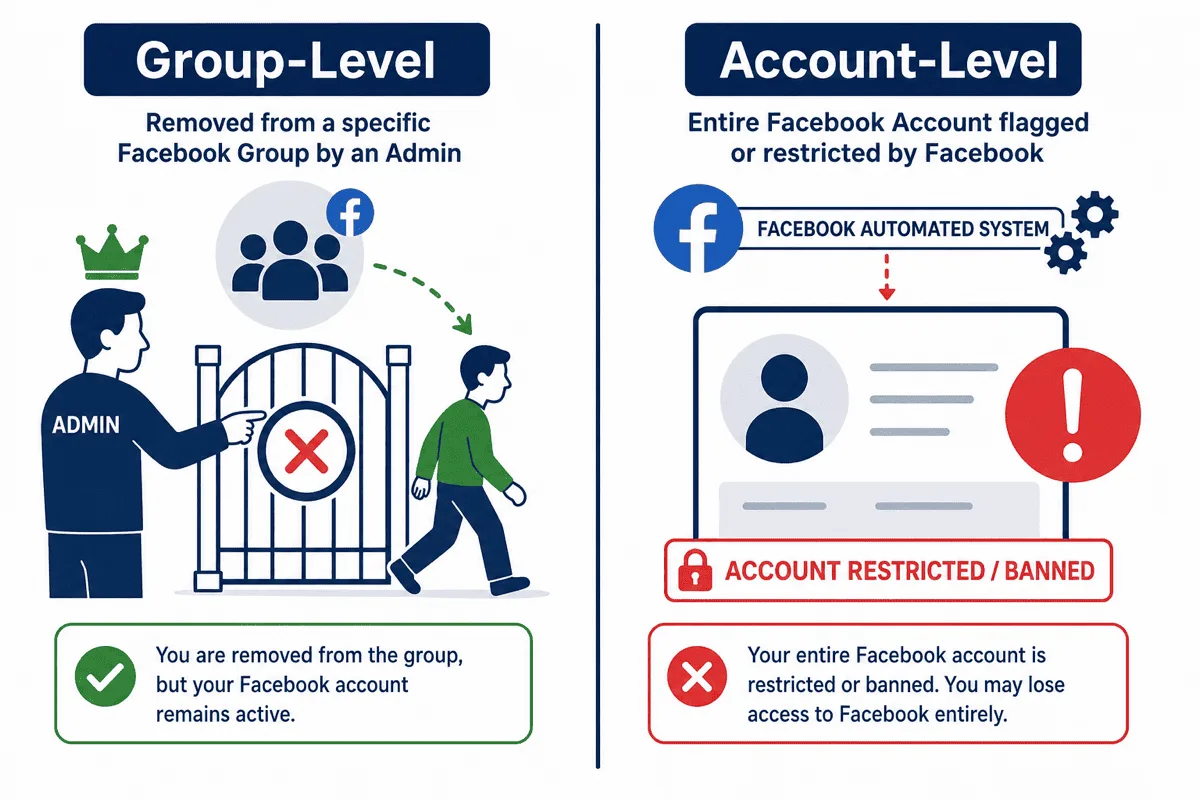
Understanding this distinction before anything else:
| Type | Who Decides | Scope | How Long | Fixed By |
|---|---|---|---|---|
| Group ban (admin removal) | Group admin | That group only | Often permanent (that group) | Improving approach; can't appeal most cases |
| Group posting block (by admin) | Group admin | That group only | Admin's discretion | Contact admin or wait |
| Facebook account restriction | Facebook's systems | All groups (potentially) | Hours to weeks | Wait out restriction; adjust behavior |
When a group admin removes you, it affects only that group. You can still post in every other group you belong to. When Facebook restricts your account, it affects all your group activity. These require different responses.
Why Admins Remove Members: The Real Reasons #
Group admins are typically volunteers with limited time. They remove members for efficiency: the less time they have to spend on moderation, the better. The triggers that consistently cause removals:
Identical Content in Multiple Groups #
This is the top reason active niche marketers get removed. If an admin belongs to multiple groups in the same niche (which they almost always do), they see your identical post appearing in all of them. They immediately identify you as a bulk poster and remove you, often from all their groups simultaneously.
The fix is content variation. Even small changes to the opening line and phrasing reduce the recognition pattern significantly. AI rewriting that generates a structurally different post for each group is more effective than manual tweaks. See how AI rewriting reduces ban risk across groups for the specific mechanism.
Pure Promotion Without Prior Value #
New members who join a group and immediately post promotional content are the most common removal case. Every group admin has seen hundreds of these accounts. The behavioral signature is unmistakable: join, wait one or two days, post a promotion.
The minimum viable approach for a new group member is to spend 2 to 3 weeks contributing to discussions, answering questions, and engaging with existing content before any promotional post. This isn't a formula to game; it's a genuine demonstration that you're interested in the community, not just the audience.
Posting Too Frequently to the Same Group #
Even valuable content becomes a nuisance at high frequency. A group member posting 3 times per week to a 500-member group is posting more than the admin themselves. It makes the feed feel like one person's broadcast channel rather than a community. Admins cap this.
The practical limit for non-admin members in most groups is once per week maximum. For promotional content specifically, once every 2 weeks is a more sustainable pace. High-frequency posters who get value from a group should focus that frequency on non-promotional content, not promotion.
Violating Explicit or Implied Group Rules #
Most bans for rule violations are preventable with 5 minutes of preparation before your first post. Group rules are either posted explicitly in the group description, in a pinned post, or visible in the posting patterns of existing content.
Common rule violations that trigger bans:
- Posting external links in a no-link group
- Posting affiliate links where they're prohibited
- Posting off-topic content in a highly specific group
- Tagging non-members or spamming tags
- Using engagement baiting (asking for reactions as a condition for something)
Low-Quality or Misleading Content #
Content that promises something in the headline that it doesn't deliver in the body, uses clickbait, or makes claims that don't hold up triggers both human reporting and admin notice. In quality groups, admins actively remove clickbait even when it doesn't violate any explicit rule, because it damages the community's quality standard.
Profile Red Flags #
Admins review member profiles when they encounter suspicious posting behavior. Red flags that accelerate a removal decision:
- Account created recently (less than 6 months old) with high activity
- No profile photo or a clearly stock/generic photo
- No friends or connections visible
- Bio that looks templated or generic
- Posting history that's entirely promotional across different groups
Reading Group Rules Effectively #
Group rules are often ignored because they seem like boilerplate. They're not. Experienced admins write specific rules based on the actual problems they've dealt with. Reading them carefully tells you exactly what not to do.
The checklist before your first post in any group:
✓ Read the group description for audience and purpose
✓ Read all pinned posts (rules are often there, not in the group rules section)
✓ Review the formal rules list in group settings
✓ Scroll through recent posts to see what format and topics get engagement
✓ Note whether other members post promotional content and in what form
✓ Check whether links are posted directly or through comments
✓ Identify whether the group is discussion-focused, resource-sharing, or mixed
The most useful signal is what successful existing members do. If promotional posts are rare and educational posts dominate, that tells you the group's culture. If every promoted post follows a specific format (question first, then offer), that's a pattern worth following.
Warning Signs Before a Ban #
Bans rarely come with no warning. The signs that a group is becoming hostile to your presence:
- Your posts stop getting engagement: Not comments, no reactions. The group has mentally filtered you out.
- Members respond negatively: Comments calling out your posts as promotional, spam, or unwelcome.
- Admin comments on your post: A warning post or public note from an admin about your content.
- Your posts go to "pending" status when they didn't before: The admin has moved your account to require approval for all posts.
- Dramatic drop in reach: Your posts appear to be visible but are generating no activity at all. The admin may have restricted your posting without removing you.
When you see these signs in a group, the right response is to immediately pull back on promotional content, spend 2 to 4 weeks posting purely educational material, and gradually rebuild credibility before trying any promotion again.
How to Recover After Being Removed #
Once you've been removed from a group, direct re-entry is often impossible. Some admins block removed members from rejoining. Here's how to handle this:
Don't Request to Rejoin Immediately #
Immediately requesting to rejoin after a ban signals that you don't understand why you were removed and makes permanent blocking more likely. Wait at least 3 to 4 weeks.
Contact the Admin Respectfully #
If the group is important to your marketing, a direct, respectful message to the admin can sometimes result in reinstatement. The message should:
- Acknowledge that your posting approach was inconsiderate of the community
- Not argue about whether the removal was fair
- Explain briefly how you intend to contribute differently
- Accept their decision without pressure
A short, genuine message gets better results than a long explanation. Most admins respond positively to members who show self-awareness rather than defensiveness.
Find Alternative Groups in the Same Niche #
Most niches have multiple Facebook groups. A removal from one group rarely closes off a niche entirely. Use the time you would have spent in that group to identify 3 to 5 alternative groups in the same niche, approach them correctly from the start, and build standing there instead.
Group-Level vs Account-Level Safety: The Key Distinction #
To be clear about scope: everything described in this guide is about your standing with individual group admins. A group admin removing you has no effect on your Facebook account. You can still post in all other groups, message friends, and use all Facebook features normally.
Account-level restrictions are entirely different. They are imposed by Facebook's automated systems based on behavioral signals: machine-speed posting, duplicate content across many groups, login anomalies, or Terms of Service violations. These restrict your ability to post anywhere on Facebook temporarily.
The two problems sometimes appear together (if your posting approach is causing both admin removals and account flags), but they're separate issues with separate causes and separate fixes. If you're experiencing restrictions on your Facebook account itself, not just removals from individual groups, see how to avoid Facebook Jail for that specific topic.
Sustainable Group Posting: The Long-Term Model #
The marketers who post in Facebook groups for years without serious ban problems follow a consistent pattern:
- They belong to groups they genuinely participate in. They answer questions, engage with discussions, and are recognized contributors, not just posters.
- Their promotional content is in context. When a group member asks "does anyone know a good tool for X?", a relevant reply that includes your product is invited promotion. It lands completely differently than a cold promotional post.
- They post less frequently than they want to. Discipline about frequency is the simplest ban prevention strategy. Most marketers post too often in the groups they care about most.
- Their content varies. Whether through AI rewriting or careful manual variation, their posts in different groups don't look identical. They use tools like PilotPoster's automated posting with content variation to maintain this without manual effort at scale.
- They monitor engagement signals. They notice when a group's response to their posts changes and adjust before an admin does.
- Group bans are admin decisions affecting only that group, not your account. They are separate from Facebook account restrictions.
- The top causes of admin removal: identical content across groups, pure promotion with no community contribution, posting too frequently, and rule violations.
- Warning signs appear before bans: no engagement, negative comments, posts pending approval. Adjust when you see them.
- Recovery after removal: wait before rejoining, contact admin respectfully if needed, find alternative groups in the same niche.
- Sustainable long-term posting involves genuine community participation, context-appropriate promotion, frequency discipline, and content variation.


