AI rewriting, as implemented in PilotPoster, generates a unique version of each post before it goes to each Facebook group. Because no two posts share identical text, Facebook's duplicate content detection doesn't flag your campaign as spam. This is different from Spintax, which rotates predefined word alternatives and can be detected by pattern analysis. AI rewriting produces genuinely distinct text for each group, eliminating the duplicate content signal while preserving your core message. It's both a safety feature and an engagement feature.
Content variation has always mattered for Facebook group marketing. But the mechanism that makes variation necessary, and the threshold at which identical content becomes a problem, has shifted significantly in the last few years.
This guide explains how Facebook's duplicate content detection works, why Spintax alone is no longer a reliable solution, and how AI rewriting addresses the problem at a deeper level.
How Facebook Detects Duplicate Content Across Groups #
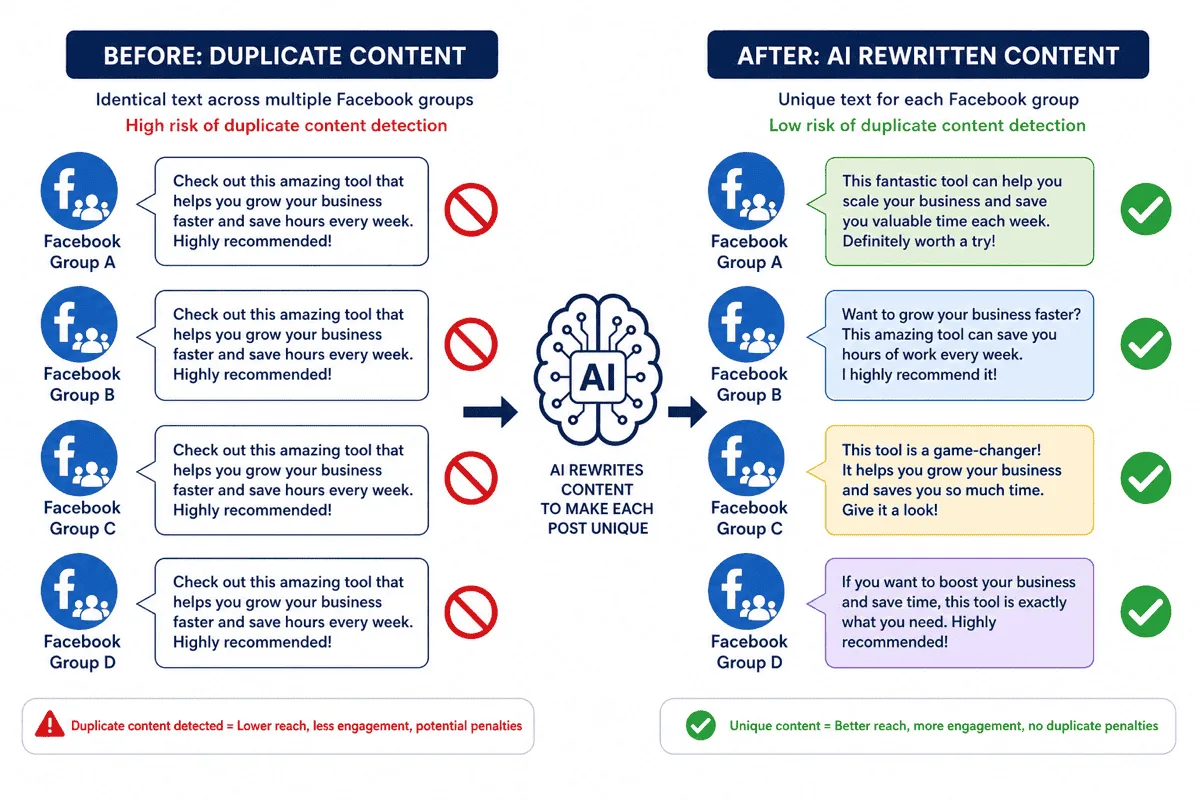
Facebook's spam detection system runs multiple layers of analysis on content. For group posting specifically, the system looks at several signals:
- Text similarity: When identical or near-identical text appears in multiple groups within a short time window, it's compared against a hash-based similarity index. High similarity across many groups is a spam signal.
- Posting pattern: An account posting to many groups in a short window, regardless of content, draws review. This is a rate signal, not a content signal, but it compounds with content signals.
- Account history: An account with a history of spam flags weights the content review more heavily. A clean account with a first-time similar-content campaign gets less scrutiny than an account with prior flags.
- Group member overlap: When many groups you're posting to share a significant number of mutual members, those members encounter your content multiple times. Human spam reports from recognizing the same post in multiple groups trigger manual review.
The combination of automated text similarity detection and human spam reporting from members in multiple groups makes duplicate content the highest practical risk factor in group posting campaigns.
Why Spintax Is No Longer Enough #
Spintax, the classic group poster technique, works by defining alternatives at specific positions in a text template:
{Check out|Have a look at|Take a look at} this {amazing|great|fantastic} resource...
When Spintax became widely used among group marketers, it was effective at evading early duplicate content detection because the surface text varied enough to avoid exact hash matches.
Facebook's detection has since improved in two ways that undermine Spintax's effectiveness:
- Semantic similarity matching: Rather than just comparing exact text, modern detection systems analyze meaning and structure. Spintax variations are semantically near-identical because they follow the exact same sentence structure with only lexical substitutions. This pattern is detectable.
- Spintax pattern recognition: The {word1|word2|word3} substitution pattern itself creates a predictable structural fingerprint across variations. When a system sees hundreds of posts that all have the same underlying template with different word choices, it can identify the template even without recovering the original Spintax syntax.
This doesn't mean Spintax is useless. For small group lists with high group diversity and low membership overlap, Spintax still provides useful variation. For high-volume campaigns hitting many groups in the same niche, Spintax alone is a thin shield.
How AI Rewriting Works Differently #
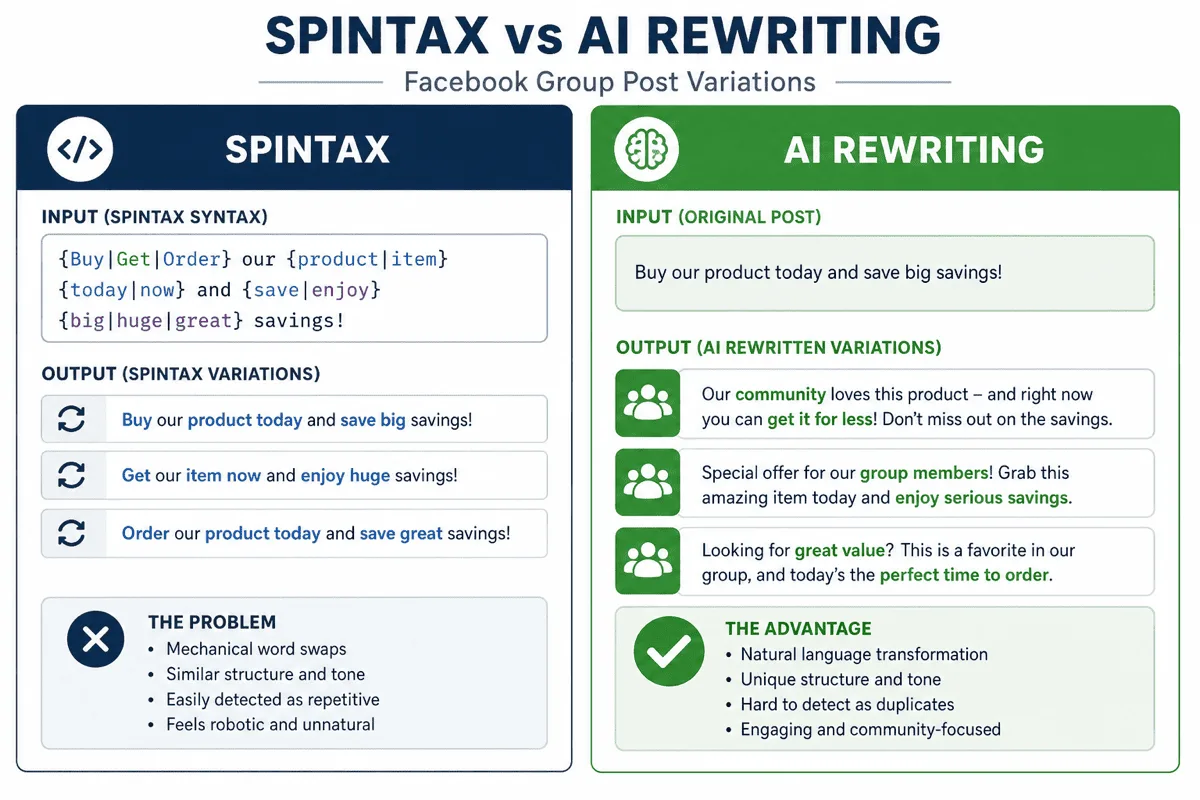
AI rewriting doesn't substitute words at predefined positions. It takes your source post as a brief and generates a distinct text that conveys the same information in a structurally and stylistically different way.
Consider a source post like:
"If you're a real estate investor looking for off-market deals in Texas, join the deal flow. I share one new opportunity every week, completely free. Drop a comment or DM me."
A Spintax version might look like:
"If you're a real estate investor {searching for|looking for|hunting for} off-market deals in Texas..."
An AI-rewritten version might look like:
"Texas real estate investors: I send one off-market deal opportunity to my list every week, no cost. If you want to be on that list, drop a comment or send me a message."
The second version has different sentence structure, different word order, different emphasis, and a different opening. The content hash is different. The semantic analysis reveals the same topic (Texas real estate, off-market deals, free list), but the structural fingerprint is genuinely distinct.
When PilotPoster applies AI rewriting to a post before sending it to each group, the text that lands in Group 1 is meaningfully different from the text in Group 2, Group 3, and Group 50. A member in multiple groups who happens to see your post more than once reads two different posts on the same topic, not the same post twice.
The Human Spam Report Problem #
Automated detection is only half the risk. Human spam reports from group members are the other half, and they're not addressed by anything other than genuine content variation.
In any active niche, many Facebook groups share overlapping membership. Serious enthusiasts join multiple groups on the same topic. If you're posting to 40 groups in the fitness niche, any individual member interested in fitness may be in 8 to 12 of those groups. If they see your identical post 8 times across the groups they're in, they will report it as spam. That report triggers manual review of your account and your posting history.
Spintax doesn't solve this because the human eye recognizes the same underlying message even when individual words differ. The opening structure is the same, the offer is phrased the same way, the call to action is the same. AI rewriting changes the opening, the structure, and the phrasing enough that the same person seeing two AI-rewritten versions of your post in two different groups encounters what reads as two separate posts, not duplicates.
AI Rewriting and Engagement Quality #
There's a secondary benefit to AI rewriting that goes beyond spam prevention: engagement quality.
Different groups have different community cultures, norms, and vocabulary. A post written for a casual lifestyle group lands differently in a professional trade group. AI rewriting can adapt the tone and register of a post to fit the target group, not just shuffle words around.
When your post in a professional group reads like it was written for professionals, and your post in a casual hobby group reads like it was written for that community, you get better engagement from both. The same underlying offer lands better when it's framed for the audience that's receiving it.
This is the AI rewriting use case that's about effectiveness, not just safety. The safety benefit is avoiding duplicate content flags. The engagement benefit is content that feels native to each community rather than broadcast across communities.
Combining AI Rewriting with Spintax #
PilotPoster supports using both techniques together. The practical approach for high-volume campaigns:
- Spintax in your source post for structural alternatives: two or three different openings, two different calls to action.
- AI rewriting on top of the Spintax output for each group, creating a further layer of variation.
This combination produces the maximum practical variation: Spintax creates a set of structurally distinct source versions, and AI rewriting creates group-specific variations from each source version. If you have 3 Spintax source variants and AI rewriting for 60 groups, each group could get a uniquely generated post that isn't a close duplicate of any other group's post in that campaign.
For the technical setup of Spintax in Facebook posts and how it works with PilotPoster, see the complete guide to Spintax for Facebook group posts.
Practical Settings for AI Rewriting in PilotPoster #
When you create a campaign in PilotPoster with AI rewriting enabled, the setting applies per-group: before each posting event, the AI takes the current post from your queue and generates a unique version for that specific group.
The rewriting preserves:
- Core message and offer
- Any specific details (names, locations, prices) you've included
- The call to action intent (even if the phrasing changes)
- Links and hashtags (these are not rewritten)
The rewriting changes:
- Sentence structure and word order
- Opening line (the most important variation for human recognition)
- Phrasing and vocabulary choices
- Post length slightly (some versions may be a sentence longer or shorter)
Does AI Rewriting Affect Post Quality? #
This is a fair question. The short answer: well-implemented AI rewriting produces human-quality variations from good source material. The quality depends heavily on what you give it to work from.
Source posts that are specific, conversational, and clear produce good variations. Vague, generic source posts produce variations that are equally vague and generic. The input quality ceiling applies.
The practical recommendation is to review the first few AI-rewritten versions before running a full campaign. PilotPoster allows you to preview what the AI produces before sending. If the rewriting output looks natural and on-brand, you're good. If it looks off, adjust the source post to give the AI better material to work from.
- Duplicate content across many Facebook groups triggers both automated detection and human spam reports.
- Spintax is insufficient for high-volume campaigns because semantic similarity detection and human pattern recognition both catch it.
- AI rewriting generates structurally distinct post versions per group, eliminating the duplicate content signal.
- The benefit is dual: spam prevention and better engagement from content that fits each group's culture.
- AI rewriting enhances good source content. It does not fix weak content.


