Auto posting to Facebook groups is safe when done with a browser-based tool like PilotPoster that mimics human behavior, uses randomized delays, varies content between groups, and posts at realistic human speeds. It is risky with cloud-based or API-accessing tools that produce machine-speed activity patterns Facebook's systems can detect. The architecture of the tool matters more than whether you use automation at all.
Every marketer considering Facebook group automation eventually hits the same fear: what if this gets my account banned? It's a legitimate concern. Facebook's Terms of Service are broad, and the cost of an account restriction is real.
But the fear itself is often untargeted. People treat "auto posting" as a single thing with a single risk level. In practice, there is a wide spectrum of automation approaches, and their safety profiles are genuinely different. This guide gives you the honest breakdown, including the specific behaviors that attract Facebook's attention and the architectural choices that avoid them.
What Facebook's Systems Actually Look For #
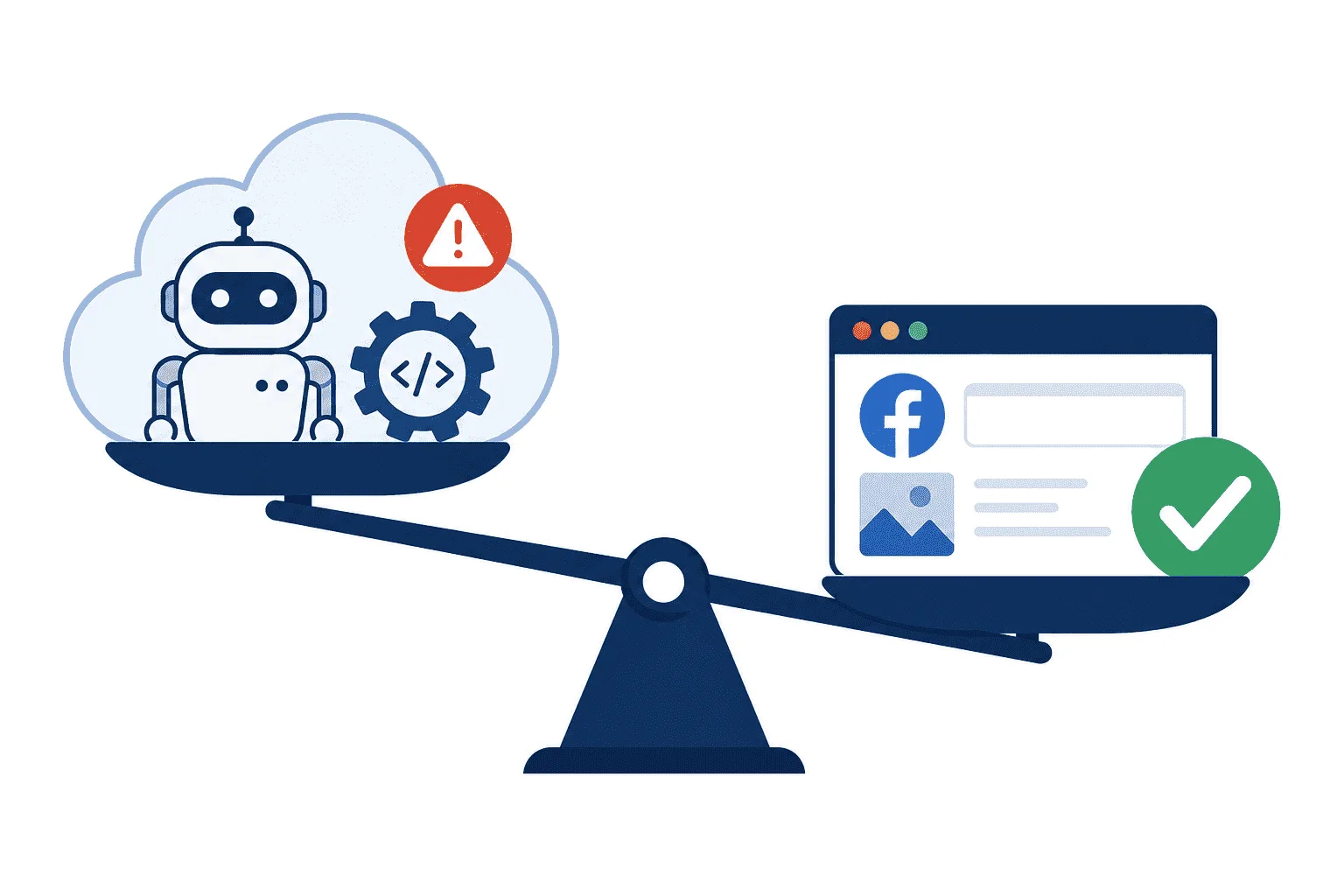
Facebook has automated spam and abuse detection running across all activity on the platform. It is not primarily looking for the word "auto poster" or checking whether a third-party app is involved. It's looking for behavioral patterns that don't match how real users interact with the platform.
The patterns that flag accounts:
- Machine-speed actions: Posting to 20 groups in 2 minutes. No human can do that. The platform notices.
- Identical content across many groups: The same text appearing in multiple groups within a short window is a strong spam signal, especially if those groups overlap in membership.
- Unusual login locations or environments: Cloud-based automation often runs from data center IP addresses that don't match any residential location. This is a strong automated bot signal.
- Non-browser API calls: When a tool calls the Facebook API directly, the HTTP headers, request patterns, and client fingerprint look different from a browser. Facebook can and does detect this.
- Volume spikes: An account that has historically posted 3 times per week suddenly posting 50 times in one day looks automated regardless of the mechanism.
None of these patterns are specific to "automation". They are patterns that wouldn't appear in genuine human activity. That framing is important because it clarifies exactly what to avoid.
The Risk Spectrum: Tool Architecture Matters #
Here's where the honest differentiation happens. Not all automation tools carry the same risk because they don't all produce the same behavioral patterns.
Cloud-Based Automation Tools (Higher Risk) #
Cloud-based tools run your posting from servers. Your account credentials (or an access token) are stored on the tool's infrastructure, and posts are triggered by that server calling Facebook's API or accessing the platform from a machine that is not yours.
This creates multiple detection signals simultaneously: non-residential IP addresses, API call patterns, requests from a device that doesn't match your usual device fingerprint, and often consistent timing patterns because the server runs on a schedule rather than with the random variation of human activity.
The risk is compounded by the fact that if the tool's server infrastructure gets flagged by Facebook, every account using that server is potentially affected, not just yours.
Browser Extension Automation (Lower Risk) #
Browser-based tools run on your computer, in your browser, with your real Facebook session. The IP address is yours. The browser fingerprint is yours. The session is the same one you use for everything else you do on Facebook. From Facebook's infrastructure side, the activity looks like it's coming from the same person who has been using that account for years, because it is.
The main remaining risk with browser-based tools is behavioral: posting too fast, posting identical content, or posting at volumes that don't match a human's natural capacity. These are controllable through the tool's settings.
PilotPoster uses this browser-based approach: the Chrome extension runs in your browser, uses your active session, and posts through the actual Facebook web interface. No API calls for posting, no server-side credential storage, no foreign IP addresses.
| Risk Factor | Cloud-Based Tools | Browser-Based (PilotPoster) |
|---|---|---|
| IP address matches your account history | No (server IP) | Yes (your IP) |
| Browser fingerprint matches your sessions | No | Yes |
| Uses your real Facebook session | No | Yes |
| Posts through Facebook web interface | Rarely | Yes |
| Credentials stored on third-party server | Yes | No |
| Randomized posting delays | Sometimes | Yes |
| Content variation per group | Rarely | Yes (AI rewriting) |
Behavioral Safety: What You Control #
Regardless of which tool you use, there are behaviors within your control that significantly affect how safe your automation is in practice.
Posting Speed #
The single most important safety variable is how fast you post between groups. A human posting manually to groups takes 2 to 5 minutes per group at minimum: open the group, read the rules, compose or paste the post, add media if applicable, submit, wait for confirmation. Any automation that posts faster than 90 seconds per group is already outside normal human behavior range.
PilotPoster uses configurable randomized delays. The recommended setting for safe posting is a random delay between 2 and 5 minutes per group. At that pace, posting to 20 groups takes between 40 minutes and 100 minutes, which is a plausible working session for an active marketer.
Daily Volume #
An account that has posted to 5 groups in the last month does not suddenly post to 200 groups in a single day without that standing out. Ramp up your volume gradually, over weeks, to match what a busy human would do.
A practical rule of thumb: your daily group posting volume should be explainable as a focused manual effort. "I spent my morning posting to 30 relevant groups" is believable. "I posted to 300 groups in one hour" is not.
Content Uniqueness #
Identical content across many groups is consistently the highest-risk posting behavior on Facebook. Group admins also flag it independently of Facebook's systems. Your post in 40 groups with identical text will be seen by members who are in multiple groups, and those members report spam.
The solution is content variation per group. PilotPoster's AI rewriting feature generates a unique version of each post before it goes out. The core message is the same; the phrasing, opening line, and sentence structure vary. This eliminates the duplicate content signal across both Facebook's automated detection and human pattern recognition by group members. For more on how this works, see how AI rewriting reduces ban risk when posting to multiple groups.
Account Warmup #
New accounts posting to groups immediately are a major red flag. Facebook expects new accounts to build connections, interact with existing content, and develop a posting history before they start promoting to many groups. If you're setting up automation on a new or recently reactivated account, spend 2 to 4 weeks of normal activity first.
A Practical Safety Checklist #
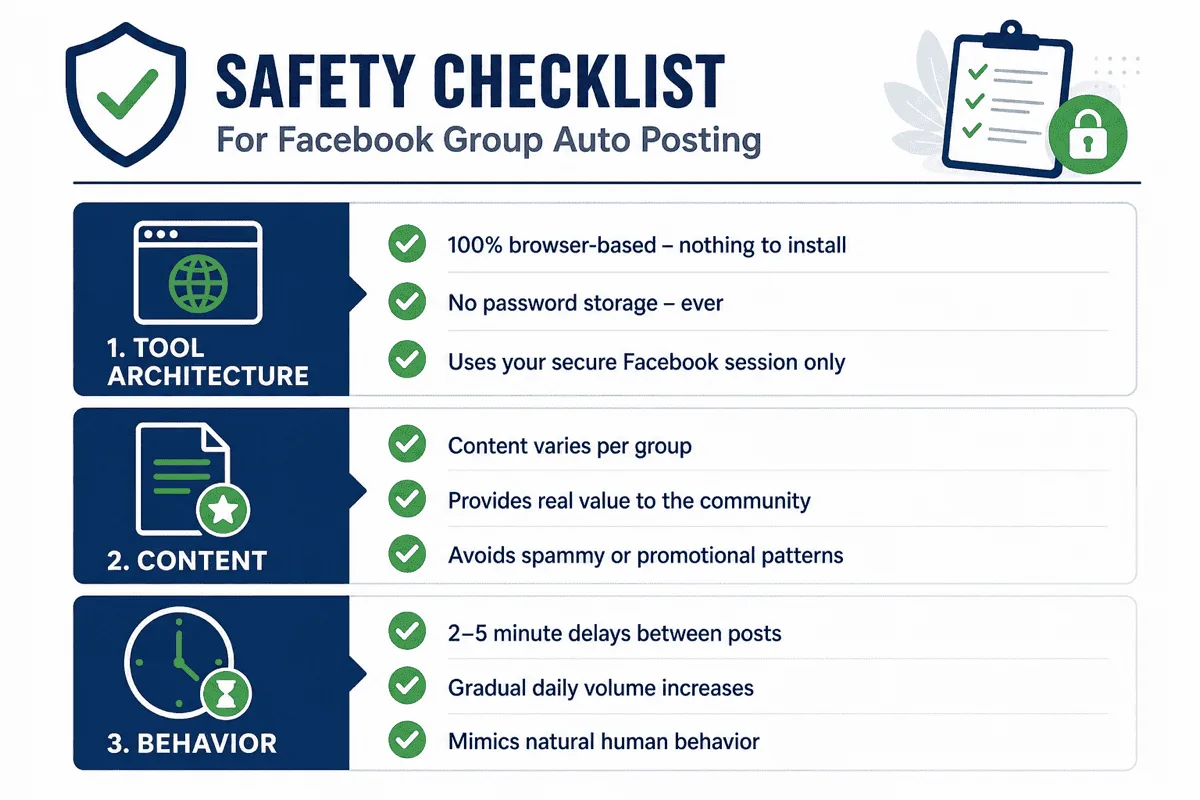
Tool architecture:
✓ Tool posts from your browser, not a cloud server
✓ No Facebook password stored on third-party servers
✓ Uses your existing Facebook session
Content:
✓ Post content varies between groups (AI rewriting or manual variation)
✓ Content provides value, not just promotion
✓ Content complies with each target group's posted rules
Behavior:
✓ Minimum 2 minutes delay between group posts
✓ Daily volume is consistent with your account's posting history
✓ Account has at least 4+ weeks of normal activity before automation
Targeting:
✓ All target groups allow member posts
✓ You are an active, approved member of each target group
✓ Groups are relevant to your content topic
What About Facebook's Terms of Service? #
This question deserves a straightforward answer rather than vague reassurance.
Facebook's Terms of Service prohibit automated actions that access the platform "in an automated way without our permission." They also prohibit creating fake accounts, buying engagement, and other forms of inauthentic behavior.
Browser automation exists in a practically grey area. Facebook has not taken enforcement action against browser extension-based posting tools the way it has against API scraping tools and credential-harvesting automation. The enforcement pattern that exists is behavioral: accounts showing spam patterns get restricted regardless of the mechanism. Accounts posting valuable content at human-plausible speeds generally don't attract attention regardless of whether they use light automation.
The practical reality for Facebook group marketers in 2026 is that browser-based, human-paced automation with content variation has a proven track record of sustainable operation. Tools that exploit the platform aggressively get shut down. Tools that genuinely mirror human activity at scale do not.
What Happens If Something Goes Wrong? #
Understanding the escalation pattern helps calibrate risk correctly. Facebook's enforcement is not typically a sudden lifetime ban. The escalation looks like this:
- Post rejected: Individual posts get marked as spam or rejected by group filters. No account impact.
- Temporary posting restriction: A 1-hour to 24-hour cooldown on group posting. Common trigger: posting too many identical posts in a short window. Resolves on its own.
- Account checkpoint: Facebook asks you to confirm your identity or review recent activity. Standard procedure, not severe.
- Feature restriction: Posting to groups is restricted for a period (sometimes called a "soft ban" or Facebook Jail). Usually lasts a few days.
- Account suspension: Rarely applied except in cases of severe or repeated Terms of Service violations.
Most people who encounter problems with group automation experience steps 1 through 3. These are recoverable by slowing down, improving content quality, and waiting for the restriction to clear. Steps 4 and 5 are reserved for persistent or severe violations.
For a detailed explanation of how to handle account-level restrictions if they do occur, see how to avoid Facebook Jail and what to do during an active restriction.
The Practical Bottom Line #
Safe Facebook group automation in 2026 comes down to three things working together: the right tool architecture (browser-based), the right behavior pattern (human-paced, varied content), and the right targeting (relevant groups where you're a valued member).
When those three things are in place, automation does not introduce meaningful additional risk compared to manual posting. The risk profile of a well-run automated campaign is similar to the risk profile of a well-run manual campaign. The danger is in treating automation as a license to do things at scale that would get you flagged at manual speed.
- Facebook detects behavioral patterns (speed, volume, duplicate content), not automation itself.
- Browser-based tools carry lower risk than cloud-based or API tools because the activity profile matches a real user.
- Randomized delays, content variation, and gradual volume ramp-up are the most important safety behaviors.
- Enforcement escalates gradually: most issues are temporary restrictions, not bans.
- The quality and relevance of your content remains the primary determinant of how groups and Facebook treat your account.
Related Reading #
- How to Auto Post to Facebook Groups Without Getting Banned
- Can You Auto Post to Facebook Groups You Joined?
- How Not to Get Banned or Blocked Posting to Facebook Groups
- How to Avoid Facebook Jail
- What Happens When Facebook Detects an Auto Poster?


