When Facebook detects what it identifies as automated or spam posting, the response escalates gradually: first, individual posts may be rejected or marked as spam; next, a temporary posting restriction (often called a "soft ban") limits your ability to post to groups for hours or days; in serious cases, a feature restriction affects your account more broadly. Permanent bans are rare and typically follow repeated violations, not a first incident. The detection is behavioral, not tool-specific: machine-speed posting, identical content across many groups, and non-browser API patterns are the main triggers.
The fear of detection keeps many marketers from automating Facebook group posting at all. That fear is often miscalibrated: overestimating the severity of a first incident, underestimating how much the right tool architecture changes the risk profile. A browser-based tool like PilotPoster, which operates through your real Chrome session, has a fundamentally different detection profile than cloud-based posters.
This guide breaks down what Facebook's detection actually does, what triggers it, and the architectural decisions that prevent detection in the first place.
The Escalation Ladder: What Facebook Actually Does #
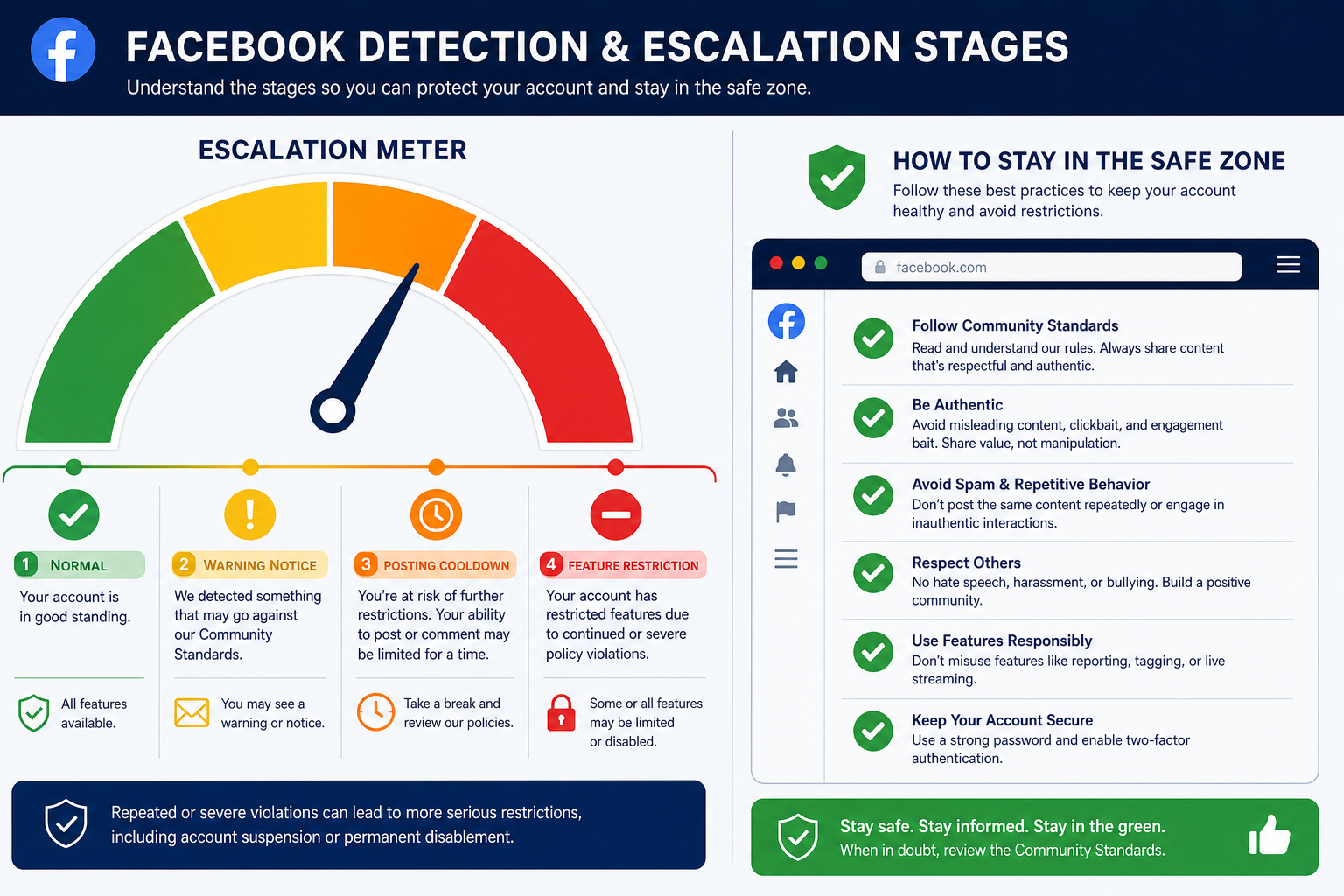
Facebook's enforcement for automated behavior isn't binary (banned or not banned). It follows an escalation path that looks like this:
Stage 1: Individual Post Rejection or Spam Marking #
Your post doesn't publish. Facebook shows an error: "This looks like spam" or "You've been doing this too often." The post goes to a failed state. No account-level consequences yet.
This is the most common first encounter with detection. It happens when a specific post in a specific group gets flagged by the group's spam filter, group admin settings, or Facebook's automated content review. It's group-level, not account-level. Posting continues to other groups normally.
Stage 2: Temporary Group Posting Restriction ("Soft Ban") #
You can see groups but you can't post. If you try, you get a message that you're temporarily restricted from posting in groups. This typically lasts between 1 hour and 72 hours, depending on the severity and frequency of the triggering behavior.
This is what most people call a "soft ban" or a "Facebook Jail" incident as it relates to groups. It's recoverable without any action on your part: the restriction expires, you can post again. The right response is to stop posting immediately and wait it out.
Stage 3: Account-Level Feature Restriction #
Specific features are restricted for your account: posting to groups, posting to your timeline, using certain ad features, or commenting. This is more serious than Stage 2 and typically follows either a Stage 2 incident that was ignored and repeated, or a serious Terms of Service violation. Restrictions at this level usually last days to weeks.
Stage 4: Account Suspension or Permanent Disable #
The account is suspended or permanently disabled. This is rare in the context of group posting automation and typically results from severe or persistent violations across multiple policy areas: fake accounts, coordinated inauthentic behavior, repeated ToS violations after multiple warnings, or explicit hate speech or illegal content.
Most marketers using reasonable automation tools and following basic safety practices never get past Stage 2, and many operate for years without encountering Stage 2 at all.
How Facebook Detects Automation #
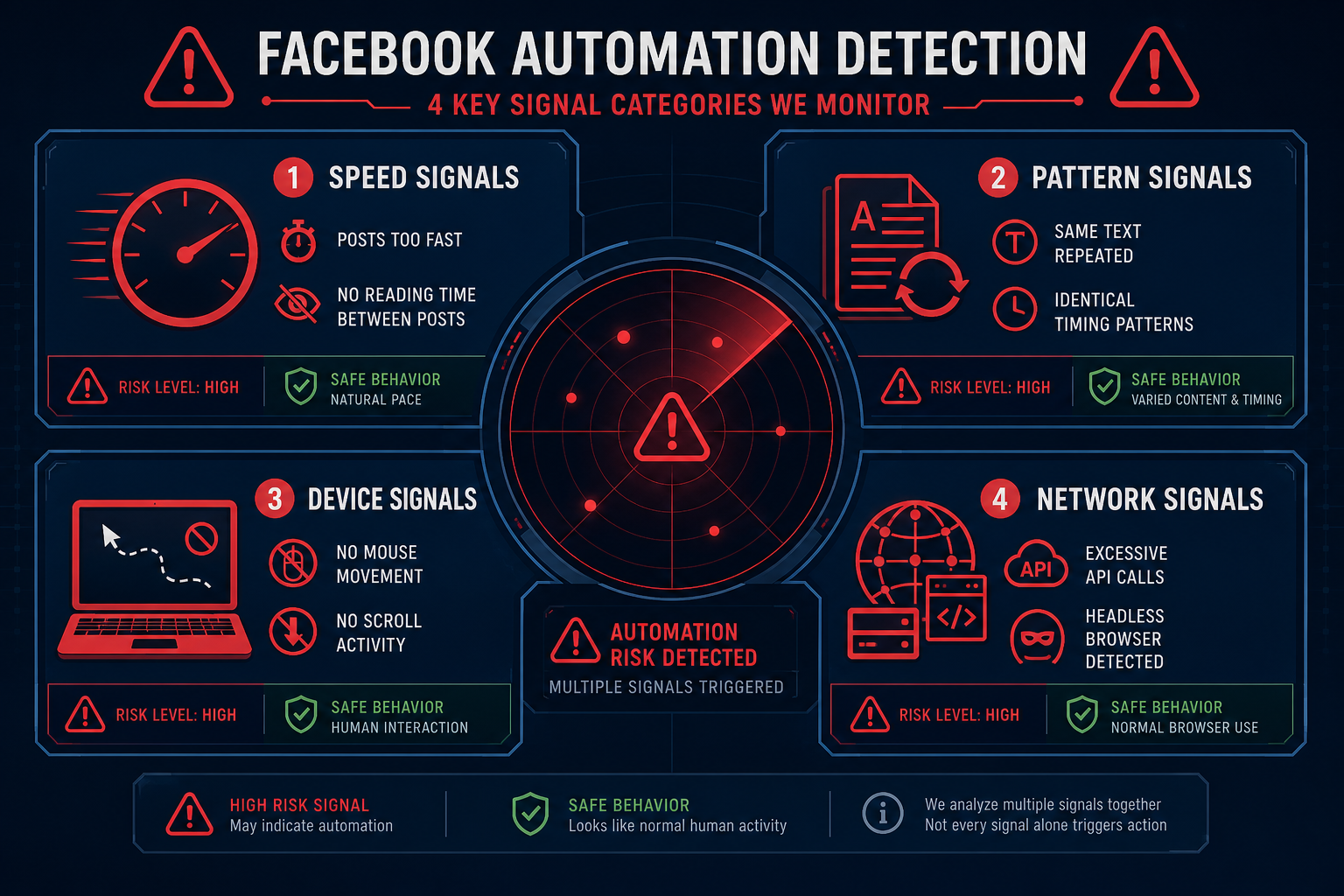
The detection systems operate across multiple signal types:
Behavioral Pattern Analysis #
The most important detection mechanism. Facebook's systems look for behavior that doesn't match human posting patterns:
- Speed: Posting to 10 groups in 5 minutes is physically impossible for a human to do manually with any quality. The platform notices posting velocity that exceeds human capacity.
- Regularity: Machine-scheduled posting produces perfectly regular intervals. A human posting to multiple groups has irregular timing: sometimes 2 minutes between groups, sometimes 8. Perfectly consistent 3-minute intervals are a machine signature.
- Volume spikes: An account that has posted 5 times in the last month suddenly posting 100 times in a week stands out in the system's activity model for that account.
Content Fingerprinting #
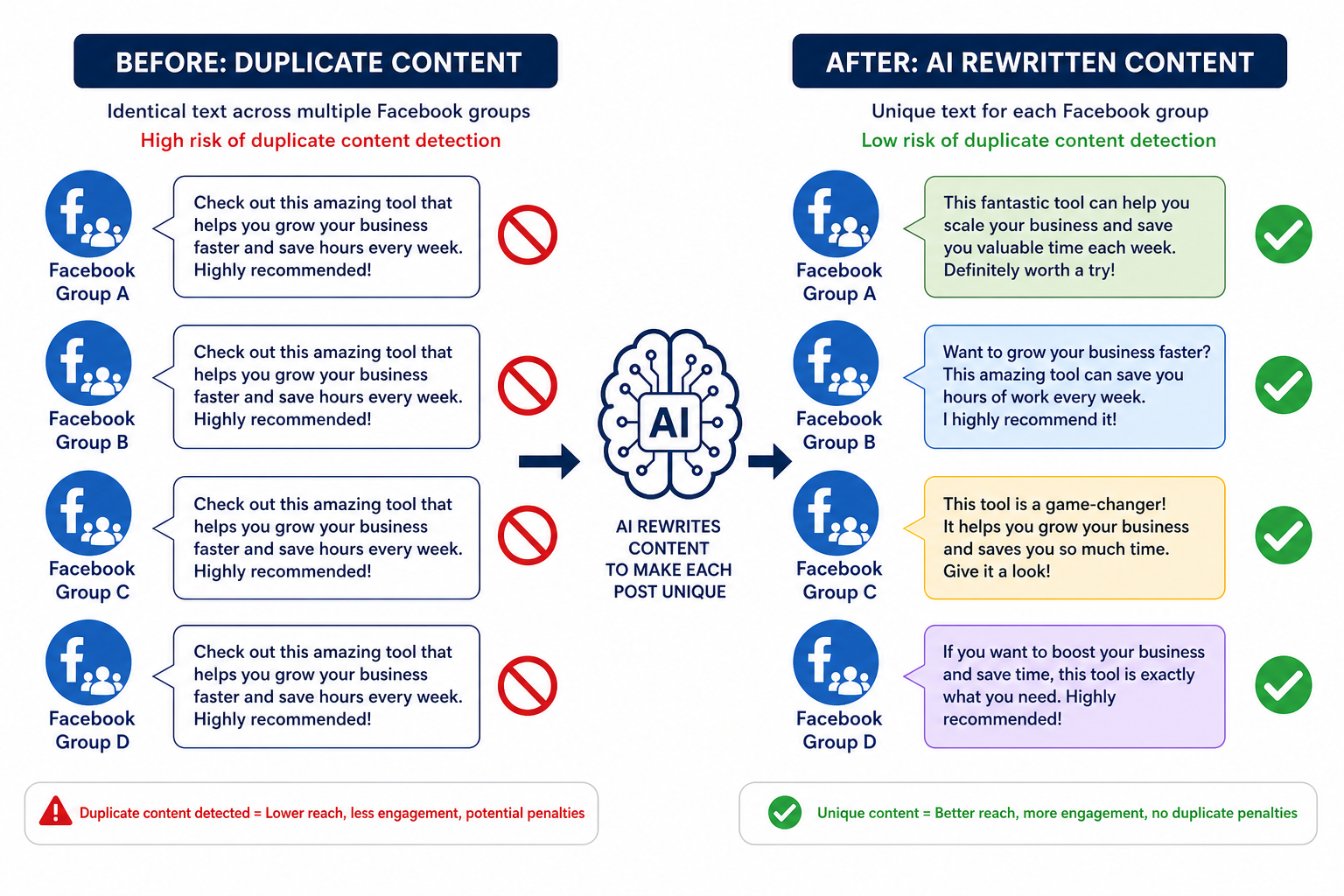
When identical or near-identical content appears across multiple groups in a short window, the system flags the posts and the account. This is the most common trigger for group posting campaigns because posting the same content to many groups is the intuitive thing to do, and it's exactly what the spam detection is built to catch.
The threshold depends on the number of groups, the window of time, the degree of similarity, and the overlap in group membership. There's no published number, but in practice: the same post to 5 groups with varied membership over a few hours is unremarkable; the same post to 40 groups in the same niche within an hour is high-risk.
API vs Browser Activity Patterns #
When content is posted through the Facebook Graph API rather than through a browser, the HTTP request profile looks different. API calls have specific header patterns, originate from non-residential IP addresses (data centers), and lack the browser-specific context that real user sessions produce. This pattern is one of the strongest signals that a tool, not a person, is driving the activity.
This is why browser-based tools carry lower detection risk: they produce browser activity patterns, not API patterns. The IP is residential (yours), the session context is your real session, and the headers match Chrome rather than an HTTP client library.
Device and Location Signals #
Facebook tracks the devices and locations associated with your account. If posting activity starts coming from an IP address or device fingerprint that your account has no history with (as happens with cloud-based automation tools running from servers), it triggers a security review as well as a behavioral one.
The Architectural Choices That Prevent Detection #
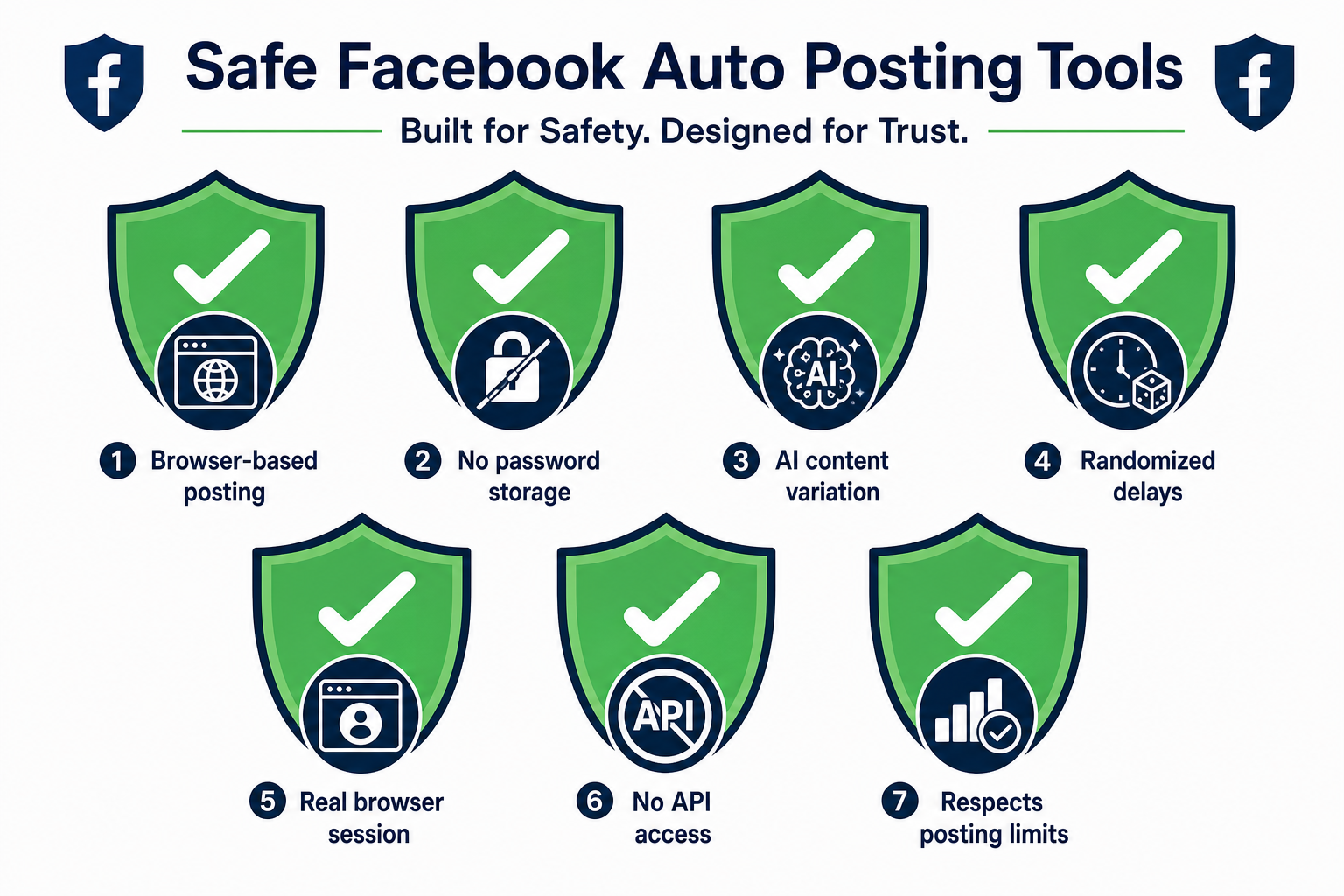
PilotPoster's design specifically addresses each detection mechanism:
| Detection Mechanism | PilotPoster's Response |
|---|---|
| Machine-speed posting | Configurable randomized delays (min/max range, not fixed intervals) |
| Volume spikes | Campaign limits; gradual ramp-up recommended in onboarding |
| Content fingerprinting | AI rewriting generates unique post per group; Spintax support |
| API vs browser patterns | Chrome extension posts through real browser; no API posting calls |
| Foreign IP/device signals | Runs on your machine, your IP, your session; no server-side posting |
| Session authenticity | Uses your existing authenticated Facebook session in Chrome |
When all of these elements are in place, the behavioral signature of a PilotPoster campaign is: a person opening groups in Chrome during their work hours, typing and submitting posts with a few minutes between each, with slightly different phrasing in each group. That's a behavioral profile Facebook doesn't flag because it's consistent with what a careful, organized human marketer would do.
What to Do If You're Already in Stage 2 or 3 #
If you've encountered a restriction, here is the recovery approach:
- Stop posting immediately. Don't try to push through the restriction. Every failed attempt or ignored warning escalates toward the next stage. Just wait.
- Identify the trigger. Review your recent posting activity. Was the posting velocity too high? Were you posting identical content to many groups? Was it a specific post that kept getting rejected?
- Wait out the restriction fully. Don't resume until the restriction has clearly lifted and you can post normally. Testing repeatedly during a restriction can extend it.
- Resume at lower volume. When you restart, begin with a fraction of your previous volume. 5 to 10 groups per day for the first week, then increase gradually over 2 to 3 weeks.
- Fix the underlying issue. If you were posting identical content, implement AI rewriting or Spintax. If your delays were too short, increase the minimum. If you were using a cloud-based tool, switch to browser-based.
How Long Do Restrictions Last? #
This depends on the stage and frequency of the incident:
- First Stage 2 incident: Usually 1 to 24 hours.
- Repeated Stage 2 incidents: 24 to 72 hours per incident, potentially longer with recurrence.
- First Stage 3 restriction: Several days to 2 weeks.
- Repeated Stage 3 restrictions: Potentially months, sometimes with escalation to Stage 4 review.
Facebook doesn't publish specific timelines, and individual account history affects these durations. What's consistent is the escalation dynamic: first incidents are brief; repeated incidents at the same account are progressively longer.
The Risk in Proper Perspective #
A Stage 2 restriction (the most common outcome of pushing too hard with automation) is a temporary posting cooldown. It expires. Your account is fine. Your group memberships are intact. You adjust your approach and continue.
The marketers who end up in Stage 3 or Stage 4 typically got there through a combination of using tools with genuinely risky architecture (cloud-based, API-based, identical content blasting) and ignoring or working around Stage 2 restrictions rather than adjusting their behavior.
With browser-based automation, human-paced scheduling, and per-group content variation, the realistic risk profile for a well-run campaign is: occasionally a Stage 1 rejection in a specific group (the group's spam filter caught the post), very rarely a brief Stage 2 restriction if you ran a particularly aggressive session. That's a manageable risk for a marketing channel that delivers real organic reach.
For more on the specific account-level restriction experience and how to handle it effectively, see the complete guide to avoiding Facebook Jail.
- Facebook's enforcement escalates gradually. Most automation incidents result in temporary posting restrictions, not account bans.
- The main detection triggers are machine-speed posting, identical content across many groups, and non-browser (API) activity patterns.
- Browser-based tools eliminate the IP and session detection risks that cloud-based tools carry.
- Randomized delays, content variation, and gradual volume ramp-up prevent behavioral detection.
- Recovery from a Stage 2 restriction is simple: stop, wait, resume at lower volume with corrected practices.