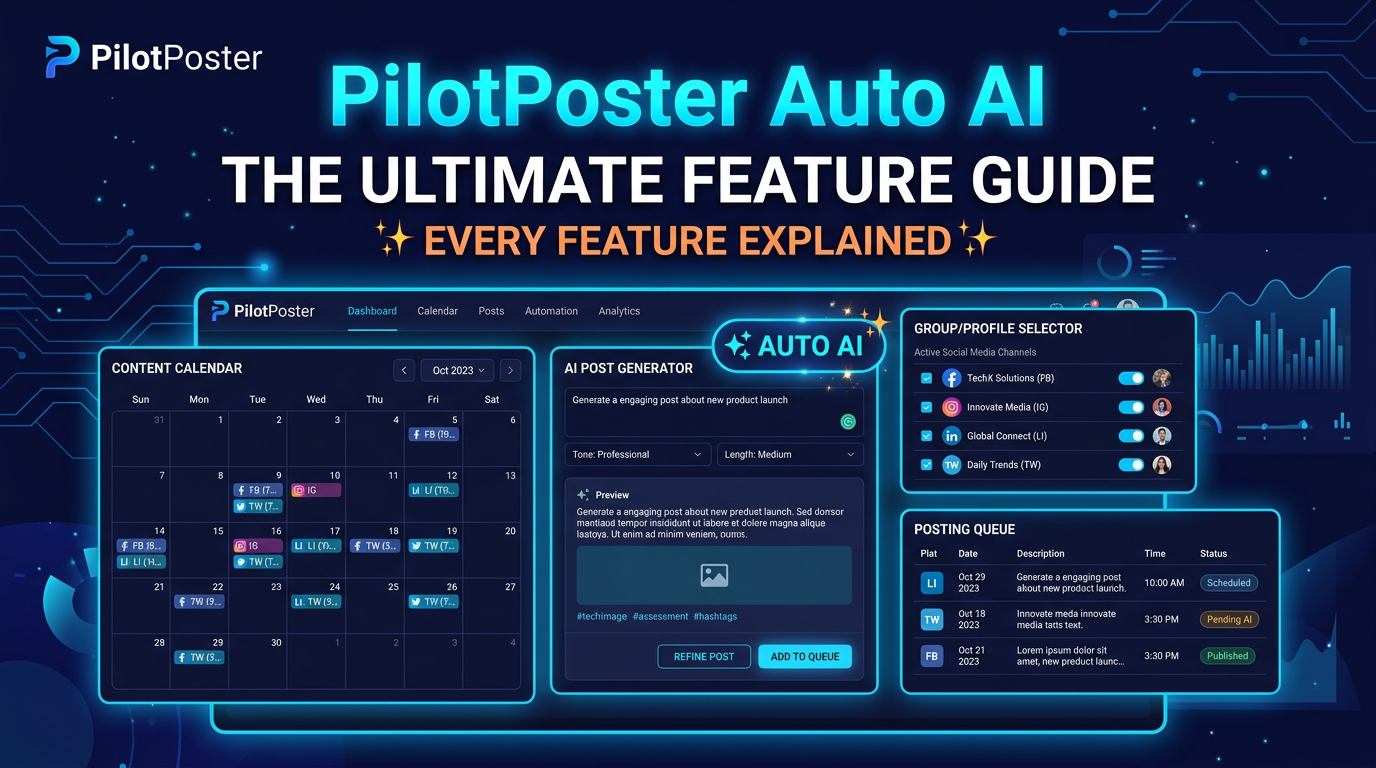
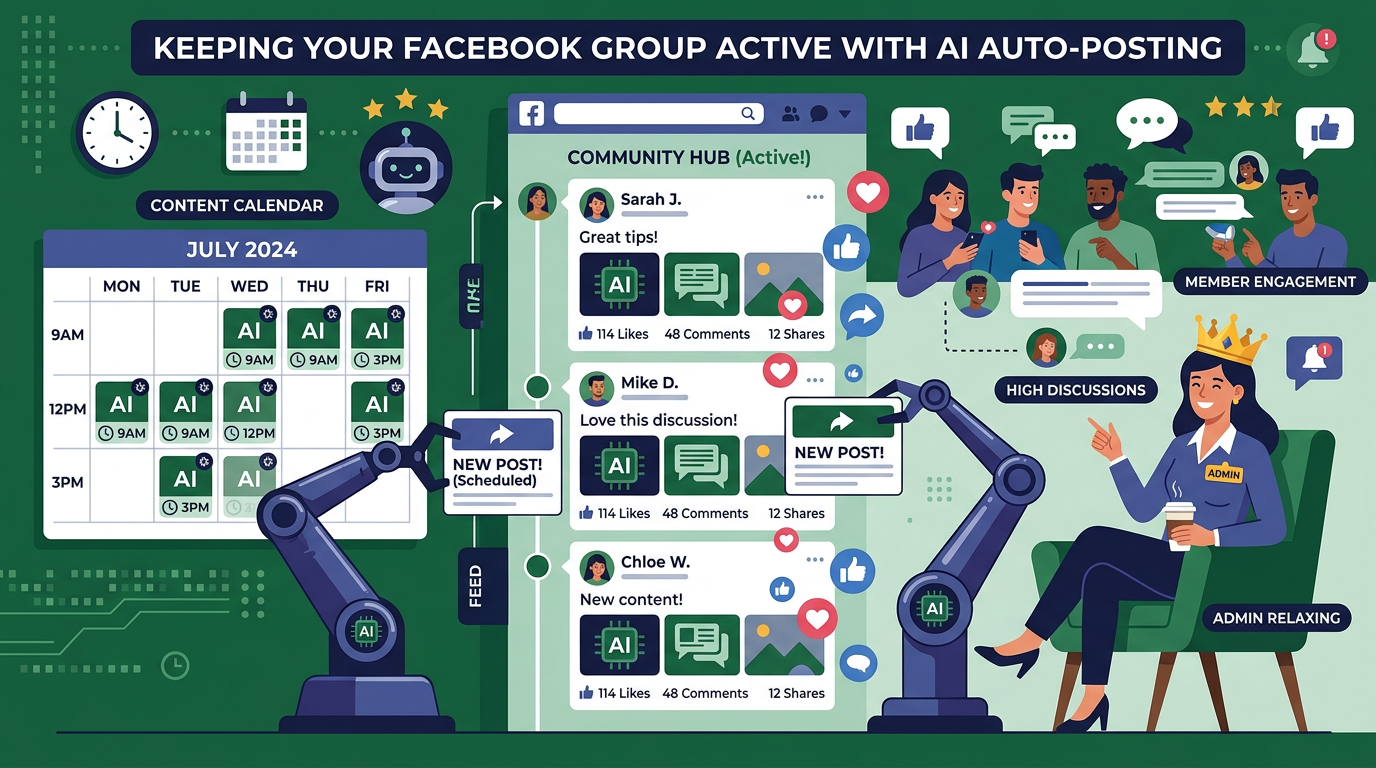
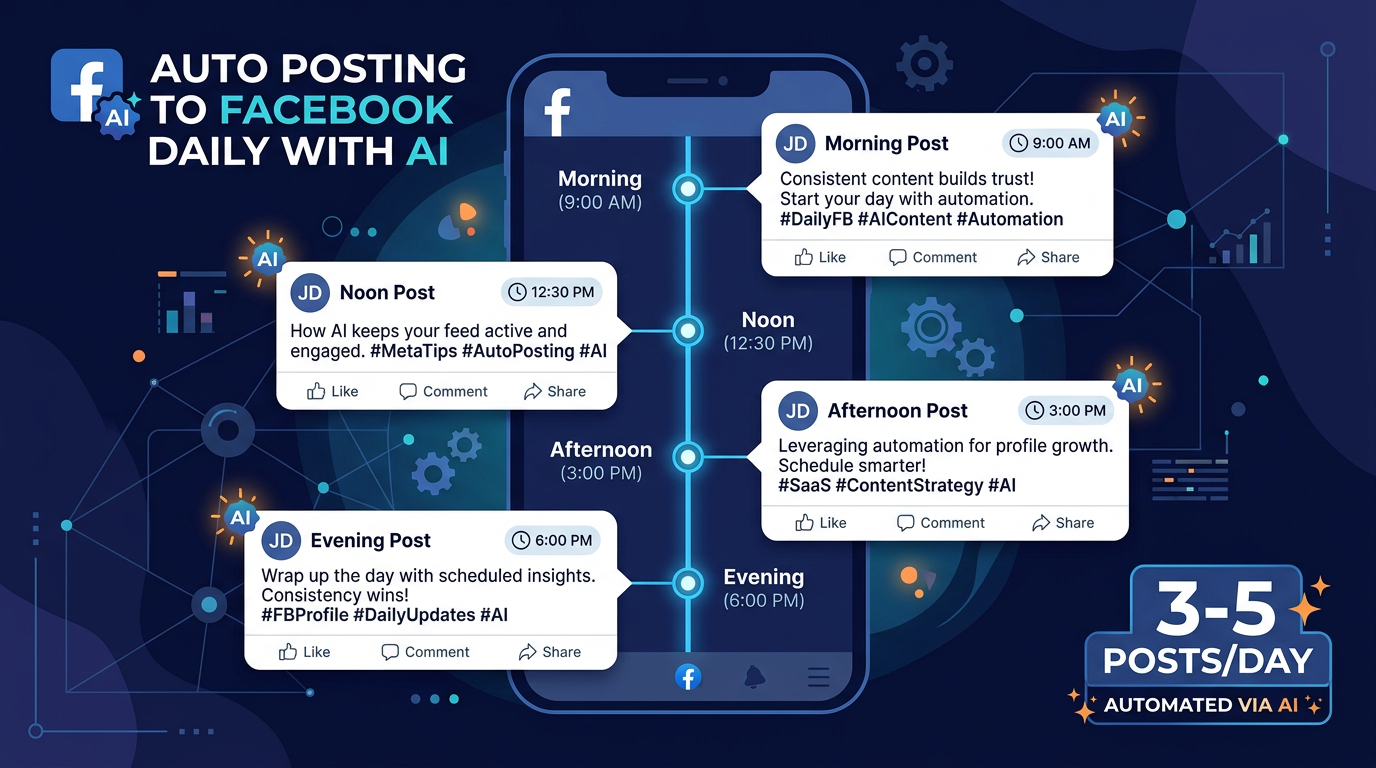
AI-generated Facebook posts sound robotic when the AI uses generic prompts without business context and defaults to formal, listicle-style writing. The fix is training the AI on your specific business, using a feedback loop to refine its tone, and mixing 9 different post types so your feed doesn't feel like a content machine. PilotPoster Auto AI handles this end-to-end, generating posts trained on your website and business context.
At some point, most people trying to post consistently to Facebook have turned to ChatGPT. The process is familiar: you open a new chat, type something like "write 5 Facebook posts for my real estate business," and get back something that technically works but feels off.
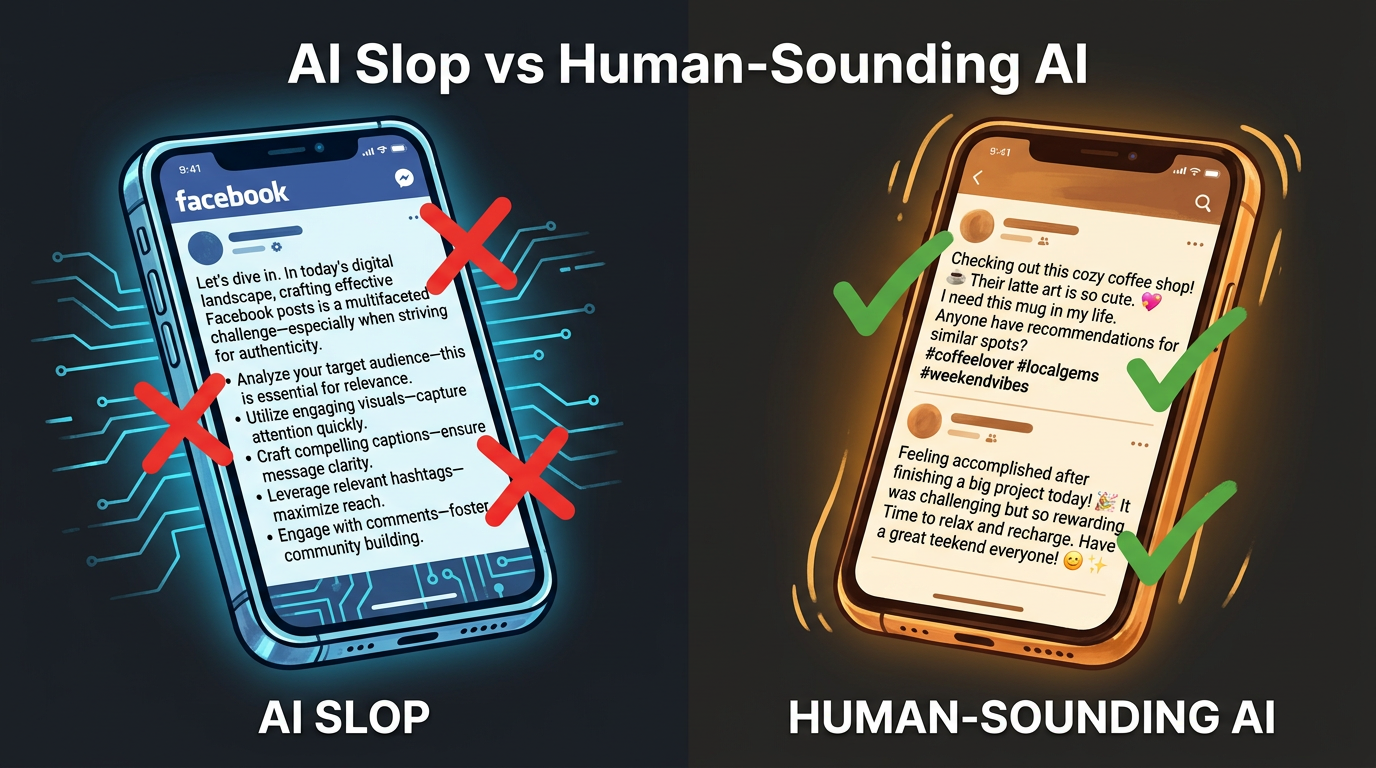
You can usually spot AI-written posts within the first three words. The sentence structure is too formal. There are bullet points where no one naturally uses bullet points. Every post ends with an exclamation mark and a call to action. The hashtags are generic.
That kind of content doesn't build an audience. It might get some reach initially, but followers stop engaging when the feed starts feeling like a press release machine.
The good news is the problem isn't AI itself. It's how most people use AI for content.
Why Generic AI Posts Fail on Facebook
Facebook is a personal network. Even business content performs best when it sounds like it comes from a real person with opinions, context, and a distinct voice. Generic AI doesn't have any of that.
The specific patterns that kill AI-generated Facebook posts:
"In today's digital landscape, building a strong social media presence is crucial for businesses of all sizes." No one talks like this. It signals immediately that nobody actually wrote the post.
Facebook posts with 5 bullet points of "tips" get lower reach than conversational posts. The format signals AI, and the algorithm has learned to show less of it. Write in paragraphs the way a human would.
Hook sentence. Two sentences of context. Call to action. If every post in your feed has this structure, readers pattern-match it as automated within a week and start skimming past your content.
"Growing your business on Facebook requires consistent effort and a clear strategy." This could apply to any business, any industry, any person. Readers feel nothing because there's nothing specific to connect with.
"Building trust with your audience, the foundation of any successful marketing strategy, requires consistency and authenticity." A dead giveaway. Real people writing casually don't reach for em dashes.
What Actually Makes AI Content Sound Human
The difference between robotic AI content and content that reads naturally comes down to three things: specificity, tone calibration, and post type variety.
Specificity
AI content feels generic because it is generic. It pulls from its training data to produce content that's technically accurate but lacks any detail that couldn't apply to anyone. Human writers naturally include specifics: a real number, a recent event, a product name, a personal story.
When you train an AI on your actual business, it has material to work with. Instead of "grow your real estate business," it can write "if you've had a listing sit for 45 days, here's what I've seen work." That's the difference business context makes.
Tone Calibration
Generic AI defaults to a formal, neutral tone because that's the average of its training data. Your brand voice probably isn't formal and neutral. You might be direct and a little edgy. Or warm and conversational. Or technical and precise.
Getting the tone right requires explicit instruction and then refinement based on what you like and don't like. This is where a feedback loop matters.
Post Type Variety
A feed that's all tips and advice posts feels like a blog subscription, not a person's profile. Real social media feeds include opinions, personal updates, questions, promotional content, and off-topic things. The variety is what makes it feel human.
The PilotPoster Auto AI Approach
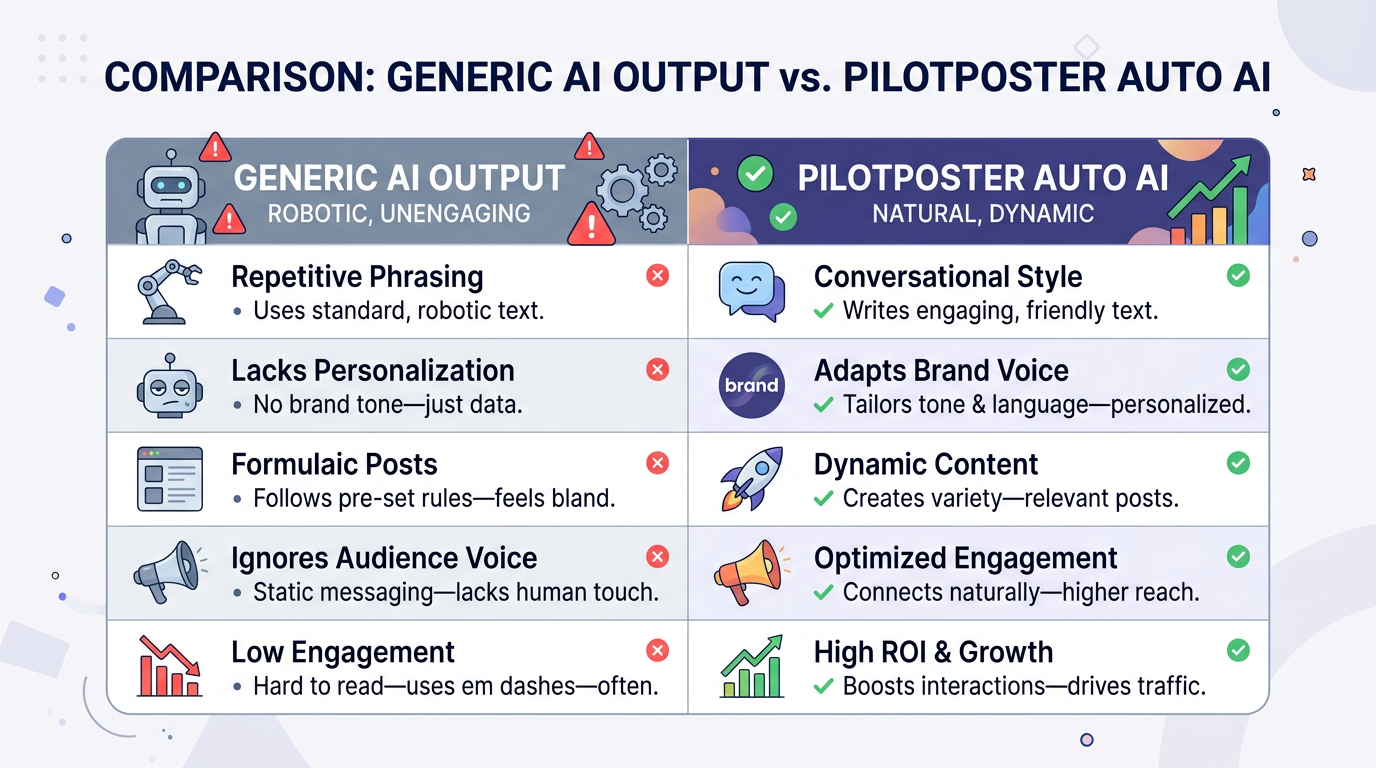
PilotPoster Auto AI was built specifically to solve the generic AI content problem for Facebook. Here's how the approach differs from prompting ChatGPT:
| Factor | Generic AI (ChatGPT, etc.) | PilotPoster Auto AI |
|---|---|---|
| Business context | You write a prompt each time | Trained on your website and business details once |
| Tone | Formal, generic default | Configured to your brand voice with controls |
| Post variety | Whatever you ask for | 9 post types mixed automatically on a schedule |
| Feedback loop | None (starts fresh each session) | Learns from your ratings over time |
| Scheduling | Manual copy-paste to Facebook | Posts automatically on configured schedule |
| Volume | One-off generation | Continuous daily generation and posting |
| Images | Separate tool required | AI image generation built in |
| Languages | Supported but manual | 13 languages, configured per campaign |
The Feedback Loop That Actually Trains AI on Your Voice
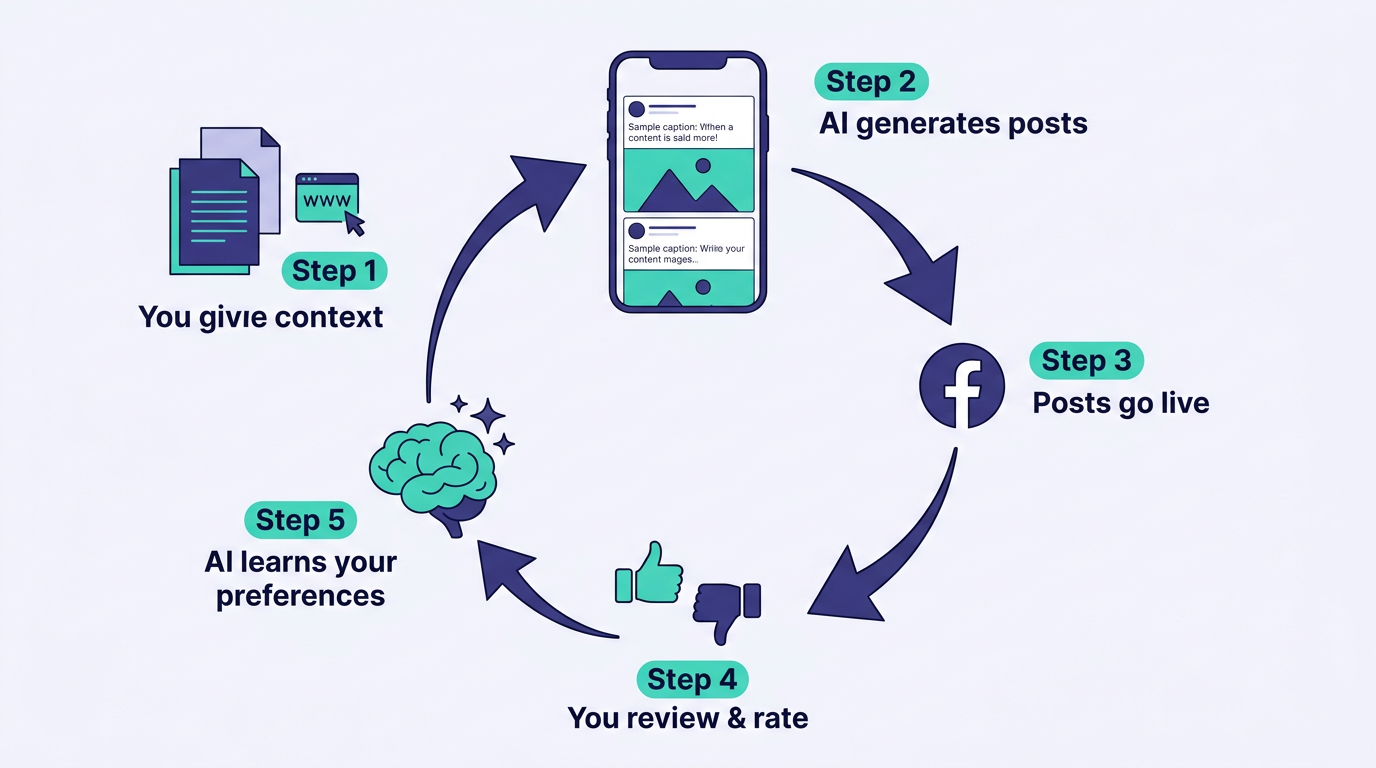
The single biggest advantage of a purpose-built AI posting tool over generic AI is the feedback loop. Here's how it works in practice:
Week 1: The AI generates posts based on your initial business context setup. Some posts will feel right, some won't. You rate them (or note which ones you edited significantly in the review queue).
Week 2-3: The AI adjusts based on your feedback. Posts that resembled the ones you rated positively get generated more. Patterns from posts you rejected get avoided. Your personal tone starts coming through more clearly.
Week 4+: The output starts feeling genuinely calibrated to your voice. You spend less time in the review queue and more time just checking that posts went out.
This is what makes the difference between AI that sounds like AI and AI that sounds like you. No single prompt session with ChatGPT has this kind of iterative refinement. You'd have to manually update your prompt every session and remember what worked last time.
How the 9 Post Types Keep Your Feed Natural
One of the best things you can do for engagement is stop thinking about each post as marketing and start thinking about your feed as a whole. What should the experience of following your profile feel like over the course of a week?
Somebody who follows a good business profile sees a mix: a helpful tip one day, a personal story the next, a product mention, an opinion piece, a question for the community. That variety is what keeps people from muting you.
PilotPoster Auto AI mixes 9 post types automatically:
| Post Type | Why It Works | Recommended Frequency |
|---|---|---|
| Informative | Builds authority, gets saved and shared | Daily (30%) |
| Soft Sell | Warm, non-pushy product mention | Every other day (20%) |
| Engagement | Questions boost comments and reach | 3-4x per week (20%) |
| Story/Personal | Humanizes your brand | 2-3x per week (15%) |
| Motivational | High share rate, broad reach | 2-3x per week (10%) |
| Hard Sell | Direct conversion posts | 2-3x per month (5%) |
| Testimonial | Social proof, trust building | Weekly |
| Hot Take | Generates comments and discussion | Weekly |
| Seasonal/Trending | Timely relevance signals | As applicable |
Keep promotional posts (hard sell + soft sell) to roughly 20-25% of your total content. If more than 1 in 4 posts is about your product, followers start muting or unfollowing. The other 75-80% should provide value, entertainment, or community without asking for anything.
Smart Spintax: Scaling Without Sounding Repetitive
If you run recurring promotions, the same offer will appear in your feed multiple times per month. Most people handle this by rewriting the same post slightly differently each time, which takes effort and the posts still end up feeling similar.
Smart Spintax solves this with structured variation. You write one template with alternatives at each variable point:
{Thinking about|Considering|Ready for} a {change|fresh start|new approach} in how you {market|grow|promote} your business? {Our clients|People who use our system|Businesses that switch} typically see results within the first {two weeks|month|30 days}.
Every time this template publishes, a different combination of options is selected. The post reads naturally each time, doesn't repeat, and you wrote it once. For high-frequency promotional content, this is much more practical than generating entirely new posts every time.
Website Import: Training the AI Without Writing a Prompt
One of the setup features worth mentioning separately is website import. Instead of writing a detailed business description to give the AI context, you paste your website URL and PilotPoster reads your pages: your homepage, about page, services, product descriptions, and blog posts.
The AI extracts your business details, the language you use to describe your offer, your target audience signals, and your tone from the copy already on your site. For most users, this produces better initial context than writing a prompt from scratch, because your website already has polished, accurate descriptions of what you do.
PilotPoster supports Bring Your Own Key (BYOK), meaning you can connect your own OpenAI or Anthropic API keys. This lets you use the latest GPT or Claude models as they're released, and can reduce per-post cost at scale. If you care about content quality and output volume, BYOK is worth setting up.
Checking AI Content Before It Goes Out
The review queue is your safety net. Before any AI-generated post goes live, it appears in the queue where you can read it, edit it, approve it, or reject it. This is especially useful in the first few weeks when the AI is still calibrating to your voice.
Most users transition through three phases:
Phase 1 (weeks 1-2): Review every post. Edit frequently. Rate what you keep and what you change significantly.
Phase 2 (weeks 3-6): Review a sample each day. Most posts pass with minor tweaks or none at all.
Phase 3 (month 2+): Spot-check a few posts per week. The AI has learned your voice well enough to run mostly unsupervised.
The review queue isn't just a safety check. It's the primary mechanism for training the AI faster. The more intentionally you use it in phase 1, the sooner you get to phase 3.
- Generic AI posts fail because they have no business context and default to formal, listicle-style writing
- Training the AI on your website and business details produces significantly more specific, on-brand content
- A feedback loop that learns from your ratings over time is what separates purpose-built AI tools from general AI
- 9 post types mixed automatically prevents your feed from feeling like a broadcast machine
- Keep promotional posts to 20-25% of content; the rest should provide value without asking for anything
- Smart Spintax handles recurring promotions so the same offer reads differently each time