For most businesses and creators who want to use their community for marketing and growth, Facebook Groups wins because of discoverability. People can find your group through search, Facebook recommendations, and friends' activity without you spending a cent on promotion. Discord and WhatsApp require you to send people there first before any organic growth is possible. If you're choosing for reach and marketing potential, start with Facebook Groups. Layer in Discord or WhatsApp for depth after you've built an audience.
The three dominant free community platforms going into 2026 each have a fundamentally different design philosophy, and that philosophy determines everything about what works on each one. Facebook Groups were built for social discovery. Discord was built for real-time communication within a defined group. WhatsApp was built for private messaging.
Those origins still shape each platform's strengths and weaknesses today. Choosing based on where you personally spend time, or where you think your audience is, without considering these structural differences is how communities get built in the wrong place and stall.
Platform Overview
| Feature | Facebook Groups | WhatsApp Community | Discord |
|---|---|---|---|
| Discoverability | Strong (search, recommendations, friends) | None (invite only) | Limited (directory listings, third-party sites) |
| Max group size | No hard limit (millions) | 5,000 per group, 50 groups per community | No hard limit with boosts |
| Organic content reach | Algorithmic feed distribution | All messages delivered to all members | Notification-based, no algorithm |
| Content formats | Posts, video, events, polls, live, files | Messages, voice notes, files, status | Text, voice, video, threads, forums |
| Moderation tools | Strong (membership questions, keyword alerts, admin queue) | Limited (admin only, no screening) | Very strong (bots, roles, permissions) |
| Monetization | Paid groups, subscriptions, marketplace | None native | Server subscriptions, boosts |
| Best for | Marketing, brand communities, local groups | Small team coordination, local community | Tech/gaming, tight-knit creator communities |
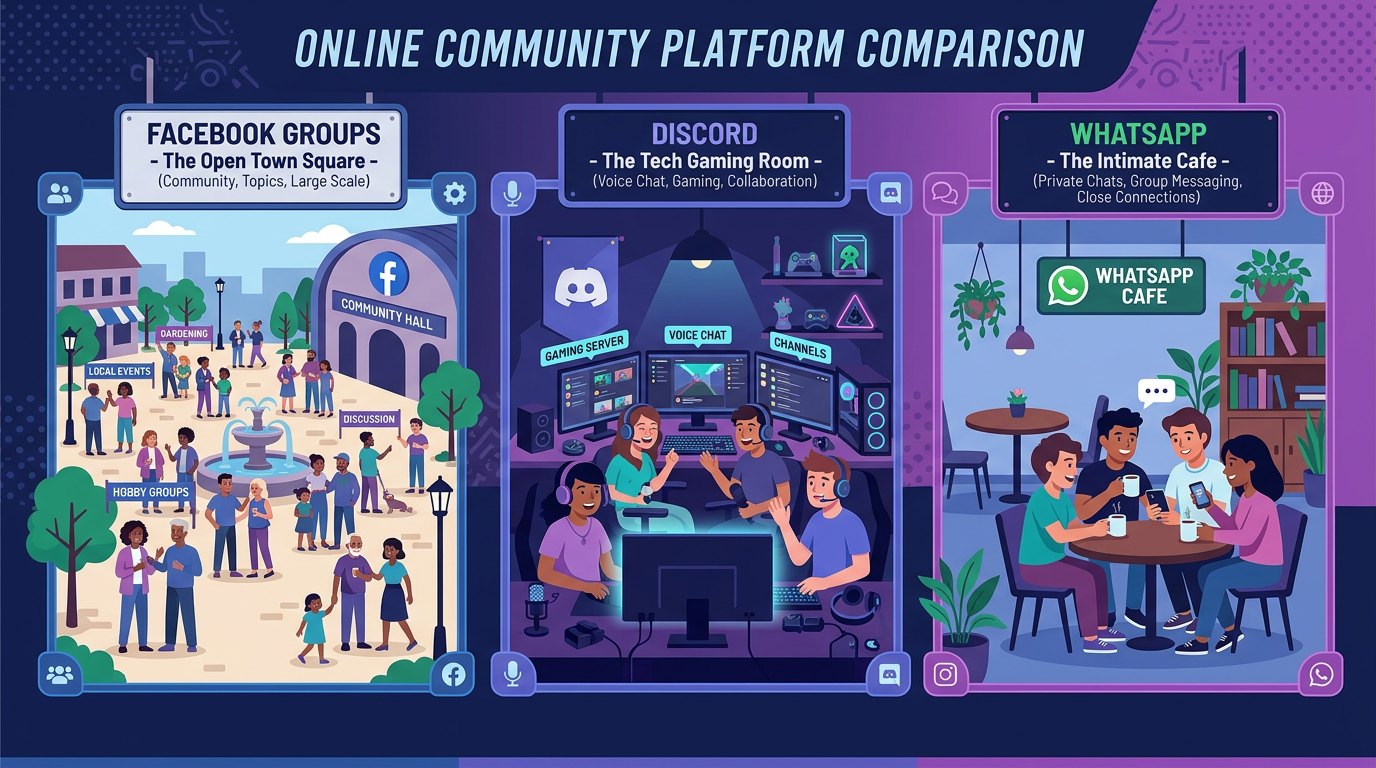
Facebook Groups: The Open Town Square
Facebook Groups win the discoverability argument by a wide margin. When someone searches for "[your niche] community" on Facebook, groups appear in the results. When someone joins a group related to your topic, Facebook recommends similar groups. When a friend joins your group, their connections may see that activity.
None of this is available on WhatsApp or Discord. Those platforms require external promotion to grow because they have no organic discovery mechanism at all.
What Facebook Groups Do Well
- Discoverability and organic growth: The only platform where new members can find you through the platform itself, without paid promotion or external marketing.
- Content longevity: Posts in a Facebook group persist and can be searched. A helpful post from six months ago can still be found by a new member searching the group. Discord's chat and WhatsApp messages scroll away.
- Event promotion: Facebook's Events feature, integrated with groups, is unmatched for community event organization. RSVPs, reminders, and event discovery all work natively.
- Rich content types: Long-form posts, video, live streams, polls, files, links, images. The content format range is the widest of the three platforms.
- Moderation infrastructure: Membership screening questions, keyword alerts, post approval queues, the ability to suspend rather than just remove. These tools are the best of the three platforms for community managers.
Facebook Groups Limitations
- Algorithmic feed means not every post reaches every member. High-quality consistent posting is required to stay visible.
- The Facebook brand itself is polarizing. Some demographics (particularly younger users) have largely moved away from Facebook.
- No real-time communication. Facebook groups are asynchronous, not a chat platform.
- Native automation is limited. You cannot schedule posts to groups you've joined through Meta's tools. Third-party tools with browser-based automation are required.
Beyond your own group, Facebook Groups are also where you can market to other communities. Joining relevant groups in your niche and posting value-first content there is a distribution channel with no equivalent on Discord or WhatsApp. You can join 500 relevant Facebook groups and post to all of them. Try doing that on Discord. This asymmetry is huge for businesses using groups for marketing rather than just building their own community.
WhatsApp Community: The Intimate Cafe
WhatsApp Communities were launched in 2022 as a way to organize multiple WhatsApp groups under one umbrella. Think of it like a hub with sub-groups: a neighborhood WhatsApp Community might have sub-groups for local events, parents, marketplace, and general chat.
What WhatsApp Does Well
- Message delivery: Every message goes to every member, every time. There's no algorithm filtering content to a percentage of your audience. If you send it, everyone sees it.
- Trust and intimacy: WhatsApp messaging feels more personal than a social media platform. Messages arrive like text messages, not like posts in a feed.
- Local and regional communities: Neighborhood groups, local business networks, school parent communities. WhatsApp dominates these use cases because it's phone-number based and already how people communicate locally.
- End-to-end encryption: For communities where privacy matters, WhatsApp's encryption is a genuine advantage over Facebook's data practices.
WhatsApp Limitations
- No discoverability whatsoever. You must send people a link or QR code to invite them. There is no search, no recommendations, no organic growth mechanism.
- Size ceilings: 5,000 members per group, 50 groups per community. Manageable for small communities, limiting for scale.
- Poor content archive: Messages scroll away. Finding something said three weeks ago in an active group is tedious. There's no search within groups comparable to Facebook.
- No monetization. WhatsApp has no native way to charge for access or sell within the platform.
- Admin burnout risk: All-message delivery sounds great until you have 500 active members. The volume of messages in an active WhatsApp group becomes unmanageable, and members mute notifications, defeating the purpose.
Who WhatsApp Communities Are For
Small to medium local or regional communities. Parent groups, neighborhood associations, local business owner networks, small professional cohorts. The intimacy and message delivery work best when the group is small enough that all communication is actually relevant to all members.
Discord: The Tech Community Club
Discord started as a gaming communication platform and still carries that DNA even as it's expanded to creator communities, professional groups, and brand communities. Its architecture is server-based: each Discord server is a collection of channels (text channels, voice channels, forum channels) organized by topic.
What Discord Does Well
- Real-time communication: Discord is genuinely excellent for live chat, voice calls, and video. If you want a community where people hang out together in real time, Discord wins.
- Organization: Channels let you create distinct spaces for different topics within one community. A creator Discord can have channels for announcements, general chat, specific topic discussions, and paid-tier content, all in one server.
- Bot ecosystem: The Discord bot ecosystem is enormous. Bots can handle moderation, onboarding, role assignment, polls, leveling systems, and more. For communities that want automation and gamification, Discord's bot support is unmatched.
- Developer and tech community: If your audience skews technical, Discord is where they already are. The platform has become the default home for developer tools, crypto projects, and tech startups.
Discord Limitations
- No meaningful discoverability for businesses. Discord's server directory is limited and niche. Most server growth happens through external promotion: YouTube channels, newsletters, Twitter/X audiences. Growing a Discord server from zero without an existing audience is extremely difficult.
- Learning curve: Discord is more complex to set up and navigate than Facebook Groups or WhatsApp. Older demographics often find it confusing, which limits your potential audience.
- No content longevity: Like WhatsApp, messages scroll away. Forum channels are a partial solution, but Discord is not designed for the kind of searchable knowledge base that Facebook Groups creates organically.
- Fragmentation risk: The channel structure that makes Discord organized also means a fragmented community. Members often stick to two or three channels and miss the rest. High-quality posts don't spread across channels the way Facebook posts can reach the whole group.
Head-to-Head: The Questions That Matter
| Question | Winner |
|---|---|
| Where can new people find us without being invited? | Facebook Groups (by a large margin) |
| Where can we post content that reaches the most members? | WhatsApp (100% delivery) or Facebook Groups (algorithmic but scalable) |
| Where can we host live voice/video hangouts? | Discord |
| Where can we market our business in communities we don't own? | Facebook Groups (only platform where this is possible at scale) |
| Where can we charge for community access natively? | Facebook Groups (paid groups) or Discord (server subscriptions) |
| Where can we build a knowledge base members can search? | Facebook Groups |
| Which platform is most trusted by older demographics (35+)? | Facebook Groups |
| Which platform is preferred by tech/developer audiences? | Discord |
| Which platform works best for small local groups? |
Which Platform for Which Business Type
Service businesses, coaches, consultants: Facebook Groups. Your clients are on Facebook, the platform's discoverability helps you grow without paid promotion, and the content format supports the long-form educational posts that build trust and credibility in service businesses.
E-commerce and product sellers: Facebook Groups. The ability to join niche interest communities and post product-relevant content is a distribution channel with no equivalent on other platforms. Read more in our e-commerce group marketing guide.
Developer tools and tech startups: Discord. Your audience is already there, they expect the platform, and the technical complexity is a feature rather than a bug for tech-savvy users.
Creator communities (YouTubers, podcasters, newsletters): Split. Use Facebook Groups if your audience skews older (35+) or you want organic discovery. Use Discord if your audience is younger (18-35) and values real-time interaction with you and each other.
Local businesses and neighborhood organizations: WhatsApp for the actual community, and Facebook Groups for visibility and event promotion. Both, for different purposes.
Online courses and paid communities: Facebook Groups for the community itself (especially if using a Kajabi, Teachable, or Thinkific course platform that integrates with Facebook). Discord for the more intimate, real-time tier.
Many successful communities use Facebook Groups for top-of-funnel discovery and WhatsApp or Discord for deeper engagement with a core audience. A public Facebook Group to attract new people, a paid or invite-only Facebook Group or Discord for the committed inner circle. The platforms complement each other when used intentionally. Just be clear about what role each platform plays before you build both.
- Facebook Groups is the only platform where new people can discover your community without being invited. This discoverability advantage is decisive for businesses that want organic growth.
- WhatsApp delivers every message to every member, which sounds great, but becomes unmanageable at scale. Best for small, intimate, local communities.
- Discord wins on real-time communication and bot automation, but has minimal discoverability for businesses. Best for tech/gaming communities with an existing external audience to send there.
- Beyond building your own community, Facebook Groups is also the only platform where you can post to other communities you've joined, creating a marketing distribution channel with no equivalent on Discord or WhatsApp.
- Most businesses are best served starting with Facebook Groups for reach and layering in Discord or WhatsApp for depth once they've built an audience