The affiliate marketers who succeed in Facebook groups don't think of themselves as affiliate marketers. They think of themselves as someone who is genuinely knowledgeable about a topic who happens to recommend products they use. The affiliate link is secondary to the reputation. Build the reputation first in the right groups, and the commissions follow naturally from contextual recommendations people actually trust.
Affiliate marketing in Facebook groups has a bad reputation, and most of it is deserved. The stereotype: someone joins 50 groups, immediately posts a link to their affiliate offer with a wall of copied product description text, and gets removed from all 50 groups within 48 hours. Their affiliate dashboard shows zero clicks. They conclude Facebook groups don't work for affiliates.
The approach that actually works looks nothing like that. It requires the same thing all effective group marketing requires: genuine presence, genuine value, and recommendations that feel like recommendations from a knowledgeable friend rather than ads from a salesperson.
Which Groups Allow Affiliate Content (Honestly)
Most groups have explicit rules about affiliate links. Before posting anything, read the group rules. Groups fall into roughly three categories for affiliate marketers:
| Group Type | Affiliate Content Policy | Best Approach |
|---|---|---|
| Buy/Sell/Trade groups | Direct product listings often allowed | Can post with disclosure, but competition is high and trust is low |
| Niche interest groups | Usually no direct affiliate links; contextual recommendations sometimes allowed | Build credibility first, recommend only in context of answering questions |
| Professional/business groups | Mixed: some allow, many ban any links | Soft approach: mention products in discussion without linking, link later in DMs if asked |
| Review/recommendation groups | Often explicitly allow affiliate links with disclosure | High-value environment: thorough, honest reviews convert well here |
| Coupon/deals groups | Promotional content expected | Works for discount-oriented offers; lower trust environment |
Some groups have no explicit promo rule but will remove you for posting an affiliate link anyway. The safest test: spend 2-3 weeks in the group before posting anything promotional. Observe whether other members share links and whether admins remove them. If no links survive, don't risk your standing in the group for a commission.
The Trust-First Method That Actually Generates Commissions
The highest-converting affiliate approach in interest-based groups is the same as the coach's approach: build credibility through genuine helpful content first, and let product recommendations emerge naturally from that credibility.
The timeline looks like this:
- Weeks 1-4: Post helpful content about the topic your affiliate products relate to. Answer questions thoroughly. Build name recognition as someone knowledgeable in this space. No links.
- Week 4-8: When the topic of your product category comes up (in your posts or others'), mention what you personally use and why you chose it. No link yet. Just genuine experience-based recommendation.
- Week 6+: When people ask specifically what product you use or recommend, provide a full answer including your affiliate link with clear disclosure.
The people asking specifically for your recommendation are the highest-intent leads. They've observed your expertise, decided to trust your judgment, and are asking you to point them toward a purchase. A conversion at this stage is far more likely than from a cold post with a link.
The Review Post: The Highest-Converting Affiliate Format
A thorough, honest product review posted in a relevant group is the single best-performing content format for affiliate marketers. Why: it provides genuine value (people want trusted reviews before buying), and the conversion intent of someone reading a detailed review is very high.
What makes a review post convert without getting removed:
- Personal experience framing: "I've been using [product] for [time period]. Here's my honest assessment." Not "[Product] is the best in the market, here's why you should buy it."
- Include real limitations: A review that only mentions positives reads as an ad. Mention what the product doesn't do well. This counterintuitively increases credibility and conversion because it signals honesty.
- Specific details: "It took me 3 days to figure out [specific feature]" is credible. "It's incredibly easy to use" is marketing speak.
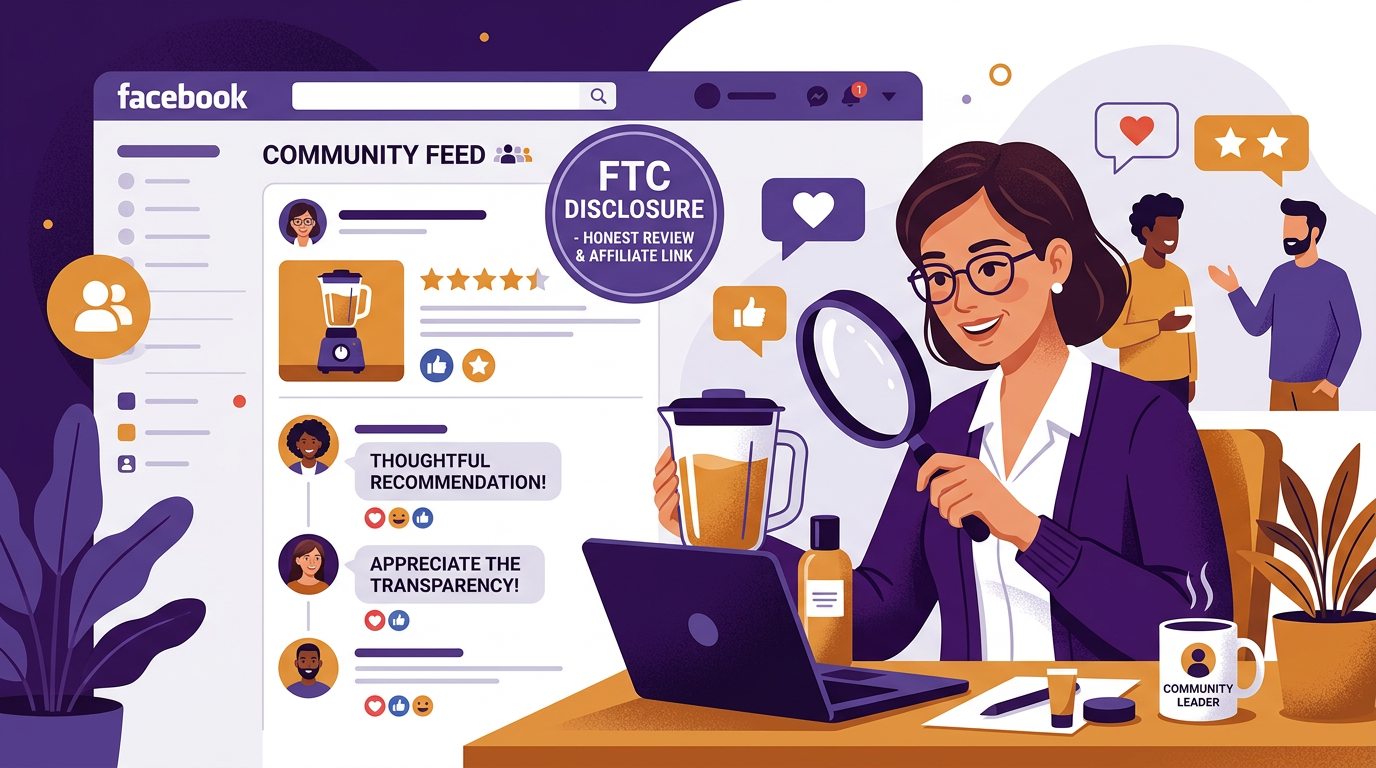
- Clear disclosure: The FTC disclosure needs to be in the post itself, not buried or mentioned as an afterthought. See the disclosure section below.
- Link placement: Put the link in the first comment rather than the post body. Facebook reduces distribution on posts with external links. A post with the link in the first comment gets more reach, and interested members scroll to comments anyway.
FTC Disclosure: What's Required and How to Do It Right
The FTC requires clear disclosure when you receive compensation (including affiliate commissions) for recommendations. This applies to Facebook group posts. The disclosure must be:
- Clear and prominent: Not in tiny print at the bottom. Somewhere a reader will actually see it before making a decision.
- Easy to understand: "Affiliate link" is acceptable but "AD" or "Sponsored" is clearest. "This post contains affiliate links" in plain language works.
- Present in the actual post: A disclosure in your bio or profile doesn't count for individual posts.
Effective disclosure that doesn't harm conversion:
"I use [product] daily for [specific use case]. Sharing my link here (affiliate, I earn a commission at no extra cost to you) because several people have asked what I use. Happy to answer questions about it."
Honest, clear disclosure actually improves trust for many audiences. It signals that you know the rules and follow them, which is a positive credibility signal.
The highest-trust affiliate recommendation happens in the comments of someone else's post. When someone asks "what [product category] does everyone use?" and you answer with a genuine, experience-based recommendation plus your affiliate link plus disclosure, you're responding to an active buying intent question. That commenter is already in purchase mode. Conversion rates from well-placed comment recommendations often exceed standalone post rates.
Which Affiliate Niches Work Best in Facebook Groups
| Niche | Group Marketing Fit | Notes |
|---|---|---|
| Software tools (SaaS) | Excellent | Business-focused groups actively seek tool recommendations. High commission rates. Contextual mentions in "what do you use for X" conversations convert exceptionally well. |
| Online courses and education | Very good | Learning-oriented groups welcome course recommendations. Requires demonstrated expertise in the topic. |
| Health and wellness products | Good (careful) | Health communities are highly engaged. Requires personal experience evidence and sensitivity around health claims. FTC scrutiny is higher in this category. |
| Physical products (Amazon) | Moderate | Works in buy/sell and review groups. Harder in interest groups unless the product is niche-specific. |
| Financial products | Difficult | High regulatory scrutiny, many groups ban financial product promotion. Proceed carefully and verify regulations for your jurisdiction. |
| Generic "make money" offers | Poor | Immediately recognized as MLM or low-quality affiliate spam by most groups. Avoid. |
Scaling Affiliate Group Marketing Without Triggering Bans
The scale challenge for affiliate marketers in groups: you want to reach many groups, but identical posts across dozens of groups is exactly the pattern Facebook's spam detection flags and that gets you removed from groups by admins. The general rules for safe posting at scale are covered in the complete guide to not getting banned posting to Facebook groups.
Solutions that work:
- Different angles per group type: The same affiliate product reviewed from different angles for different audiences. A project management tool reviewed from a freelancer's angle in one group and from a small team lead's angle in another.
- Spintax variation: Write one review template with interchangeable phrases, generating genuinely different versions for each group. See the full guide to Spintax for Facebook group posts.
- Time spacing: Don't post the same product to multiple groups on the same day. Spread it over a week. If a member is in multiple groups, they won't see the same post repeatedly.
When you have a review or recommendation that's performing well in one group, distributing a varied version of it across your other relevant groups is where PilotPoster helps. It posts to all your joined groups through your real browser session, with AI rewriting per group so each version is genuinely different. You stay within group rules on duplicate content while reaching all your relevant audiences.
- The affiliate marketers who work in groups think of themselves as knowledgeable community members who recommend products, not as affiliates looking for places to drop links
- Build credibility for 4-8 weeks before any affiliate recommendation. Trust precedes conversion.
- Comment-based recommendations in response to active buying intent questions often convert better than standalone posts
- Always disclose affiliate relationships clearly and prominently. It's legally required and builds credibility when done well.
- Review posts convert best when they include honest limitations, specific personal experience details, and the link in the first comment (not the post body)
- Software tools, online courses, and niche-specific physical products work well in groups. Generic money-making offers do not.
- Vary content across groups using different angles or Spintax. Identical posts across many groups trigger bans and spam detection.