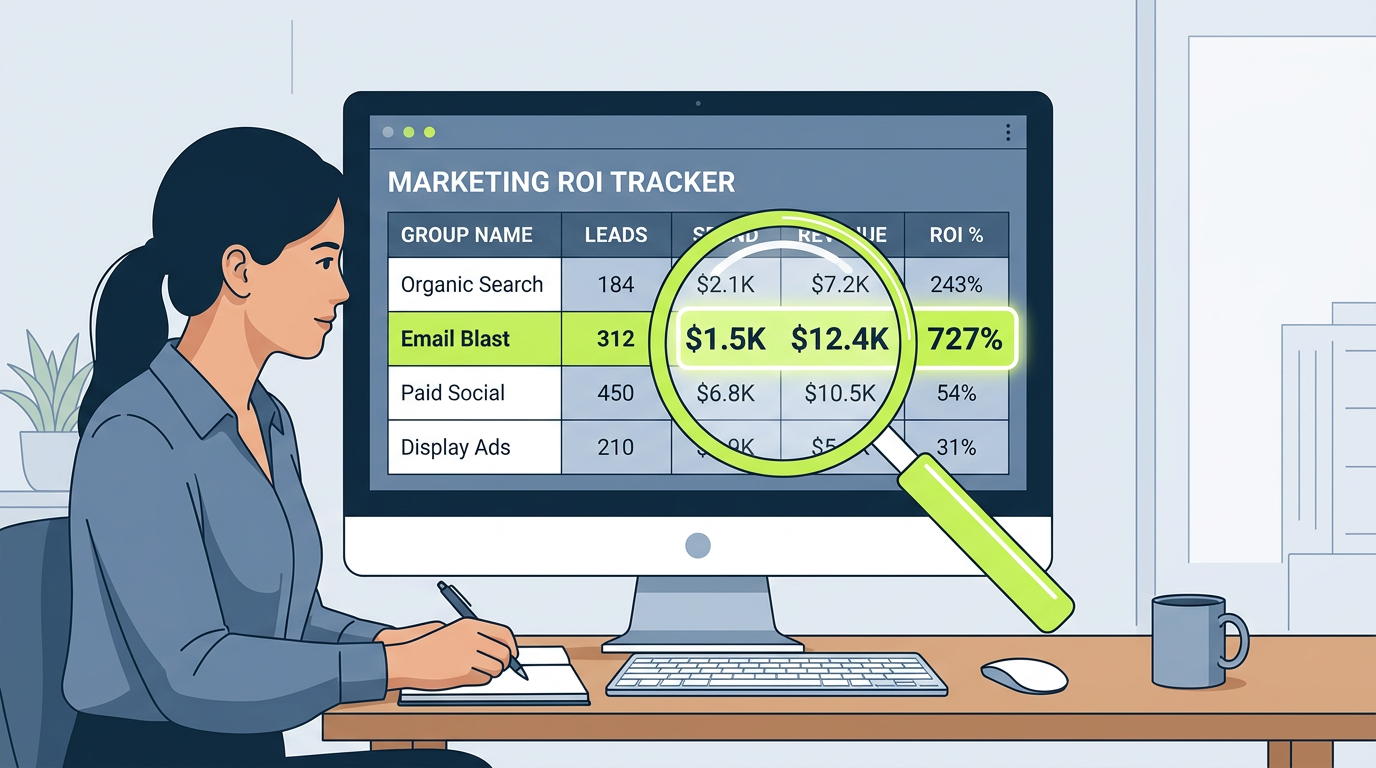
The simplest ROI tracking system for group marketing: every time you get a lead or close a client, ask where they first saw you or found you. Keep a running note with the group name and the revenue associated with that client. After 90 days, you'll see clearly which two or three groups are driving the majority of your business. Everything else is a time audit decision.
The most common mistake in Facebook group marketing is measuring the wrong things. Likes, comments, and follower growth in groups are easy to see and feel good. Revenue, leads, and clients are harder to track back to source but are the only numbers that matter for a business.
It's entirely possible to spend 10 hours a week posting in groups, get good engagement, and generate zero business. It's also possible to spend 2 hours a week in three specific groups and generate most of your client pipeline. Without measurement, you can't tell the difference, so you keep doing everything and remain too busy to scale.
The Problem With Vanity Metrics
Facebook group metrics that feel like progress but don't predict business outcomes:
| Metric | Why It Feels Important | Why It's Misleading |
|---|---|---|
| Likes and reactions | Immediate positive signal | Non-buyers like posts. Buyers are harder to identify from reactions alone. |
| Comment count | Indicates engagement | Groups vary wildly in comment culture. 5 comments in a high-signal group beats 50 comments in a low-quality group. |
| Post reach | More people saw it | Reach without conversion intent is just awareness. Awareness doesn't pay invoices. |
| Profile visits from posts | People are curious about you | Curiosity and purchase intent are very different. Profile visits don't track back to revenue without additional tracking. |
| Follower growth | Audience is growing | Group followers aren't buyers. Some of the most profitable group marketers have small but precisely targeted group presences. |
None of these metrics are useless. They tell you about content performance. But they should be inputs to your content decisions, not your primary business metrics.
The Metrics That Actually Predict Revenue
The metrics worth tracking for group marketing ROI:
- Inbound DMs per week by group source: When someone messages you after seeing you in a group, note which group. This is the top-of-funnel signal that actually correlates with revenue.
- Lead-to-conversation rate: Of the DMs you receive, what percentage turn into a genuine business conversation (not just a quick exchange)? This tells you about message quality and your DM follow-up process.
- Conversation-to-call rate: Of the business conversations that start in DMs, what percentage book a discovery call?
- Call-to-close rate: Of discovery calls, what percentage result in paid work?
- Revenue by group source: The ultimate metric. Track every closed deal back to its originating group.
You don't need software for this. A simple spreadsheet with columns for Date, Group Name, Lead Name, Stage (DM / Call / Closed), and Revenue tracks everything you need.
Building the Simple Group ROI Spreadsheet
Create a spreadsheet with these columns:
| Column | What to Track | Example |
|---|---|---|
| Date | When you first connected | March 14, 2026 |
| Source Group | Which group they saw you in | "Female Entrepreneurs Network" |
| Lead Name | First name or initials | Sarah M. |
| Status | DM, Call Booked, Active, Closed Won, Closed Lost | Closed Won |
| Revenue | Value of the deal | $2,400 |
| Time to Close | Days from first DM to close | 18 days |
Review this spreadsheet monthly. After 90 days you'll start seeing patterns. After 6 months the data is reliable enough to make significant time allocation decisions.
Most people are happy to tell you where they found you if you ask at the right moment. The right moment is early in a DM conversation, before any sales discussion: "Quick question before we dig in: where did you first come across my content?" This feels conversational rather than clinical, and people almost always answer. When they say "I saw you in [Group Name]", add it to your spreadsheet immediately.
Using UTM Parameters for Link Tracking
When you share a link in a group post (a lead magnet, your website, a booking page), UTM parameters let you track exactly how many people clicked through from that specific group and what they did after.
A UTM-tagged link looks like this:
https://yoursite.com/page?utm_source=facebook_group&utm_medium=post&utm_campaign=female_entrepreneurs_network
How to use this effectively:
- Create a unique UTM link for each group you post in (the campaign parameter changes per group)
- Use Google's free Campaign URL Builder to generate links
- View results in Google Analytics under Acquisition > Traffic Sources
- After 30 days, compare which group UTMs drove the most traffic, the most sign-ups, and the most conversions
UTM tracking works best for posts that include a link. For content-only posts (where the goal is DMs rather than clicks), the manual attribution method (asking where they found you) is more relevant.
The Time ROI Calculation
The question that matters is not just "which groups produce revenue" but "which groups produce the best revenue per hour invested."
Track your time per group for one month:
- Time writing posts for that group
- Time responding to comments in that group
- Time scanning for questions to answer in that group
- Time on DM conversations that originated from that group
Then calculate: Revenue from group / Total hours spent on that group = Revenue per hour.
A group generating $3,000 in client work from 5 hours/month is worth far more than a group generating $1,000 from 20 hours/month. Groups that feel productive because of high engagement but produce low revenue per hour are where time goes to die. Cut them or reduce your investment significantly.
New groups need 8-12 weeks of consistent posting before you can accurately assess ROI. The trust pipeline takes time. Don't cut a group after 3 weeks because it hasn't produced a client yet. Set a calendar reminder to review each group at the 90-day mark with real data, not feelings.
The Group Tier Decision Framework
After 90+ days of tracking, use this framework to allocate your time:
| Group Performance | Action |
|---|---|
| High revenue, high engagement | Tier 1: Post most frequently, answer every question, prioritize this community |
| High revenue, low engagement | Tier 1: These quiet groups are converting somehow. Dig into why. Probably strong member quality. |
| Low revenue, high engagement | Tier 2: Post less frequently. The community may be high-volume but wrong audience for your offer. |
| Low revenue, low engagement | Tier 3 or exit: If after 90 days there's no revenue signal and low engagement, your time is better spent elsewhere. |
| Zero revenue after 120 days | Exit: Post a final "thanks for the great discussions" post and leave. Redirect time to better groups. |
When to Scale: The Signal That More Groups Are Worth It
Scale your group marketing (join more groups, post more frequently) when two conditions are both true:
- You have 2-3 groups producing consistent, trackable revenue at a positive time ROI
- Your capacity to serve new clients exceeds your current inbound lead volume
Scaling before condition 1 means you're multiplying an unproven approach across more surface area. When you're ready to scale, automating your group posting is what makes joining 20 more groups practical without proportionally increasing your time. Scaling before condition 2 means you'll generate more leads than you can serve, which damages your reputation and burns you out.
Once you've identified your best-performing groups and the content types that convert there, scaling means posting to more similar groups without increasing your time proportionally. PilotPoster posts to all your joined groups from one place, so doubling your group count doesn't double your manual effort. The tracking and attribution work still happens on your end; the distribution is handled automatically.
- Likes, comments, and reach are inputs to content decisions, not business metrics. Revenue, leads, and clients by group source are what matter.
- The simplest tracking system: ask every new lead where they found you. Add their group source and deal value to a spreadsheet.
- Calculate revenue per hour, not just total revenue per group. High-engagement groups with low conversion are time traps.
- UTM parameters track link clicks by group. Combine with manual attribution for a complete picture.
- Give each group a 90-day trial before making cut decisions. Trust takes time to build.
- Exit groups that produce zero revenue after 120 days of consistent effort. That time is worth more elsewhere.
- Scale only when you have proven groups and capacity to serve the leads that scaling will produce