The best times to post in Facebook groups are 8-10 AM and 7-9 PM in your audience's local timezone, Tuesday through Thursday. But the first 30 minutes after posting are disproportionately important: early engagement signals boost visibility across the group feed. For audiences outside your timezone, organize groups by region and schedule separate campaigns per time zone. And for your specific joined groups, 4 weeks of simple A/B testing will tell you more than any industry average.
Group posts don't have a precise expiry time, but they do have a visibility window. Most of a group post's engagement happens in the first 2 to 3 hours after it's published. After that, it gets buried. Scheduling tools like PilotPoster let you queue posts to go out at these peak windows across multiple groups simultaneously under newer posts in the group feed.
This means timing matters, but perhaps not as much as you'd expect from general advice about "best posting times." What matters most: posting consistently to your joined groups, posting content that generates real replies in that early window, and using scheduling to hit the right time without being available at 8 AM manually every day.
Why the First 30 Minutes Matter Most #
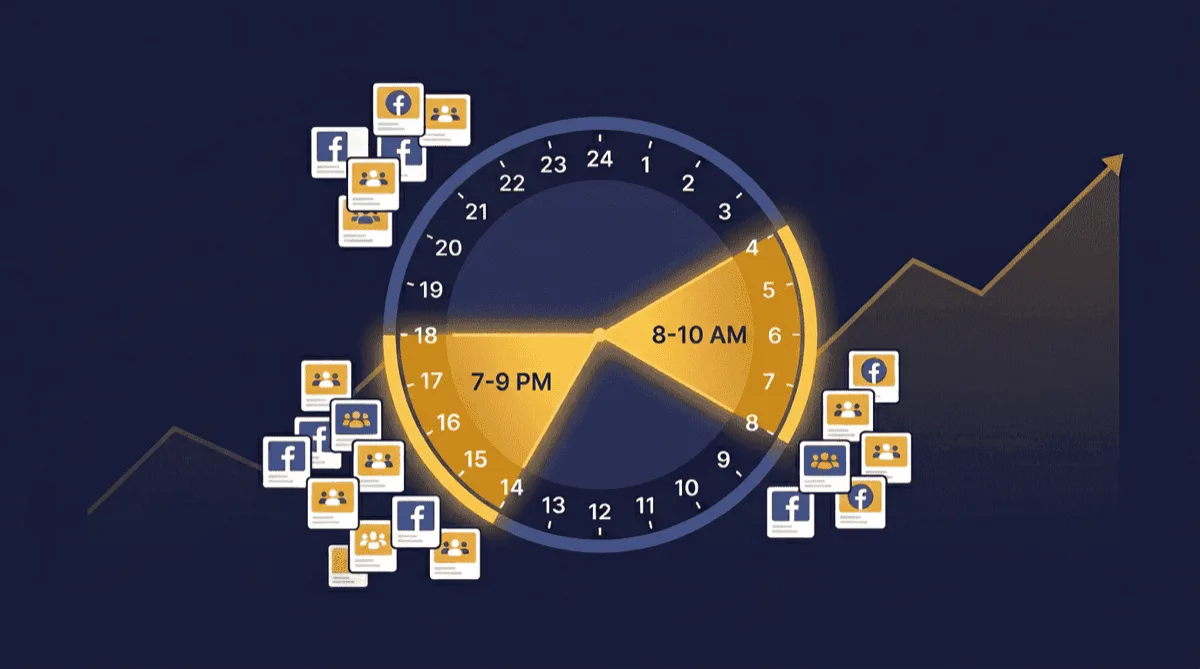
Facebook's group feed uses early engagement as a ranking signal. When a post goes up in a group, it gets initial exposure to a subset of online members. If those members engage quickly (likes, comments, reactions), the algorithm surfaces the post to more members who are currently active. If the post gets little engagement in the first 30 minutes, it's ranked lower and fewer members see it.
This is why timing and content work together. A mediocre post timed perfectly to hit peak activity still underperforms a strong post with a compelling opening line. But a strong post that goes up at 3 AM, when almost no members are active, never gets the early signal boost that would push it up the feed.
The practical implication: you want your post to go live when at least 20 to 30% of the group's active membership is online. For most groups, this correlates with the morning and evening windows. Posts that go live at the start of an activity window get the full benefit of the first-30-minutes ranking boost. Posts that go live late in an activity window catch the tail end.
When Facebook Group Members Are Most Active #
Facebook group activity follows the rhythm of the workday. People check Facebook in the morning before work, during lunch breaks, and in the evening after work. The groups they engage with most are the ones that have fresh content when they open the app.
Best Times of Day (General) #
| Time Window | Engagement Level | Best For |
|---|---|---|
| 6:00 AM - 8:00 AM | Moderate | B2B, business owners, early risers |
| 8:00 AM - 10:00 AM | High | Most niches, commuters checking phones |
| 10:00 AM - 12:00 PM | Good | Professionals, general audiences |
| 12:00 PM - 2:00 PM | Moderate to Good | Lunch break browsing |
| 2:00 PM - 5:00 PM | Lower | Quieter period for most audiences |
| 5:00 PM - 7:00 PM | Moderate | After-work commute crowd |
| 7:00 PM - 9:00 PM | High | General consumers, B2C audiences |
| 9:00 PM - 11:00 PM | Moderate | Night owls, certain communities |
Best Days of the Week #
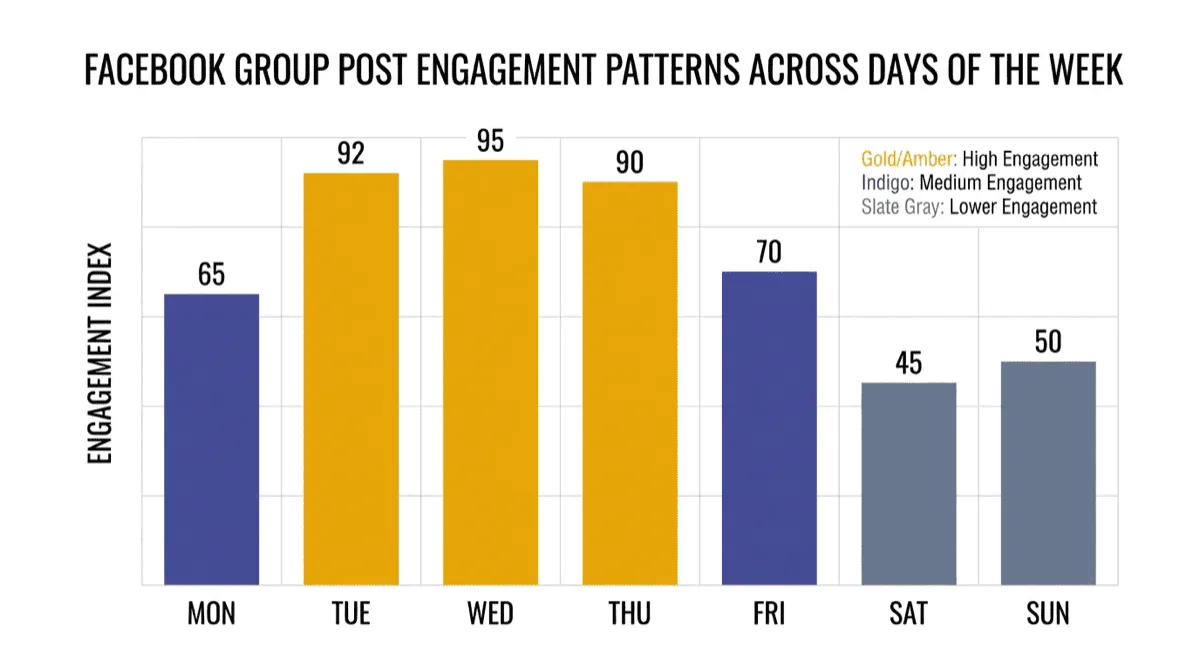
Tuesday, Wednesday, and Thursday consistently outperform the rest of the week for Facebook group engagement. Monday is lower because people are catching up at work. Friday afternoon drops off fast as the weekend starts. Weekends are slower for B2B audiences but can work well for consumer and lifestyle groups.
Timing by Niche and Audience Type #
General rules only get you so far. Here's how optimal timing shifts by use case for the types of joined groups marketers typically post to:
| Niche / Audience | Best Days | Best Time Windows | Notes |
|---|---|---|---|
| Real Estate | Tue-Thu, Sat | 8-10 AM, 7-9 PM | Saturday morning works well for buyers browsing |
| HR / Recruiting | Mon-Thu | 8:30-10 AM, 12-1 PM | Job seekers check before/during lunch |
| Network Marketing | Tue-Thu, Sun | 8-10 AM, 7-9 PM | Sunday evening catches people planning the week |
| Coaches / Consultants | Tue-Thu | 9-11 AM, 6-8 PM | Avoid Monday mornings when prospects are busy |
| E-commerce / Products | Wed-Sat | 10 AM-12 PM, 7-9 PM | Weekends stronger for impulse-buy audiences |
| Local Services (B2C) | Tue-Sat | 8-10 AM, 6-8 PM | Homeowners and local buyers are most active evenings |
| Fitness / Health | Mon-Sat | 6-8 AM, 5-7 PM | Active people check before and after workouts |
| Finance / Investing | Mon-Thu | 7:30-9:30 AM, 12-1 PM | Financial decisions happen early in the day |
| General Marketing (B2B) | Tue-Thu | 9-10 AM, 7-8 PM | Standard B2B pattern applies well |
B2B vs B2C: The Timing Difference That Matters #
B2B and B2C audiences have structurally different Facebook usage patterns because their lives and working conditions are different.
B2B audiences (business owners, marketers, recruiters, consultants) tend to be on Facebook during business hours and on weekdays. They're more likely to engage with content that is professional, educational, or business-relevant. Peak windows for B2B skew toward mornings (8 to 10 AM), when people are getting into the work mindset and checking information, and mid-morning (10 AM to noon) rather than evenings. Weekend engagement is significantly lower.
B2C audiences (consumers, general audiences, lifestyle niches, hobbyists) are active throughout the day and have stronger evening and weekend engagement. The 7 to 9 PM window is typically when consumer Facebook usage peaks because people are relaxed at home. Weekend mornings are often excellent for consumer groups, particularly niches like food, fitness, home decor, and lifestyle.
If you run campaigns that post across both B2B and B2C groups, consider organizing them into separate categories with separate time schedules rather than posting everything in a single campaign window. The 9 AM post that works for your B2B groups lands at the wrong time for your consumer audience groups.
The Timezone Problem at Scale #
Timing gets complicated fast when your joined groups span multiple countries or US time zones. A post scheduled for 9 AM Eastern hits at 6 AM Pacific and 2 PM UK time. That's great for New York, poor for Los Angeles, and decent for London.
For marketers posting across multiple geographies, the solution is to organize groups by region and run separate campaigns per time zone.
How the Facebook Algorithm Uses Timing #
Understanding the algorithm's timing mechanics helps you use scheduling more strategically:
The Initial Distribution Window #
When you post to a Facebook group, the post is initially shown to a subset of members who are currently active. This initial distribution window is where the algorithm decides whether to give the post broader reach. If early viewers engage (comment, react, click), the algorithm expands distribution to more members in the next few hours.
This means posting at the beginning of an activity peak (8 AM, not 9:30 AM) gives you the full benefit of the active window for early engagement signals. A post that goes live at 9:30 AM, with the morning peak winding down, misses most of that first-30-minutes opportunity.
Comment Weight vs Like Weight #
In Facebook group ranking, comments carry more weight than likes or reactions. A post with 5 comments ranks higher than a post with 30 reactions. This has a timing implication: posts that invite discussion (asking a question, presenting a problem, sharing an opinion that invites disagreement) generate comments, which extend the post's visibility window well beyond the initial 30 minutes.
For group posting campaigns, especially in joined groups where your goal is visibility rather than pure community building, posts that end with a question consistently outperform broadcast-style posts regardless of timing. The question generates comments, comments extend visibility, visibility generates more engagement. The timing window is the trigger; the content quality determines the duration of the effect.
Group Activity Level Matters Too #
In an active, high-traffic group with many daily posts, your post competes with many others for feed position. Peak posting times are when everyone else is also posting, which means more competition. In smaller, lower-activity groups, there's less competition and your post retains feed visibility longer.
This means the optimal timing strategy isn't the same for all your groups. In low-activity niche groups, the timing matters less because there's less competition. In high-activity general groups, hitting the early morning window precisely matters more.
Scheduled Posting (Recommended)
- Hit the right time window for your joined groups every day
- Post to morning groups at 8 AM even when you start work at 9
- Consistent daily cadence builds recognition in group feeds
- Run campaigns across timezones automatically
- No temptation to skip posting on busy days
Manual / Real-Time Posting
- Only works if you're available at the right times
- Easy to skip on busy days, breaking your cadence
- Can't be in the right timezone for every audience
- Doesn't scale beyond a handful of joined groups
A Practical 4-Week Testing Framework #
Industry timing data is a starting point. Your specific joined groups, audience demographics, and content type will shift what works for you. Here is a testing framework to find your actual best times:
Week 1 to 2: Morning Test #
Post to a representative sample of your joined groups (15 to 20 groups) at 8:30 to 9:00 AM on Tuesday, Wednesday, and Thursday. Use your standard content type. Track comment rate per post.
Week 3 to 4: Evening Test #
Post to the same set of groups at 7:30 to 8:00 PM on the same days of the week. Same content quality and format. Track comment rate per post.
Compare and Conclude #
Compare average comment rate (not just like rate) across the two windows. Whichever window produced more comments is your primary posting window. Run a secondary test across day-of-week if you want to refine further.
After you have your primary window, use PilotPoster's scheduling to consistently hit that window for all your joined groups. The Chrome extension runs the campaign at the specified time with randomized delays between groups, so your posting lands in the right window without requiring you to be available manually. See how to schedule posts to your joined groups for the setup walkthrough.
Consistency Over Optimization #
Before obsessing over the perfect posting window, make sure these fundamentals are in place:
- Your hook/opening line: In group feeds, only the first 1 to 2 lines show before a "See more" cut. If your opening doesn't stop the scroll, timing doesn't matter.
- Relevance to the group: A perfectly timed but irrelevant post gets ignored and reported. A highly relevant post at 2 PM still gets engagement.
- Visual content: Posts with images or video consistently outperform text-only posts in group feeds, regardless of timing.
- Asking a question: Posts that end with a specific question get far more comments than pure statements. Comments boost the post in group feeds.
Consistency beats optimization for most people. Posting at 9 AM every Tuesday, Wednesday, and Thursday builds a predictable presence in group feeds. Members start to recognize your name. That recognition compounds over weeks into actual engagement. Chasing the "perfect" time while posting inconsistently is worse than posting at a decent time every day.
- Peak posting windows are 8-10 AM and 7-9 PM in your audience's timezone. Tuesday through Thursday outperforms other days for most niches.
- The first 30 minutes of a post's life matter most: early engagement signals determine whether Facebook expands distribution to more group members.
- B2B audiences engage most on weekday mornings. B2C audiences have stronger evening and weekend patterns.
- Organize groups by timezone and run separate scheduled campaigns per region when your audience spans geographies.
- Comments carry more weight than likes in group feed ranking. Post formats that invite discussion extend your post's visibility beyond the initial window.
- Run a 4-week A/B test on your own groups to find your actual best time rather than relying purely on industry averages.
Related Reading #
- How to Increase Facebook Engagement in 2026
- How to Schedule Facebook Posts in 2026
- 18 Facebook Group Post Ideas That Actually Get Engagement
- Can You Schedule Posts to Joined Facebook Groups?
- How to Schedule Posts to Multiple Facebook Groups
- How to Auto Post to Facebook Groups Without Getting Banned
- Facebook Group Marketing Strategy for Small Business


