To promote your business in Facebook groups without being spammy, follow the 80/20 rule: 80% of your posts should be genuinely helpful content with no direct pitch, 20% can include a soft promotion. Lead with value, put your product or service in context, and never post the same message across multiple groups. Group admins ban accounts that look like broadcasts, not people.
If you've ever posted in a Facebook group and been greeted with silence, or worse, a ban, you already know that blasting promotional content doesn't work. What's less obvious is exactly what does work, and why the approach most people take is the fastest route to getting removed.
This is not a post about avoiding account bans from a technical standpoint (that's covered in the guide on posting without getting banned). This is about the content itself: what to write, how to frame it, and how to build a reputation in groups that generates genuine business without making people cringe.
Why Most Group Promotion Fails
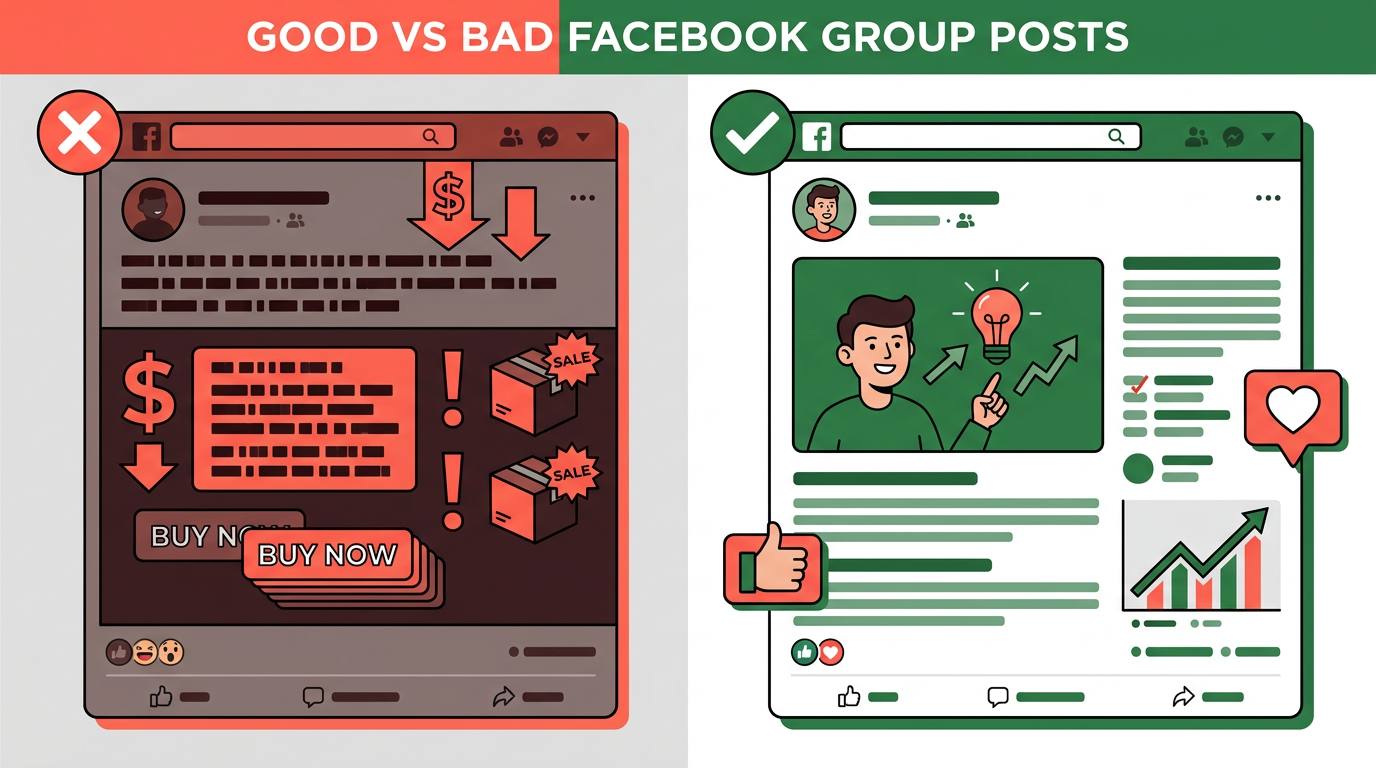
Facebook group admins see hundreds of promotional posts. They've pattern-matched what spam looks like, and they delete it without a second thought. Here's what triggers immediate deletion or bans:
- Opening with a price or offer before establishing any context or value
- Copy-pasted identical posts (even if it's your first offense, admins recognize templated language)
- Posts that only talk about your product, with nothing useful for someone who isn't buying
- Multiple links or aggressive CTAs ("Click here now! DM me! Limited time!")
- Long, breathless blocks of text with no structure or breathing room
The root problem is perspective. Most business owners write group posts from the seller's point of view: what do I want people to do? Group members read posts from the community member's point of view: what's in this for me right now?
When those two don't align, the post fails. The fix is to start from the reader's perspective, not yours.
The 80/20 Rule for Group Promotion
The most reliable framework for sustainable group marketing is simple: for every promotional post you make, publish four posts that have nothing to do with selling.
The 80% non-promotional posts should:
- Answer questions other members have posted
- Share genuinely useful information related to the group's topic
- Start a discussion or ask a question that sparks engagement
- Share your own experience or a lesson learned, without selling anything
The 20% promotional posts don't have to be hard pitches. They can be soft-sells, which we'll cover in the frameworks below.
Group members notice when someone only shows up to promote and never contributes otherwise. They develop a mental filter: this person is here to take, not give. Once that filter is set, even your best content gets ignored. The 80/20 ratio keeps your presence feeling balanced and human rather than automated and one-dimensional.
What Group Admins Actually Delete
Based on patterns across thousands of groups, here's what reliably gets removed versus what gets tolerated or even welcomed:
| Gets Deleted | Gets Tolerated or Welcomed |
|---|---|
| "Check out my service, link in bio" | Sharing a result or case study with your service mentioned as an afterthought |
| Identical posts copied across groups | Posts clearly written for that specific community |
| Hard CTAs with urgency ("Last chance!", "DM me now!") | Soft invitations ("Happy to answer questions if anyone's curious") |
| Posts with multiple external links | Posts with zero links, or one link clearly relevant to the discussion |
| Promotional posts before you've contributed anything | Promotional posts from members who are recognized as helpful regulars |
| Posts that ignore the group's focus entirely | Posts that open with something specific to the group's audience |
Post Frameworks That Actually Work
Here are five content frameworks that promote your business without triggering the spam filter in members' brains or admins' moderation queues.
1. The Value-First Post
Share a useful tip, insight, or piece of information that stands completely on its own. Your business gets mentioned only as context for how you know this.
Structure: [Useful tip or information] + [Your experience as the source of credibility, briefly]
Example for a productivity coach:
Something that helped a lot of my clients who struggle with staying focused: block your first 90 minutes before checking email or Slack. That window is when your prefrontal cortex is freshest. Most people waste it responding to other people's priorities. Three months of doing this consistently changed how productive my days feel. Anyone else shifted their morning routine recently?
The service is implied (coaching) but the post is useful whether someone hires you or not.
2. The Problem-Solution Story
Share a real story, yours or a client's, that describes a problem the group members likely recognize, then explains how it got solved. Your product or service is the solution, but it's shown through narrative, not announced as a feature list.
Structure: [Relatable problem] + [Struggle or turning point] + [Solution with result] + [Soft invitation]
Example for a social media automation tool:
A client of mine was spending Sunday afternoons writing and scheduling posts for the week. She had a toddler. Those afternoons were gone. She tried batching content, but it still took 4-5 hours per week just for Facebook groups. She's now posting to 60 groups on autopilot and spends that time with her kid. If you're in the same boat, happy to walk you through what changed.
3. The Case Study Post
Share a specific, measurable result with enough detail to be credible. Vague claims ("My client doubled their business!") are ignored. Specific details (numbers, timeframes, context) are read.
Structure: [Who the client is, in general terms] + [Starting point] + [What was done] + [Specific result] + [Offer to discuss]
"A coaching client went from 3 leads per week to 11 leads per week in 6 weeks" is believable. "A client 10x'd their business" is not. The more specific the number, the context, and the timeframe, the more people believe it and the more they want to know how.
4. The Discussion Starter
Ask a genuine question related to your area of expertise. When you answer comments, your knowledge becomes the proof of credibility. This format often generates the most organic reach because comments drive distribution.
Example for a bookkeeper serving small businesses:
Quick question for small business owners here: do you categorize your software subscriptions as "office expenses" or "software" on your books? I see a lot of clients get this wrong at tax time, and it's worth getting right. What's your current system?
The bookkeeper demonstrates expertise by knowing why it matters. People who comment and get a helpful response often end up asking about their services.
5. The Soft Sell With Context
For those 20% posts where you do want to mention your product or service directly, frame it with context: who it's for, what problem it solves, and why you're sharing it here specifically. Remove urgency language entirely.
Bad version: "Check out my new course! Limited spots! Link in bio! DM for details!"
Better version:
I've been putting together a short guide on [specific topic] based on what I see coming up repeatedly in this group. It covers [specific thing], [specific thing], and [specific thing]. If that's useful for anyone here, I'm happy to share it. Drop a comment and I'll send it over.
Content Variation: Why You Can't Post the Same Thing Across Groups
One of the most common reasons accounts get flagged in Facebook groups is identical content across multiple groups. Facebook's algorithm detects duplicate posts and can limit their distribution or flag the account. Admins across multiple groups often recognize templated language too.
The solution is content variation: changing enough of each post that it reads as original for each group.
There are two practical ways to do this at scale:
Spintax: Write one post with interchangeable phrases using {option1|option2|option3} syntax. Each group gets a different combination. Read the full breakdown in how to use Spintax for Facebook group posts.
AI text rewriting: Tools like PilotPoster can automatically rewrite your post slightly for each group it's posted to: same message, different phrasing. You set the tone and any specific instructions, and each group gets a genuinely different version of the text without you writing 50 variations manually.
Most scheduling tools only post to groups you admin. PilotPoster's Chrome extension posts directly through your real browser session, which is why it works for joined groups where you're a member (not an admin). Its AI rewriting feature applies a unique variation to each group automatically during that posting session.
Building a Reputation That Does the Selling for You
The highest-leverage thing you can do in any group is become the person members think of when your topic comes up. Not by posting more, but by being consistently useful over time.
Three habits that build this reputation fast:
- Answer questions first. Scan the group daily and answer questions in your area of expertise, without promoting anything. Do this for two to three weeks before posting anything promotional. By then, members recognize your name and trust your input.
- Be specific, not general. Generic answers get ignored. Specific, detailed answers get saved, shared, and remembered. "It depends" is not an answer. Give your actual opinion with reasons.
- Follow up on your own posts. Reply to every comment on your posts, even briefly. This signals that you're a real person, not a content bot, and it pushes your post back into the feed as active.
Once you have this reputation in a group, your promotional posts get a completely different reception. Members who recognize your name are already predisposed to trust what you're sharing.
- Lead with value in 80% of your posts. Promotional content works only when you've established yourself as genuinely helpful first.
- Write from the reader's perspective: what's useful for them right now, regardless of whether they buy anything
- Specific case studies and results beat vague claims every time. Numbers and context make things believable.
- Never post identical content across multiple groups. Facebook detects it and admins recognize it.
- Discussion-starter posts often outperform direct promotional posts because comments drive distribution
- The soft-sell format (context, who it's for, what problem it solves, no urgency language) is what actually gets tolerated
- Building a reputation as the go-to helpful person in a group makes every future promotional post more effective