Facebook Groups matter more than ever for three reasons that all point the same direction. Group usage is still climbing (roughly 1.8 to 2 billion people use Groups every month, and rising), the conversations inside Groups are now training data that AI companies pay hundreds of millions for, and answer engines lean on real human discussion that AI cannot fake. Marketers who build a consistent presence across relevant Groups now are positioning themselves for both the organic reach of today and the AI-answer visibility of tomorrow.
Facebook Groups are in the middle of their strongest stretch yet, and the data behind it is more convincing than most marketers realize. The fastest-growing meaningful part of Facebook right now is not the feed, not Pages, and not Reels. It is Groups. More people are joining communities, participating in them, and spending real time inside them than at any point in the platform's history.
Something else changed too. The private-ish conversations happening inside millions of niche communities turned into one of the most valuable commodities in tech: authentic human text that AI models are hungry for. That shift quietly rewired the math on why showing up in Groups is worth your time.
This post walks through what the data actually shows, why AI made Group conversations more valuable rather than less, and what all of it means if you are trying to reach people on Facebook.
Facebook Group Usage Keeps Climbing #
Start with the top line. Facebook still sits at around 3.12 billion monthly active users in 2026, and it is still adding users, mostly from South Asia, Southeast Asia, Africa, and Latin America. The platform is bigger today than it has ever been. The more interesting number is what those people do once they are logged in.
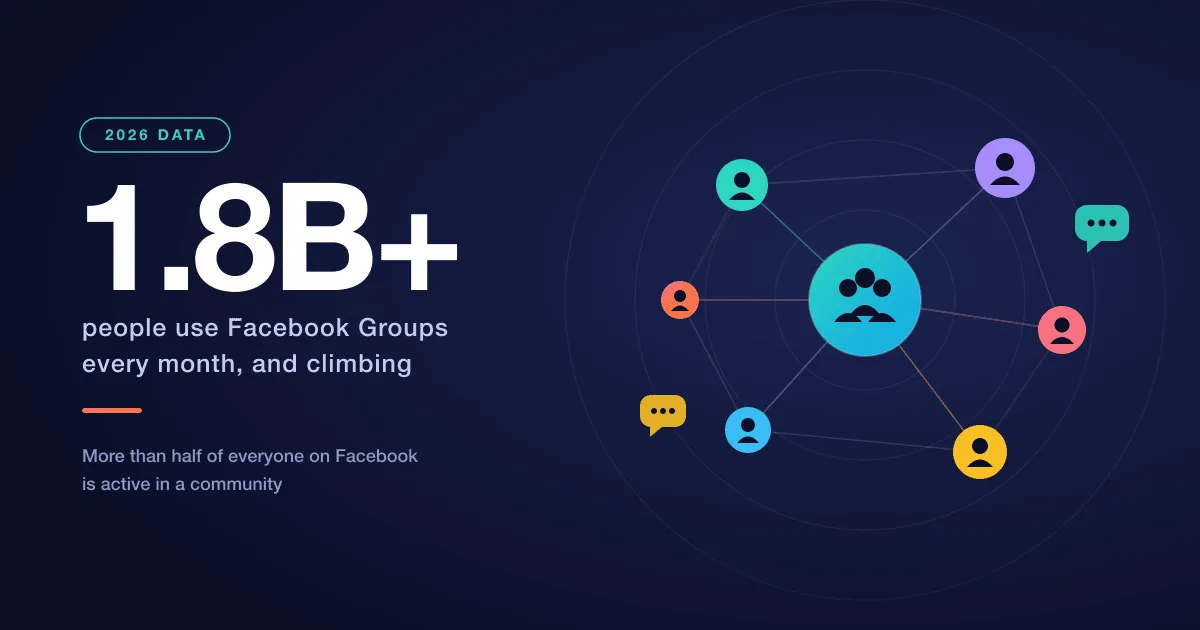
Almost 1.8 billion people use Facebook Groups every month, according to Meta's most recent figure (October 2024; see our sourced Facebook group statistics). That is roughly six in ten people on the platform. Group membership is not a fringe feature anymore; it is the center of gravity. Here is what the community data looks like heading into 2026:
| Metric | Figure | Why It Matters |
|---|---|---|
| Monthly Group users | 1.8 to 2 billion | More than half of all Facebook users touch Groups every month |
| Active admins and moderators | 70 million plus | A massive layer of people invested in keeping communities alive |
| People in "meaningful" groups | 400 million plus | These are not lurkers; they identify with the community |
| Users in five or more groups | About 50 percent | The average member is spread across multiple niches |
| Daily time in group environments | Roughly 15 to 28 minutes | Higher attention than passive feed browsing |
| Group vs Page engagement | About 50 percent higher | Groups consistently out-engage brand Pages |
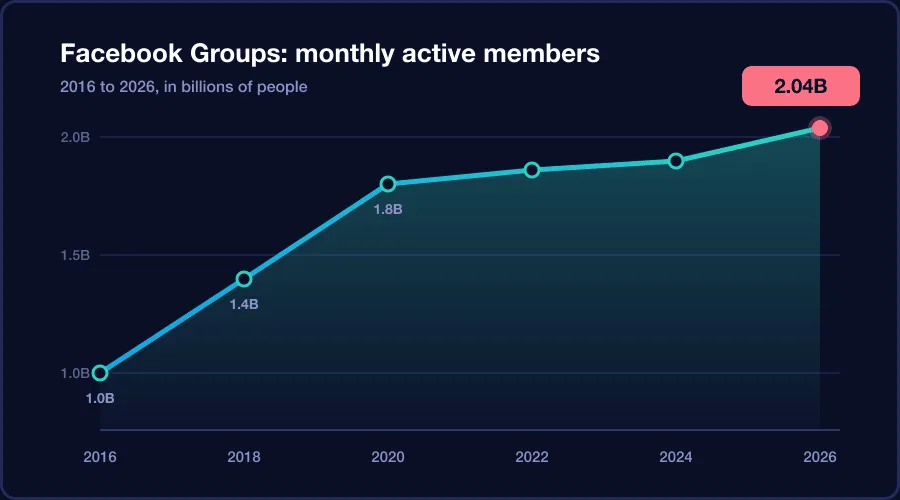
The trend line is just as telling as the snapshot. Active Group membership roughly doubled from 1 billion to 1.8 billion between 2016 and 2020, and it has kept edging up since. Compare that to the direction of Page reach, which Facebook throttled down to 2 to 6 percent over the same period. One line went up, the other went down, and they are still moving in opposite directions.
Facebook benefits when people stay longer and interact more. Group conversations generate exactly the "meaningful interactions" the algorithm was rebuilt around in 2018, so the platform keeps surfacing Group content and sending notifications for it. That is why a Group post reaches a far larger share of members than a Page post reaches of followers.
If you have ever wondered whether Groups are worth the effort compared to a business Page, the reach difference settles it. We broke down the full comparison in Facebook Groups vs Pages for business, but the short version is that Groups win on organic visibility by a wide margin.
AI Companies Are Paying Millions for Exactly What Groups Produce #
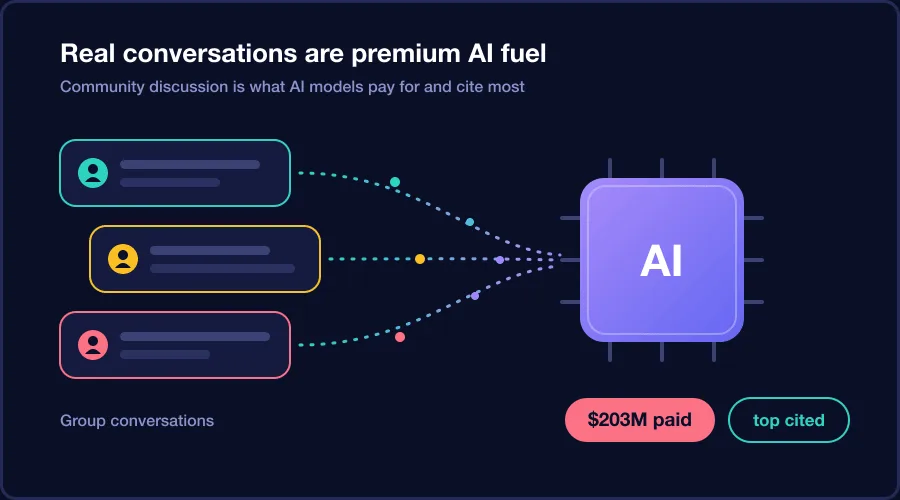
Here is the part most marketers have not connected yet. The single most valuable resource in AI right now is not compute or clever algorithms. It is authentic human conversation, and it is running short.
As the open web fills up with machine-generated articles, the supply of genuine human writing stops growing while demand from AI labs explodes. Reddit noticed this before almost anyone. Its executives now describe the platform's archive of real discussion as "modern oil" and signed licensing deals reportedly worth around $203 million with Google and OpenAI to let those companies train on Reddit threads. Reddit is now the most-cited source across large language models, reportedly referenced roughly three times more often than Wikipedia.
Why does a forum thread beat a polished article for training an AI? Because it contains something synthetic text cannot manufacture: lived experience, disagreement, correction, slang, edge cases, and the messy back-and-forth of real people working out real problems. That is the exact texture of a good Facebook Group.
"The paradox I see is that, as more content on the internet is written by machines, there is an increasing premium on content that comes from real people."
Now look at where Facebook fits. Meta has openly confirmed that it trains its own AI models on public content from its products. Per Meta's own AI Transparency Center, the training mix includes "publicly shared posts" and comments from Facebook and Instagram, used on a rolling, ongoing basis. Public Group discussion is part of that pool. Meta AI, the assistant now built into Facebook, Instagram, WhatsApp, and Messenger, learns from the kind of conversation your community produces.
Content in public Groups can be used to train AI, both Meta's and, where it is crawlable, other companies' models. Private and secret Groups are a different story. This is not a reason to stop posting; it is a reason to understand that what you share publicly now has a second life as reference material inside AI systems.
Put the two facts together. Group conversation is becoming scarcer as a share of the internet, and it is exactly what AI companies are willing to pay a premium for. That does not make Groups a fad on the way out. It makes them one of the last large, growing pools of the most valuable content type on the internet.
Why AI Cannot Replace Group Conversations #
It is fair to ask the obvious follow-up. If AI is this good, why would anyone need a Facebook Group when they can just ask a chatbot? The answer is that Groups do several things AI structurally cannot.
Lived experience beats generated text #
When someone asks a local gardening group why their tomatoes are splitting, they get answers from people who grow tomatoes in that exact climate, this exact season. An AI can summarize general advice, but it cannot tell you what happened in your county after last week's rain. Specific, current, first-hand knowledge lives in communities, not in a model trained months ago.
Trust is a human signal #
People increasingly append "reddit" or the name of a Facebook Group to their searches precisely because they want a human answer, not an SEO page or a confident-sounding bot. A recommendation from a member who has been in the group for three years carries weight that no generated paragraph can match. Trust is earned through visible, consistent participation over time.
Real-time and local by default #
Groups move at the speed of their members. A neighborhood group knows about the road closure before any map updates. A niche hobby group debates a new product the day it ships. This freshness is why AI answer engines increasingly pull from community discussion in the first place; the community got there first.
Being genuinely active in the right Groups is not just about today's reach. As AI answer engines lean more on community discussion, the brands and people who show up helpfully in those conversations are the ones more likely to be surfaced when someone later asks an AI for a recommendation. Presence in Groups now compounds into visibility inside AI answers later.
What This Means for Marketers in 2026 #
Strip away the theory and the practical takeaway is simple. The place with the most organic reach on the biggest social platform is also the place producing the content type AI values most. If you are marketing on Facebook, that is where your attention belongs.
A few things follow from that:
- Organic reach is still cheap in Groups. While Page posts reach 2 to 6 percent of followers, active Group posts can reach 30 to 60 percent of members. That gap is a discount that will not last forever.
- Consistency is the real ranking factor. Both the Facebook algorithm and human trust reward people who show up regularly, not people who drop one link and vanish.
- Helpful beats promotional. The content that earns engagement, gets cited, and survives as useful reference material is the content that actually answers a question. This is the same principle behind writing AI-assisted posts that do not sound like AI.
- Spread matters. One post in one group is a rounding error. A relevant presence across many groups in your niche is a distribution channel.
That last point is where almost everyone hits a wall, and it is worth being honest about why.
The Consistency Problem (And How Software Solves It) #
The strategy is not complicated. Post genuinely useful content, consistently, across the groups where your audience already spends time. The problem is that doing this by hand does not scale. Posting to ten groups manually is an hour of copy-paste. Posting to fifty is a part-time job. And posting the identical block of text into group after group is the fastest way to get flagged as spam.
This is the gap that tooling fills. We covered the mechanics in detail in how to post to multiple Facebook groups at once, but the core requirements are the same: reach the groups you have joined (not just ones you admin), vary the content so each post is unique, and pace everything so it looks like a human posting, not a machine dumping.
PilotPoster is the most complete Facebook group marketing software, built for exactly this. It posts organically, exactly like posts you make yourself, with no third-party API in between. It auto-syncs the groups you have joined, uses Spintax or AI rewrite so every group gets a unique version of your post, and posts at a natural, human pace to keep your posting pattern looking natural. It handles the consistency and spread that make a Group strategy work, without the copy-paste grind.
The point is not the tool for its own sake. The point is that the marketers who win in Groups are the ones who can be consistently present across many communities without burning out or tripping spam filters. However you solve that, solving it is the difference between knowing Groups matter and actually benefiting from it.
Frequently Asked Questions #
Are Facebook Groups still relevant in 2026? #
Yes, more than ever. Almost 1.8 billion people use Facebook Groups every month (Meta, October 2024), group engagement runs about 50 percent higher than brand Pages, and active membership has grown steadily since 2016. Groups are the fastest-growing meaningful part of Facebook.
Does Facebook use Group content to train AI? #
Meta confirms it trains its AI on public content from its products, including public posts and comments, on an ongoing basis. Public Group discussion falls into that pool. Private and secret groups are not treated the same way, but anything posted publicly can become training and reference material for AI systems.
Why is human conversation so valuable to AI companies? #
As more of the web becomes machine-generated, authentic human writing gets scarcer and more valuable. It carries lived experience, correction, and real-world specifics that models cannot manufacture. Reddit's roughly $203 million in licensing deals with Google and OpenAI shows how much that kind of conversation is worth, and Facebook Groups are one of the largest remaining sources of it.
Can AI chatbots replace Facebook Groups? #
No. AI can summarize general knowledge, but it cannot provide the current, local, first-hand experience that group members share in real time, and it cannot replicate the trust built by a person who is visibly active in a community. Answer engines increasingly cite community discussion precisely because the community got there first.
How do I actually get reach from Facebook Groups? #
Post genuinely useful content consistently across the groups where your audience already is, vary each post so it is unique, and pace your posting so it looks human. Doing this across many groups by hand does not scale, which is why marketers use tools that post organically to stay both consistent and safe.
- Facebook still has around 3.12 billion monthly users, and 1.8 to 2 billion of them use Groups every month, with that number climbing year over year.
- Group engagement runs about 50 percent higher than brand Pages, and organic reach is 30 to 60 percent in Groups versus 2 to 6 percent on Pages.
- Meta trains its AI on public content from its products, including public Group posts and comments.
- Authentic human conversation is now a premium commodity for AI. Reddit's roughly $203 million in licensing deals proves the value, and Groups are a huge remaining source of it.
- AI cannot replace Groups for lived experience, local and real-time knowledge, or human trust.
- Presence in Groups now can compound into visibility inside AI answers later, as answer engines lean on community discussion.
- Consistency and spread across many groups is the real bottleneck, and it is what posting software is built to solve.
Related Reading #
- How to Increase Facebook Engagement in 2026
- Facebook Groups vs Pages: Which Gets Better Results for Business?
- 6 Powerful Reasons to Create Your Own Facebook Group
- Facebook Groups vs WhatsApp vs Discord: Which Platform in 2026?
- How to Post to Multiple Facebook Groups at Once
- How to Use AI to Generate Facebook Posts That Don't Sound Like AI


