
To sell in Facebook groups, match your approach to the group type, then nail the fundamentals: lead the first line with the item and price, use a bright real photo, anchor against the retail price, and post when buyers actually browse (weekday evenings, plus Friday and Sunday nights). Answer the first question in public comments, then move to DMs to close. Protect yourself with public, daytime exchanges and payment that clears before handoff. Once you know which groups convert, relist across them on a schedule. The seller who runs this as a repeatable system outsells the one who posts once and hopes.
Most advice on how to sell in Facebook groups stops at "take good photos and be honest." That is table stakes. It does not explain why the same couch sells in three days in one group and sits for three weeks in another, or why a listing gets 40 views and zero messages.
Selling in groups is not one skill. It is a system with parts that each do a job: the group you choose, the first line you write, the price you set, the hour you post, how you handle the haggling, and whether you show up again after the listing goes quiet. Get all six right and slow items move. Miss two or three and even good stuff stalls.
This is the full playbook, built from how buy-and-sell groups actually behave. If your goal is softer brand awareness rather than moving physical product, the companion guide on how to promote your business in Facebook groups without spamming covers that side. This post is about closing sales.
The Four Kinds of Groups You Can Sell In #
The single biggest mistake sellers make is treating every group the same. A collector group and a neighborhood yard-sale group reward opposite behavior. Haggle hard in a collector group and you read as rude. Refuse to budge in a local buy-and-sell group and the deal dies. Match the group to the behavior it expects.
| Group type | What sells | Price expectation | How buyers behave |
|---|---|---|---|
| Local buy-and-sell | Used furniture, bikes, baby gear, appliances | Haggling expected; build in 10 to 20 percent room | Fast scrollers, local pickup, "is this available" comments |
| Niche hobby and collector | Gear, trading cards, instruments, specialty items | Pay for condition and rarity; light haggling | Knowledgeable, ask detailed questions, willing to ship |
| Community and neighborhood | Small items, services, local referrals | Fair local pricing; relationships matter | Trust-driven, repeat buyers, reputation follows you |
| B2B and professional | Tools, bulk lots, equipment, services | Value-based; invoices and receipts expected | Slower, compare options, decide mid-week mornings |
Joining thirty groups and blasting the same post into all of them is what gets you muted and reported. Pick three to five groups that match your item's archetype and audience. A tight set of relevant groups outsells a scattershot list every time, and it keeps you off admins' radar.
Write the First Line Like It Is the Only Line #
Buyers do not read your listing. They scan a feed of listings, and Facebook truncates the text after the first line. Your first six to eight words decide whether they stop or keep scrolling. Everything else in the post only matters if the first line earns the click.
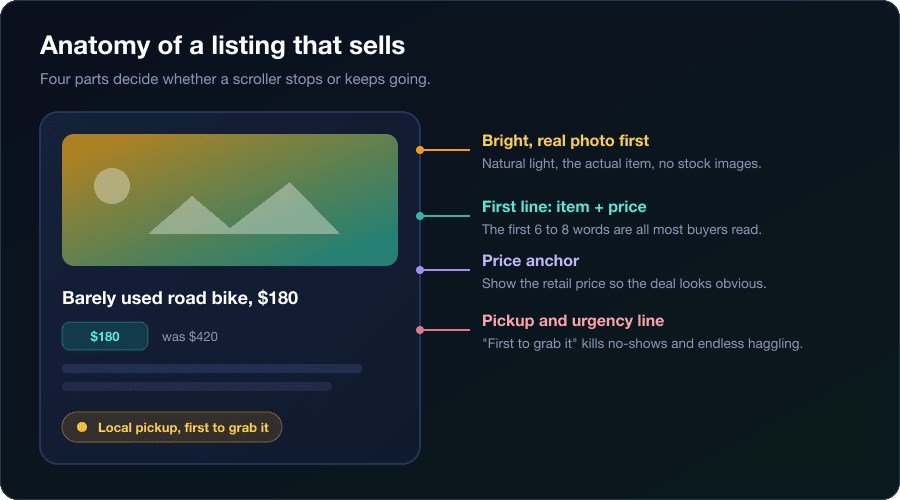
The formula is simple: item plus price plus one credibility hook. Compare these two openings for the same bike.
"Hi everyone! So I have this bike I'm thinking about selling, it's in pretty good shape and I don't really ride it much anymore, let me know if anyone might be interested :)"
"Barely used road bike, $180 (retails $420), receipt included. Local pickup in [area]."
The second one filters the feed for you. Putting the price in the first line scares off browsers and pulls in people ready to buy. Leaving it out guarantees a string of "how much?" comments that you answer for a week. The credibility hook does the rest of the work: a short phrase that removes a buyer's main doubt before they ask.
Keep a running list of hooks and pick the one that fits: "barely used," "moving sale, must go," "receipt included," "first owner," "smoke-free and pet-free home," "still under warranty," "new in box." Each one answers an unspoken question about condition, history, or urgency.
Price for the Group, Not for the Item #
The same item has different right prices in different groups, and how you present the number matters as much as the number itself.
Anchor against the retail price #
Always show what the item cost new. "$180 (was $420)" makes the discount obvious without you saying "great deal." The buyer does the math and sees value instantly. A price with no anchor forces them to guess whether it is fair, and guessing means scrolling on.
Round numbers where people haggle, considered numbers where they don't #
In local buy-and-sell groups, haggling is the culture. Price 10 to 20 percent above your walk-away number in a round figure ($200, not $185) so there is room to come down and both sides feel like they won. In niche and collector groups, where buyers know exact values, a considered price like $185 signals you have researched it, and aggressive haggling is less welcome. Read the room.
Bundle slow items with fast ones #
The fastest way to move dead stock is to attach it to something desirable. "Road bike, helmet, and lock, $210 for all" clears the helmet and lock you could never sell alone. Or offer a small discount for taking a lot: "Any three of these for $50." Bundling raises your average sale and empties your closet faster than listing each piece separately.
Write down the lowest number you will accept before the listing goes live. When the offers come in, negotiation becomes math instead of emotion. You stop caving on a bad Tuesday and stop holding out for a number that will never come.
Post When Buyers Are Actually Browsing #
A brilliant listing posted at the wrong time is invisible. Group feeds move fast, and buyers browse in predictable windows.
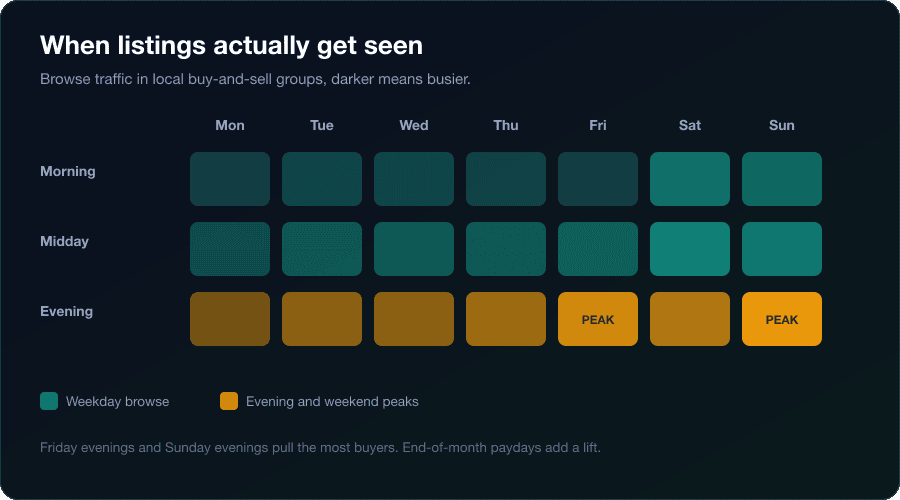
Local buy-and-sell groups peak on Friday evenings and Sunday evenings, when people plan weekend pickups and clear out clutter. Weekday evenings after work are solid. B2B and professional groups run opposite: mid-week mornings, when buyers are at their desks making purchasing decisions, beat evenings and weekends.
Layer paydays on top. The end of the month and the middle of the month, when most people get paid, loosen wallets, so schedule big-ticket items for those windows. For the full breakdown by group type, see the best time to post in Facebook groups.
Timing runs in reverse too. Buyers post their own requests, the "looking for a dresser under $200" and "ISO kids bike" posts, and those are the easiest sales in any group because the demand is already stated out loud. They also disappear fast, since the first few sellers to reply get the pickup. If you sell steadily, it pays to have something that monitors Facebook groups for keywords matching your inventory so you catch those requests while they are still open.
The Bump-and-Relist Cycle #
Here is the part almost no selling guide covers. A group listing decays fast. New posts push yours down the feed, and within 24 to 48 hours a Tuesday listing is effectively invisible by Thursday. Views on day one do not mean the item failed to sell because it was priced wrong. Often it just fell off the feed before the right buyer logged in.
Reviving a listing takes some etiquette, because clumsy bumping gets you reported.
- Comment bumps: Many groups ban "bump" comments outright, so check the rules. Where allowed, a genuine update works better anyway: "Still available, can deliver this weekend" adds information instead of spam.
- Editing the post: Some groups resurface edited posts to the top, many do not. Test it once in each group and note what happens.
- Deleting and relisting: The reliable option. Delete the stale post and create a fresh one, ideally with a different lead photo or first line so it does not look like an exact repeat.
Cadence matters. Relisting the identical post every single day annoys admins and members and trains people to scroll past you. Space relists three to four days apart, rotate the photo or opening line, and stagger which groups you refresh on which day. If you are posting the same item to several groups, watch the Facebook group posting limits so a burst of relists does not trip a spam flag.
Keeping a relist schedule straight across several groups by memory is where most sellers give up. PilotPoster, a web app plus Chrome extension that posts through your own browser session, can run a recurring campaign that refreshes a listing on the cadence you set, with varied wording each time, so you are not living by calendar reminders.
Scripts That Close the Sale and Kill Time-Wasters #
Most sales are lost in the messages, not the listing. Two habits fix that: answer in public first, then move to DM, and use set phrases for the situations that waste your time.
The comment-to-DM ladder #
When someone asks a question in the comments, answer it there first. Other watchers see the item is available and see you responding, which is quiet social proof that pulls more interest. Then move the specific buyer to DM to arrange the handoff.
Public reply: "Yes, still available. Pickup is [area], I can do today or this weekend. I'll send you the details."
The lowballer reply that keeps the door open #
When someone offers far below your floor, do not get annoyed and do not cave. Hold your number and leave a path back.
"Thanks for the offer. I'm firm at $180 since it's barely used with the receipt. If it hasn't sold by Sunday I'll message you."
Half the time they come back at your price, because they were testing. The other half, you have a backup buyer if the listing goes quiet.
The line that kills no-shows #
No-shows happen when you hold an item for someone who only said "interested." Do not. Keep the listing active until cash is in hand, and set the rule up front.
"First to confirm a pickup time and show up gets it. I don't hold items without a set time, but happy to work around your schedule."
Sell Safely: Scams and Clean Exchanges #
Buy-and-sell groups attract scammers because the transactions are between strangers with cash and goods changing hands. The patterns repeat, so learn them once.
Overpayment ("I accidentally sent too much, can you refund the difference," then the original payment reverses). Fake payment screenshots showing money that never actually arrives. Prepaid shipping-label scams where the buyer sends a fraudulent label and reroutes your package. "Is this available" messages with a link asking you to verify on a fake site. And the "your account needs a business upgrade" story that asks you to send money to receive money.
The defenses are boring and they work:
- Meet in public, in daylight, ideally at a police-station safe-exchange zone for anything valuable.
- Take cash for local deals, or wait until an electronic payment has actually cleared in your account before handing over the item. A screenshot is not money.
- Never share a verification code that gets texted to you. A "buyer" asking for one is trying to hijack your account, not buy your couch.
- Keep the conversation on Facebook or your payment app. Refuse to move to email or a random link.
- If something feels off, walk. There is always another buyer.
Local Pickup or Shipping? #
The delivery method you offer shapes who can buy and how much risk you carry. Choose deliberately instead of defaulting.
Local pickup suits bulky, low-value, or hard-to-ship items and local buy-and-sell groups. You get cash, pay no fees, and carry no shipping risk. The trade-off is a smaller buyer pool limited to driving distance, and the occasional no-show, which the pickup script above handles.
Shipping opens niche and collector groups to a national audience, which is often the only way to get a fair price on specialized items. If you ship, build the real cost into the price or state it plainly, use tracked and insured shipping for anything valuable, and photograph the item and the packed box before it leaves your hands. Only ship after the payment has cleared, never on a screenshot or a label the buyer sends you. For fragile or high-value goods, "local pickup only" is a legitimate and safer choice.
Track What Sells, Then Scale It #
Most people relist into the same twenty groups for months without knowing which three actually produce sales. That is wasted effort. Track it for a few weeks and the picture gets obvious fast.
Keep a simple spreadsheet: group name, listings posted, views, comments or DMs, and sales. After two or three weeks, you will see that a handful of groups do almost all the work while the rest return nothing. Cut the dead ones and put your energy where the buyers are.
Once you know your three to five best groups, the job changes. Now it is about posting consistently across those groups with wording varied enough that it does not look copy-pasted, because identical text pasted into multiple groups is exactly what gets flagged as spam and annoys members who see the same post twice.
Doing that by hand means opening each group and pasting one at a time, then rewording so it looks fresh. This is the manual pain point PilotPoster removes. It posts to the groups you have joined through your own browser session, schedules the listing to each with random delays, and varies the wording with Spintax or AI so every group gets a distinct version. See how to post to multiple Facebook groups at once and how to use Spintax for Facebook group posts for the setup.
Frequently Asked Questions #
How do I sell fast in Facebook groups? #
Lead the first line with the item and price, use one clear real photo, anchor against the retail price, and post in a peak window (weekday evenings, or Friday and Sunday nights for local groups). Then respond quickly to the first comment. Speed of reply matters as much as the listing itself.
What is the best day and time to post items for sale? #
For local buy-and-sell groups, Friday and Sunday evenings pull the most buyers, with weekday evenings close behind. For B2B or professional groups, mid-week mornings work best. Big-ticket items do better around paydays at the middle and end of the month.
Should I include the price in a Facebook group listing? #
Yes, in the first line. Listing the price filters out browsers, attracts serious buyers, and saves you a week of answering "how much?" in the comments. Hiding the price to "start a conversation" mostly starts conversations that go nowhere.
How do I avoid scams when selling in Facebook groups? #
Meet in public during the day, take cash or wait for electronic payment to clear before handing over the item, never share a verification code sent to your phone, and refuse to move the deal to email or an outside link. Treat a payment screenshot as unproven until the money is in your account.
Can I post the same listing to multiple Facebook groups? #
You can, but posting identical text into many groups quickly looks like spam and can get you flagged or muted. Vary the wording, space the posts out, and stay within each group's rules. Tools that reword and pace posts across your joined groups make this safer than manual copy-paste.
- Match your approach to the group type; local, collector, community, and B2B groups reward different behavior.
- The first six to eight words decide the sale: lead with item, price, and one credibility hook.
- Anchor against retail, use round numbers where haggling is the culture, and bundle slow items with fast ones.
- Post in peak windows (Friday and Sunday evenings for local groups, mid-week mornings for B2B) and around paydays.
- Listings decay in 24 to 48 hours; relist every three to four days with varied wording, not daily.
- Answer the first question in public, then move to DM; use set scripts for lowballers and no-shows.
- Meet in public, wait for payment to clear, and never share a texted verification code.
- Track which groups actually sell, cut the dead ones, and scale consistently across your best three to five.


