
You can make money on Facebook in two ways: Meta pays you (Content Monetization, Stars, subscriptions, brand deals), or Facebook puts you in front of buyers who pay you (selling products, flipping, affiliate links, local services, paid communities, managing Facebook for local businesses). Meta's programs need an audience, and Content Monetization is still invite-only, so most beginners earn $0 there for months. The fastest realistic money comes from selling, flipping or offering a service in buy/sell and local groups, where a first sale can happen within a week. Done consistently, one method typically earns a few hundred dollars a month in the first three months (our estimates, math below). Anyone paying you to like posts is running a scam.
Search for how to make money on Facebook and you get screenshots of five-figure payouts and courses selling passive income. The reality is duller and more reliable: Meta's creator money follows big view counts, while most people earn by selling something to the people they reach.
Below are nine methods that genuinely pay in 2026, each with who it suits, start-up needs, realistic earnings (sourced, or labelled as an estimate with the math), time to first dollar, effort and main risk. Then come the posting system behind most of them, a 30-day plan and the scams to avoid.
How Making Money on Facebook Actually Works in 2026 #
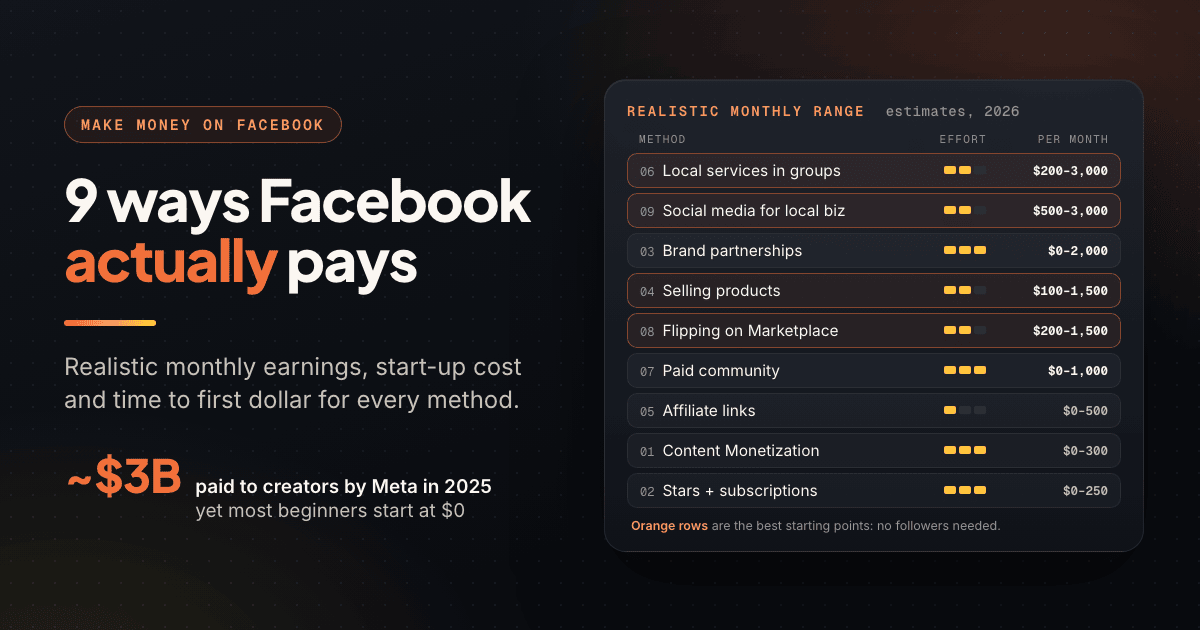
Every method falls into one of two families. In the first, Meta or a brand pays you for attention: views, live gifts, subscriptions or sponsored posts. In the second, Facebook is the distribution and a customer pays you for a product, a flip, a referral or a service. The first scales with an audience but pays almost nothing before you have one. The second can pay from week one.
The creator pot is real. Meta says it paid creators nearly $3 billion in 2025, up 35%, with 60% going to Reels. But it follows views, which concentrate in accounts that already post daily to large followings. Beginners earn their first dollars in the second family.
The 9 Methods Compared Side by Side #
Ranges are monthly and assume 5 to 10 hours a week in the first few months. Most ranges are our estimates, with the math in each method's section; brand deals and social media management use published rate surveys.
| Method | Best for | Start-up cost | Monthly range | First dollar | Effort |
|---|---|---|---|---|---|
| 1. Content Monetization | Video creators with reach | $0 | $0 to $300 | 3 to 12 months, by invite | High |
| 2. Stars and subscriptions | Live streamers | $0 | $0 to $250 | 2 to 6 months | High |
| 3. Brand partnerships | Niche creators | $0 | $0 to $2,000 | 3 to 12 months | High |
| 4. Selling products | Makers, small sellers | $50 to $500 | $100 to $1,500 | 1 to 7 days | Medium |
| 5. Affiliate marketing | Niche experts | $0 | $0 to $500 | 2 to 8 weeks | Low |
| 6. Local services and lead gen | Trades, tutors, cleaners | $0 to $100 | $200 to $3,000 | 1 to 3 weeks | Medium |
| 7. Paid group or community | Experts with a free audience | $0 | $0 to $1,000 | 3 to 6 months | High |
| 8. Reselling and flipping | Bargain hunters with a car | $50 to $300 | $200 to $1,500 | 1 to 7 days | Medium |
| 9. Social media for local businesses | Organised writers | $0 to $50 | $500 to $3,000 | 2 to 6 weeks | Medium |
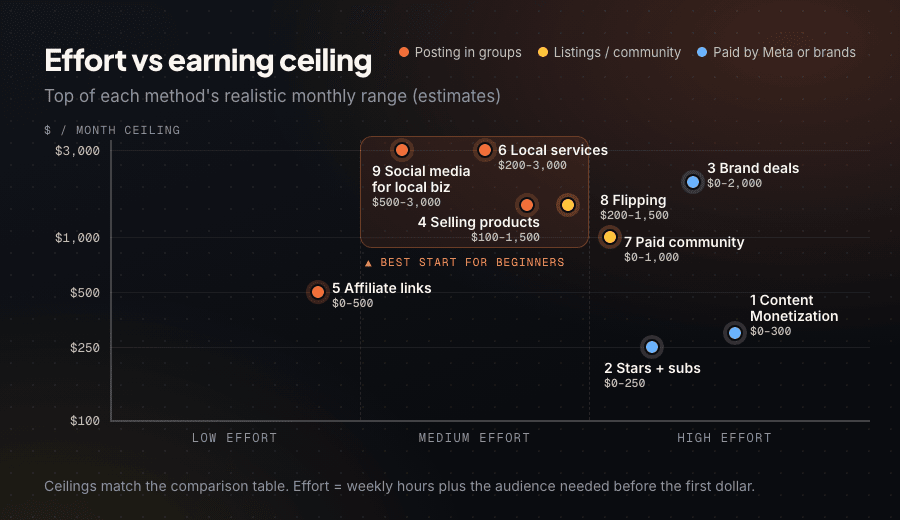
Two patterns stand out. The fastest first dollars (methods 4, 6 and 8) need no followers. And the methods Meta pays for directly (1 and 2) have the lowest beginner ceilings, because audience size and invitations gate them, not effort. Every method except flipping also depends on posting consistently, which is why it gets its own section below.
Methods 1 to 3: Getting Paid by Meta and Brands #
1. Facebook Content Monetization #
Content Monetization is Meta's single creator payout program. It merged in-stream ads, Ads on Reels and the Performance Bonus into one enrollment that pays on public Reels, videos, photos, text posts and Stories. Meta's program page says it is still invite-only: you express interest through the in-app form (Professional Dashboard, Monetization tab), and open enrollment is "planned." You need a Page or professional mode, and you and your payout account must be in an eligible country under the Partner Monetization Policies.
- Start with: a phone, a Page or professional mode, and several Reels a week.
- Earnings: Meta publishes no fixed rate. Your dashboard shows an Earnings Rate per 1,000 qualified views; repeat views and views under five seconds do not count. Estimate: 300,000 qualified views a month at $0.10 to $1.00 per 1,000 = $30 to $300.
- First dollar: 3 to 12 months, mostly waiting for an invite. High effort.
- Main risk: building for months and never being invited, or losing eligibility over unoriginal content.
Established creators get a faster lane: Meta's March 2026 Creator Fast Track guarantees $1,000 a month for three months to creators with 100,000+ followers on Instagram, TikTok or YouTube ($3,000 above a million), plus immediate program access.
Meta says genuine Content Monetization invites appear in the monetization sections of the Facebook app, Meta Business Suite or the Professional Dashboard. A Messenger message or email saying you were "selected for monetization" with a link to click is phishing.
2. Stars and Subscriptions #
Stars are virtual gifts fans send during Lives and on Reels or videos. Meta pays 1 cent per Star, and you need 500 followers for 30 consecutive days plus residence in a country where Stars is offered. Subscriptions are monthly memberships with perks such as exclusive Lives or a subscriber-only group, and need 10,000 followers or 250+ return viewers, plus 50,000 post engagements or 180,000 watch minutes in 60 days.
- Start with: 500 followers held for a month, then a regular live schedule.
- Earnings: Estimate: 15,000 Stars ($150) plus 30 subscribers at $4.99 after an assumed 30% platform and app-store cut (about $105) = roughly $250. Meta does not publish the split.
- First dollar: 2 to 6 months from zero followers. High effort.
- Main risk: income tied to live hours; stop streaming and it stops.
3. Brand Partnerships #
Meta's Creator Marketplace, long Instagram-only, is adding Facebook creators, and in September 2026 Meta launched a combined Creator Marketing Hub for advertisers. Older guides still point to Brand Collabs Manager, but most small deals still start with your own pitch.
- Start with: a focused audience, a one-page media kit and Meta's branded content tool to tag partners.
- Earnings: Published 2026 influencer pricing guides put Facebook nano creators at $25 to $200 per post and micro creators (10,000 to 50,000 followers) at $200 to $1,000. One or two deals a month gives $0 to $2,000.
- First dollar: 3 to 12 months of audience building. High effort.
- Main risk: undisclosed sponsorships, which break FTC rules and Meta policy.
Methods 4 to 6: Selling, Affiliate Links and Local Services in Groups #
These three need customers, not followers, which is why most people earn their first Facebook money here. Buy/sell groups, town boards and hobby groups hold those customers.
4. Selling Physical Products on Marketplace and in Buy/Sell Groups #
List what you make or stock on Marketplace and post it in relevant buy/sell groups. Local pickup has no selling fee. For shipped orders, Meta's seller policy charges individual sellers 10% per transaction with a $0.80 minimum, calculated on the total including shipping and tax. Marketplace is for physical goods only; the Commerce Policies exclude services and restrict many categories.
- Start with: $50 to $500 of stock, good photos and 10 to 20 relevant groups.
- Earnings: Estimate: 60 sales a month at a $25 average and 40% margin = $600 profit. The range runs from about $100 (slow start) to $1,500 (100 sales at a higher price).
- First dollar: often within a week. Medium effort.
- Main risk: payment scams and listings removed for breaking commerce rules.
Groups move volume beyond your local radius; see how to sell in Facebook groups for post formats, and the network marketer playbook if you sell for a direct sales brand.
5. Affiliate Marketing Through Groups and Your Profile #
You recommend products and earn a commission on sales through your link. Mass-market margins are thin: Amazon Associates pays 0% to 10% depending on category, many categories at 3% to 4.5%, while software and course programs often pay more. To make money on Facebook with affiliate marketing, answer questions in groups that allow promotion, post honest reviews and disclose every link.
- Start with: one or two affiliate programs and groups whose rules allow affiliate posts.
- Earnings: Estimate: 30 sales of $40 items at 4% = $48; five sales of a $100 product at 30% = $150. In the first months, $0 to $500 is the realistic band.
- First dollar: 2 to 8 weeks. Low effort to start.
- Main risk: removal from groups for link dropping.
The FTC's Endorsement Guides expect a clear disclosure close to the recommendation, such as "I earn a commission if you buy through this link." A note on your profile alone does not count. Also watch your account notices: since December 2025 Meta has been testing a two-link-posts-per-month cap for some Pages and professional-mode profiles without Meta Verified.
Which groups tolerate affiliate content, and how to write a review post that converts, is covered in our Facebook group affiliate marketing guide.
6. Selling Services and Lead Generation in Local Groups #
Local groups are full of "Can anyone recommend a cleaner?" posts. If you offer a service, weekly visibility there is the cheapest marketing available. The lead generation variant: build a local presence and refer enquiries to a business for a per-job fee agreed in writing.
- Start with: 10 to 30 local groups, a short offer and photos of real work.
- Earnings: Estimate: at a $150 average job, 3 jobs = $450 and 20 jobs = $3,000, so $200 to $3,000 once groups start referring you.
- First dollar: 1 to 3 weeks. Medium effort.
- Main risk: group rules that confine business posts to a weekly promo thread.
Turning that visibility into enquiries is covered in how to get leads and clients from Facebook groups.
Methods 7 to 9: Communities, Flipping and Managing Pages #
7. Running a Paid Group or Community #
Meta tested paid subgroups in 2021; today the documented route is Facebook Subscriptions, where one perk is a subscriber-only group, so you need the method 2 thresholds. Meta lists Subscriptions in the US, UK, Canada, Brazil, India and other countries, invite-only elsewhere. We found no current Meta page letting any admin charge for an ordinary group, so if you do not qualify, charge through your own checkout and deliver in a private group.
- Start with: a few hundred engaged followers and a clear premium promise.
- Earnings: Estimate: 50 members at $20 a month = $1,000 before fees; most first launches land well below that.
- First dollar: 3 to 6 months. High effort.
- Main risk: churn when your content cadence slips.
Tiers and launch tactics are in how to monetize a Facebook group.
8. Reselling and Flipping #
Buy underpriced items at yard sales and thrift stores, then resell on Marketplace. Furniture, tools, baby gear and electronics move fastest, and local pickup means no fee. Marketplace is built for person-to-person selling, so check local rules before scaling into a business.
- Start with: $50 to $300 of seed stock, a car and weekend time.
- Earnings: Estimate: 10 flips at $20 profit = $200; 30 flips at $50 profit = $1,500.
- First dollar: 1 to 7 days. Medium effort.
- Main risk: dead stock and no-show or scam buyers.
9. Managing Facebook for Local Businesses #
Many local businesses know they should post on Facebook and never do. Running their Page, replying to messages and sharing offers in local groups is a recurring service. One 2026 social media management pricing guide puts beginners at $20 to $35 an hour and says most small businesses pay $500 to $1,500 a month for basic management.
- Start with: a portfolio (your own Page counts), a simple monthly package and one first client.
- Earnings: one client at $500 a month, up to $3,000 with two or three.
- First dollar: 2 to 6 weeks. Medium effort.
- Main risk: scope creep and clients expecting results you cannot promise.
How to Make Money on Facebook by Posting (Without Spamming) #
Methods 4, 5, 6 and 9 run on one engine: consistent posting in groups where buyers already are. A product seen in 20 groups every week sells; the same post shared once does not. People who try to make money on Facebook by posting usually fail one of two ways: too rarely to be remembered, or so aggressively that admins remove them.
- Read every group's rules. Many allow promotion only on set days. Our guide to finding groups to join explains how to vet them.
- Lead with value. Add three or four helpful posts (answers, tips, before/after photos) for every promotional one.
- Vary every post. Identical text in 20 groups looks like spam. Change the opening and call to action per group; spintax templates help.
- Pace yourself. Space posts minutes apart and keep daily volume modest. The safe delay calculator suggests gaps, and how to avoid Facebook jail covers what triggers restrictions.
None of this needs an ad budget; the wider organic playbook is in Facebook marketing without ads.
The hard part is doing this every week across 20 or 30 groups. PilotPoster is a web dashboard plus Chrome extension that schedules posts into every group you have joined (not only ones you admin) from your own logged-in browser, with human-like delays between groups. It can write a different version of each post per group, and Safety Autopilot enforces posting limits and pauses automatically. API-based schedulers cannot post into groups, because Meta removed group publishing from its API in April 2024; PilotPoster posts where API tools can't.
A 30-Day Starter Plan for Beginners #
If you are working out how to make money on Facebook as a beginner, pick one posting-powered method (4, 6, 8 or 9) and run this plan. Add a Meta-paid method only if you already enjoy making video.
- Days 1 to 3: Package an offer. Write one sentence: what you sell, to whom, at what price. Take 10 good photos.
- Days 4 to 7: Join and read. Join 15 to 25 relevant groups, log each one's promo rules in a spreadsheet, and comment helpfully in five.
- Week 2: First posts. Post a value-first introduction where allowed, list 10 items on Marketplace if you sell goods, and reply to every message within hours.
- Week 3: Repeat with variation. Post two or three reworded versions in each active group and track which groups send messages or sales.
- Week 4: Double down. Drop groups that produced nothing, post more in the top five, ask happy customers for reviews, and calculate dollars per hour worked.
Success on day 30 is a few sales and a clear list of groups that work, not a replaced salary. Stick with one method for 90 days and repeat visibility starts doing the work.
Scams and Red Flags to Avoid #
This niche attracts scammers because the audience is hopeful and often new. The FTC reports job scam losses topped $220 million in the first half of 2024, with about 20,000 task-scam reports in six months versus about 5,000 in all of 2023.
- "Get paid to like posts." Task scams pay small amounts first, then ask for a deposit to unlock bigger earnings that never arrive.
- Account rental offers. Banned advertisers pay people to rent their accounts to run ads; you take the ban and the liability.
- Fake monetization or policy messages. "Your Page will be deleted" or "you qualify for monetization" with a login link. Meta uses its own dashboards for both.
- Bought followers. They produce no qualified views and put your eligibility at risk.
- Marketplace payment tricks. Overpayments with refund requests, or requests for a verification code. Take cash or in-app payment only.
Frequently Asked Questions #
How many followers do you need to make money on Facebook? #
Stars need 500 followers held for 30 days, and Subscriptions need 10,000 followers or 250+ return viewers plus engagement minimums. Content Monetization has no published threshold because it is invite-only. Selling, flipping, affiliate posts and local services need no followers at all.
How much does Facebook pay for 1,000 views? #
Meta does not publish a fixed rate. Creators in Content Monetization see an Earnings Rate per 1,000 qualified views in their dashboard; third-party guides report anything from a few cents to several dollars, depending on audience country, format and niche.
Can beginners make money on Facebook? #
Yes, if they start with a method that sells products or services rather than views. Selling items, flipping or offering a local service in community groups can bring a first sale within days, while Meta's creator programs usually take months.
Does Facebook pay you for posting in groups? #
No. Meta's payouts cover eligible public content from Pages and professional-mode profiles, not posts in groups you have joined. Group posts earn indirectly, by putting your offers in front of buyers.
Can you post affiliate links on Facebook? #
Yes, if you disclose the relationship clearly next to the link and follow each group's rules, since many groups ban or limit promotional links. Some Pages and professional-mode profiles are also in a Meta test that caps link posts at two a month.
How long does it take to make money on Facebook? #
Selling and flipping can pay within a week, local services and affiliate links typically take two to eight weeks, and Meta's creator programs usually take three to twelve months. The gap comes from needing an audience first.
- Content Monetization is invite-only in 2026 with no published per-view rate; expect $0 there until you have real reach.
- Stars need 500 followers for 30 days and pay 1 cent each; Subscriptions need 10,000 followers or 250+ return viewers.
- Selling, flipping and local services pay fastest, often within days, and need no followers.
- Marketplace local pickup is fee-free; shipped sales cost individual sellers 10% with a $0.80 minimum.
- Disclose affiliate links next to the link, and follow each group's promo rules.
- Consistent, varied, well-paced group posting powers methods 4, 5, 6 and 9.
- Anyone paying you to like posts, rent your account or "unlock" earnings with a deposit is a scammer.


