
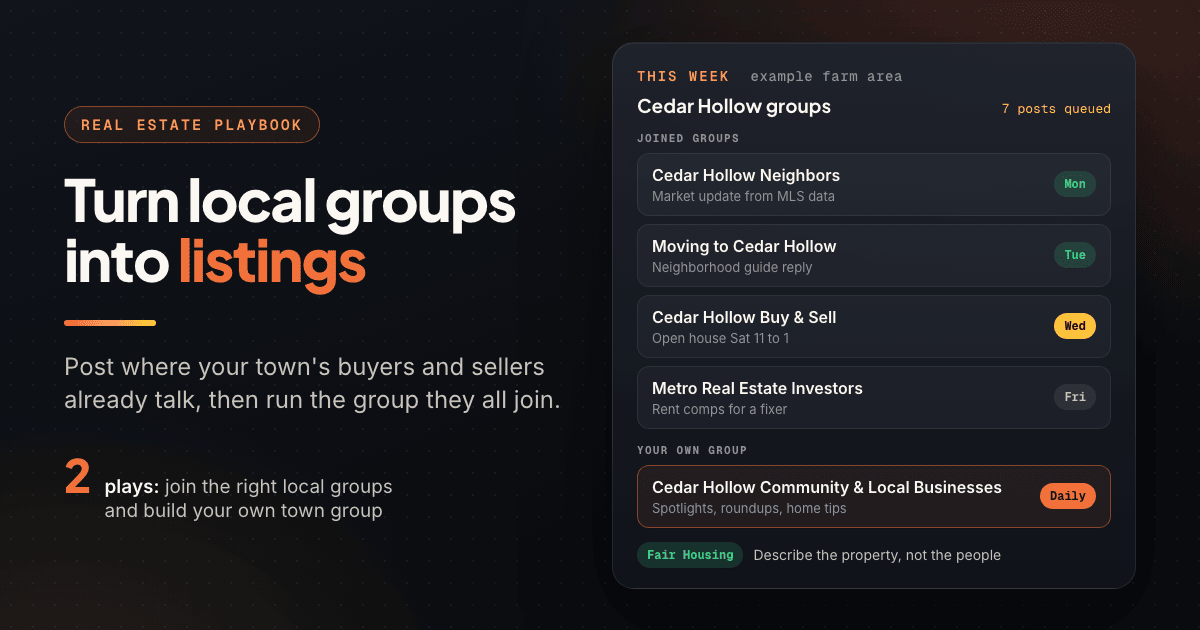
The Facebook groups for real estate agents that bring in business are local, not national realtor forums: town and neighborhood community groups, "Moving to [City]" relocation groups, local buy/sell groups, and parent groups, plus investor and agent referral groups. Post what a well-informed neighbor would share: local market numbers, neighborhood guides, vendor recommendations, and listings where rules allow. Then run your own hyper-local community group, and keep every post Fair Housing compliant with your state's brokerage disclosures.
Most agents try Facebook groups for real estate agents the obvious way: join national realtor groups, post a listing, hear nothing. The buyers and sellers are not there. They are in the town community group asking who painted a neighbor's kitchen, in "Moving to Raleigh" asking which areas to look at, and in the local moms group swapping pediatrician names. Real estate is local and runs on trust, and those groups hand out both.
This playbook covers two plays: which real estate Facebook groups to join and what to post in each, and how to run your own hyper-local group, which starts slower but compounds every month. You also get a weekly posting plan and the Fair Housing and disclosure habits that keep every post clean.
Why Facebook Group Marketing Works for Realtors #
Almost 1.8 billion people use Facebook Groups every month (Meta, October 2024). For an agent, the slice that matters is the few thousand people in your farm area, and they already ask local groups for recommendations. When three neighbors tag the same name under "Can anyone recommend a realtor?", that agent has a warm lead before saying a word.
The best-known example is Loudoun County, Virginia agent Laura Griffin, profiled by HousingWire in March 2025. She started a Facebook group for moms after relocating, conversations drifted from pediatricians to real estate, and she began treating the group as a funnel. HousingWire reports her 2023 production as $22 million in volume across 20 sides, with Facebook groups and referrals as her primary lead sources.
Florida Realtors gave similar advice in April 2025: build a group around a shared local interest and keep the conversation going beyond real estate. Groups let people watch you be useful for months before they need you, which a Page post reaching about 1.25% of followers (Socialinsider, August 2026) cannot do.
The Best Facebook Groups for Real Estate Agents to Join #
Search Facebook for your city, suburb, and county names combined with the phrases below. Join as your personal profile, read the rules and pinned posts, and watch for a week before posting. Sort them into lists by area, so a Cedar Hollow listing goes only to Cedar Hollow groups.
| Group type (search for) | Who is there | Best posts | Watch for |
|---|---|---|---|
| Community: "[Town] community", "[Neighborhood] neighbors" | Homeowners, future sellers | Market updates, vendor recommendations | Business posts often limited to a promo day |
| Relocation: "Moving to [City]", "New to [City]" | Out-of-town buyers on a deadline | Neighborhood guides, commute answers | Answer first; skip the listing as a first post |
| Buy/sell: "[City] buy sell trade" | Local sellers, renters, deal hunters | Open houses, rentals, listings | Confirm real estate posts are allowed |
| Parents: "[Town] moms", "[Town] parents" | Growing families, trade-up buyers | Recommendations, helpful answers | Usually strict; listings often banned |
| Investors: "[City] real estate investors" | Cash buyers, landlords, flippers | Fixer listings, rent comps, deal math | Expect hard questions on numbers |
| Agent referral: "[State] realtor referrals" | Agents in other markets | Referral asks and offers | Partners live here, not clients |
Community and relocation groups produce the most conversations; investor and referral groups, fewer but more deals. To vet groups, see how to find Facebook groups to join for marketing.
Many community groups allow business posts only on one day ("Small Business Saturday") or in a weekly pinned thread. Note each group's day next to its name. A listing posted on the right day earns comments; the same post on a Tuesday gets removed.
What to Post in Real Estate Facebook Groups #
Post what a well-informed neighbor would share, and let the comments and DMs carry the sales conversation. Five post types do most of the work.
Market updates with real local data #
"Now is a great time to buy" gets scrolled past. Three numbers about one town get saved. Pull last month's median sale price, median days on market, and how many homes sold over list from your MLS, and name the source. Example, with invented numbers:
"Cedar Hollow, September (from our MLS): 31 homes sold, median price $412,000, median 9 days on market, 14 of 31 sold over list. Homes priced right are still going fast; the ones sitting started too high. Happy to pull numbers for your street."
Listings and open houses, where the rules allow #
In buy/sell groups and promo-day threads, a listing is welcome when it reads like news: what, where, when, photos up top. Lead with the open house time, describe the house itself, put the link in the first comment, and add your name and brokerage.
"Open house Saturday 11 to 1: 3-bed, 2-bath ranch on Willow Lane, new roof (2024), fenced yard, 5-minute walk to the library. Listed by Dana Reyes, Example Realty. Details in the first comment."
Just-sold stories #
A SOLD graphic is an ad. A just-sold story is useful: what the seller fixed before listing, how pricing played out, what buyers asked at showings. Future sellers read these closely. Get your client's OK first.
Neighborhood guides #
Relocation groups ask about commutes, parks, and HOA fees every week. Write one strong post per neighborhood and reuse it as a reply. Describe places and amenities, never who lives there.
Vendor recommendations #
A monthly "inspectors, roofers, and movers I would hire again" post gets saved, and gives local tradespeople, who often hear about a move first, a reason to send people your way.
Answer questions too; the full approach is in how to get leads and clients from Facebook groups.
Facebook Group Marketing for Realtors, Done Right #
A group post about a listing or your services is advertising, so yard-sign rules apply. Build these habits once and post confidently anywhere.
Fair Housing: describe the property, not the people #
The Fair Housing Act bars any advertisement for selling or renting a dwelling that indicates a preference, limitation, or discrimination based on race, color, religion, sex, handicap, familial status, or national origin. HUD's rule, 24 CFR 100.75, covers words, photos, and symbols, and also selecting media or locations in a way that keeps listings from certain groups. Its steering rule, 24 CFR 100.70, covers discouraging buyers or suggesting they would not be "comfortable" with existing residents.
HUD's 1995 advertising guidance, as summarized by NAR, gives the practical test: wording that describes only the property, like "master bedroom" or "cozy family room," is fine. Wording about who should live there is not.
| Wording to avoid | Property-focused wording |
|---|---|
| "Perfect for young families" | "4 bedrooms, fenced yard, 0.4 miles to Oak Park" |
| "Ideal for empty nesters" | "Single-level living, primary suite on the main floor" |
| "Adults only" or "no kids" | Not allowed outside qualified senior housing |
| "Great area for [any group of people]" | Commute times, parks, a link to the school district map |
| Limits on wheelchairs or service animals | "Wheelchair ramp available," when true |
Two group habits matter most. Answer "Which neighborhoods are safe?" with objective sources (public crime maps, district boundaries, commute times) and let the buyer decide. And because where you advertise counts, share listings in broad community and buy/sell groups, not only in a group that skews toward one kind of household.
Brokerage and license disclosures #
Article 12 of the NAR Code of Ethics requires Realtors to present a true picture in their advertising and make their status as real estate professionals readily apparent. Standard of Practice 12-5 adds that ads must disclose the firm's name, in the ad or, for electronic ads, through a link to the required disclosures.
State rules vary and sit on top. Texas requires the license holder's and broker's names in ads but lets social media posts place them on a profile page reachable by a direct link (22 TAC 535.155). Florida requires the licensed brokerage name in all real estate ads (Rule 61J2-10.025). Check your state commission and your broker's policy, then build the disclosure into your profile and post templates.
If you turn a listing into a Facebook ad, Meta requires the Housing special ad category, which restricts targeting. Organic group posts skip that step, but Fair Housing and disclosure rules apply to both.
Play Two: Run Your Own Hyper-Local Community Group #
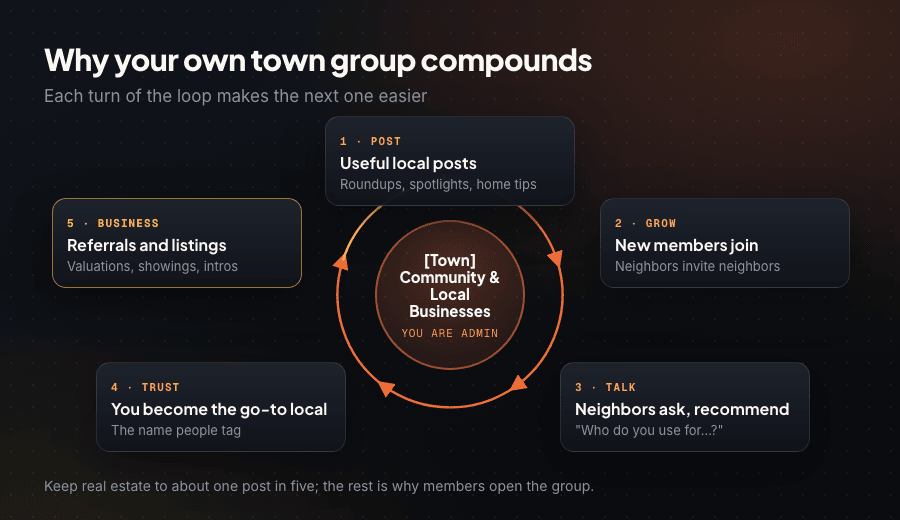
Joining groups puts you in other people's rooms; running your own builds the room. It often takes months to produce a deal, but every member adds to the next month, and the group works while you are at a closing.
Name it for the town, not for real estate #
Call it "[Town] Community & Local Businesses" or "[Neighborhood] Neighbors," not "Homes for Sale with Dana." Griffin's advice in HousingWire matches: a hyper-local topic that is not too niche, with the market name in the title. People join for the town and remember who runs it. Stuck? Try the free group name generator.
Set it up for a community #
- Privacy: public group posts and members are visible to anyone; private ones only to members, and you choose whether a private group is visible in search or hidden (Meta). Private and visible suits most community groups.
- Owner: Meta lets you create a group with your Page as admin, so it belongs to your business brand.
- Membership questions: admins can ask up to 3 questions. Ask whether they live nearby and agree to the rules. Griffin collected members' emails, per HousingWire; if you ask, keep it optional and say what they will get.
- Rules: no spam, business posts on one promo day, keep it kind. HousingWire notes that a clear "no spam" stance is one way to set your group apart.
- A co-admin who is not an agent: a long-time resident or local business owner you trust makes it read as a community group.
The full walkthrough is in how to create a Facebook group.
What to post in your own group #
Keep real estate to about one post in five. The rest is why people open the group:
- Weekend roundups of local events, markets, and games.
- Local business spotlights, one a week. Owners share them and become referral partners; how they work neighborhood groups is in Facebook groups for local business marketing.
- "Who do you recommend for...?" threads, the posts members come back to.
- Seasonal home tips. HousingWire says Griffin's video on a chirping smoke detector was a member favorite.
- A monthly market update from the admin everyone already knows.
HousingWire reports Griffin's group is most active at night, so she prospects by day and works the group in the evening.
A Weekly Posting Plan for Real Estate Agents #
About two hours a week covers both plays. Each joined group sees you once or twice a week; your own group gets something daily.
| Day | Joined groups | Your own group | Time |
|---|---|---|---|
| Monday | Market update for one town in its community groups | "This week in [Town]" thread | 30 min |
| Tuesday | Answer 3 to 5 relocation questions with your guides | Local business spotlight | 20 min |
| Wednesday | Listing or open house in buy/sell groups (rules permitting) | Seasonal home tip | 20 min |
| Thursday | Vendor recommendation post in one community group | "Who do you recommend?" question | 15 min |
| Friday | Investor or referral group post | Weekend events roundup | 20 min |
| Saturday | Promo-day posts and open house reminders | Member photo of the week | 15 min |
| Sunday | Just-sold story in one or two community groups | Reply to comments | 15 min |
Rotate towns weekly and rewrite each post per group; an identical paragraph four times in one scroll reads like an ad.
PilotPoster is a web app plus Chrome extension that schedules posts to the Facebook groups you have joined (not only ones you admin), from your own logged-in browser, with no Facebook password and no API. Sort groups into lists by town, set the Monday market update as a recurring campaign, give each group its own version, and let an automatic first comment carry the listing link. See how agents use it.
Turning Real Estate Leads From Facebook Groups Into Clients #
Group attention becomes business in comments and DMs. Reply to every comment the same day, since a question under a market update is often a future seller raising a hand, and move home-value or showing requests to a DM or call. Give each group its own tracked link to your valuation page, log the source group in your CRM, and after a quarter drop the groups that never start a conversation.
Frequently Asked Questions #
What are the best Facebook groups for real estate agents? #
Local groups in your farm area (community, relocation, buy/sell, and parent groups), plus investor and agent referral groups. National realtor groups are for learning; your clients are not in them.
Can real estate agents post listings in Facebook groups? #
Yes, where the group's rules allow it. Buy/sell groups and promo-day threads usually welcome listings; many community and parent groups do not. Read the rules first, describe the property rather than the ideal buyer, and include your brokerage name.
Do I need my brokerage name on Facebook group posts? #
Usually, yes. NAR's Code of Ethics requires firm disclosure in advertising, and states add their own rules: Texas allows social media disclosures on a linked profile page, while Florida requires the licensed brokerage name in all real estate ads. Check your state commission and your broker.
Should a real estate agent start their own Facebook group? #
Yes, if you can post daily for at least six months. Name it for the town, keep agent content to a small share of posts, and run it like a community. HousingWire's profile of Laura Griffin shows a local moms group becoming a primary lead source.
How do real estate agents get leads from Facebook groups? #
By being consistently useful (market numbers, neighborhood answers, vendor tips) until people know your name, then turning comments into DMs and calls. Track which groups start conversations.
- Real estate Facebook groups that produce clients are local: community, relocation, buy/sell, parent, investor, and referral groups.
- Post like a well-informed neighbor: MLS-backed market updates, neighborhood guides, vendor lists, and just-sold stories.
- Post listings only where rules allow, ideally on each group's promo day, with the link in the first comment.
- Fair Housing applies to group posts: describe the property, not the people, and answer "safe area" questions with objective sources.
- Disclose your brokerage in ad-style posts; NAR Article 12 requires it and state rules add more.
- Run your own town group named for the community, with about one real estate post in five.
Related Reading #
- How to Use Facebook Groups for Local Business Marketing
- How to Get Leads and Clients from Facebook Groups
- How to Find Facebook Groups for Marketing (And Evaluate Them)
- How to Create a Facebook Group in 2026: Setup Guide + First 30 Days
- The Facebook Group Lead Engine: How Small Businesses Turn Groups into Leads and Sales


