
Community-led growth means your customers and community members drive new business and keep existing customers coming back, through recommendations, answers, and stories, instead of a sales team or the product alone doing the work. For a small business, the most practical home for it is Facebook groups: show up with real help in the groups your customers already use, run one group of your own for customers and fans, and turn the recognition, DMs, and referrals that follow into customers whose stories feed the community. Track mentions, referrals, and customers by group, not likes.
Ask a small business owner where their best customers came from and the answer is rarely an ad. It is "a neighbor recommended us in the town group." That is community led growth, and most small businesses already get some of it by accident.
This guide turns the accident into a system: a plain definition, why Facebook groups are the natural place to run it, and a model with two plays (the groups your customers already use, and a group you own), plus a 90-day plan and the metrics worth tracking.
What Is Community-Led Growth? #
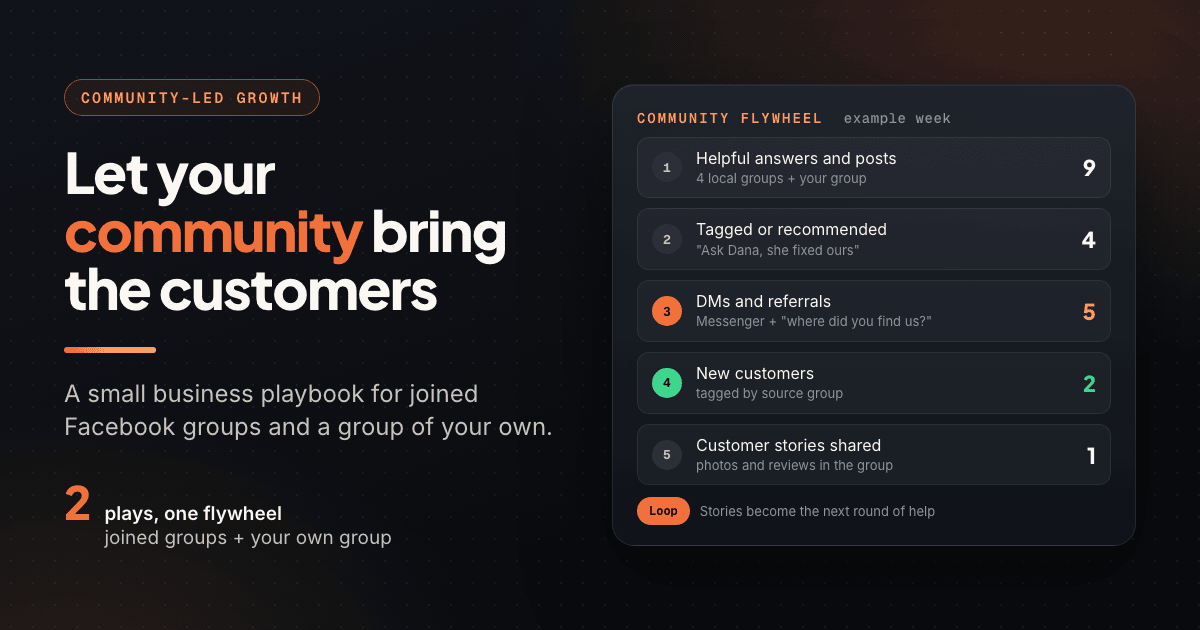
Community-led growth is a growth model where the people around your business (customers, fans, and members of the groups you are part of) do much of the acquiring and retaining. They answer questions about you, recommend you, and stick around because the community is worth being in. Your job is to give that community a reason to exist and a reason to mention you.
The term comes from software companies, which is why most articles on it talk about Slack workspaces and developer forums. The idea is older than SaaS: word of mouth with a place to happen and someone tending it.
| Model | What drives growth | First touch | Small business version |
|---|---|---|---|
| Sales-led | Outreach and closing | A call, quote, or pitch | Door knocking, cold calls, trade shows |
| Product-led | The product sells itself | A free sample or trial use | Free consultations, tastings, first-visit offers |
| Community-led | Members recommend, answer, and stay | A helpful post or a friend's tag | Being the trusted name in local and niche Facebook groups |
These are not either/or. Community-led growth is the layer that makes the other two cheaper, because a lead who arrives through a recommendation already trusts you.
Why Facebook Groups Are Where Small Business Community Lives #
SaaS companies build communities from scratch because their users are scattered. Small business customers are not. They are already in Facebook groups: almost 1.8 billion people use Facebook Groups every month, across 25 million monthly active public groups (Meta, October 2024). Meta has also said most people on Facebook are members of at least 15 active groups (Meta, October 2022).
Those groups are organized the way your market is: by town, by neighborhood, by hobby, by life stage. A town group, a local moms group, a classic car club, and a homeowners group are each a ready-made community where people ask for recommendations every day. Compare that with a business Page, where the average post reaches about 1.25% of followers (Socialinsider, August 2026). A Page is a broadcast channel. A group is a conversation, and community-led growth runs on conversation.
That gives a small business two places to build: groups other people run, and a group you run. The rest of this guide treats them as one model with two plays.
The Community-Led Growth Flywheel for Small Businesses #
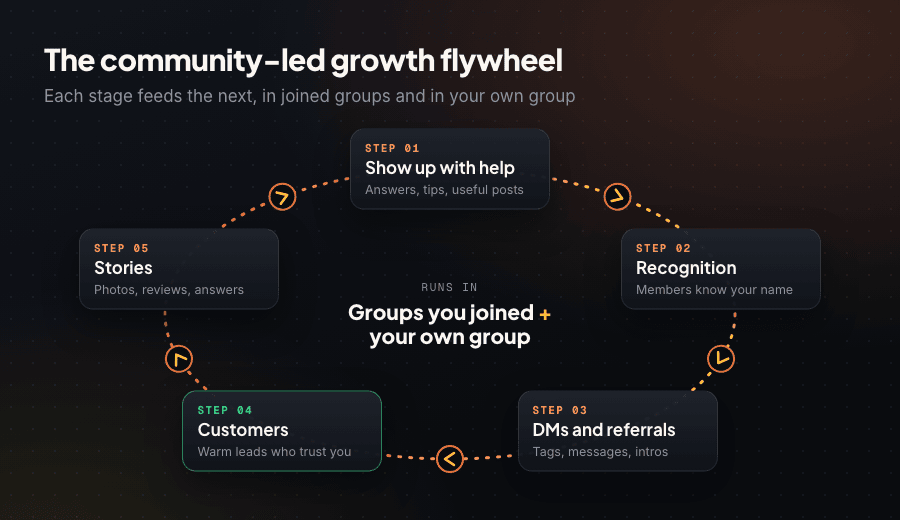
Each stage feeds the next, and the wheel gets easier to turn the longer you keep at it. It works in both plays.
- Show up with help. Answer questions, share know-how, and post things members would want even if they never hire you. A landscaper explaining when to aerate a lawn in your region is more useful than one posting "call us for a quote."
- Recognition. After a few weeks of useful posts, members start recognizing your name. Someone asks "who does gutter cleaning?" and another member tags you before you see the post.
- DMs and referrals. Recognition turns into private messages ("saw your post about drafty windows, can you look at mine?") and public tags. Reply quickly.
- Customers. A recommended lead needs less convincing; the group already did part of the selling.
- Stories feed the community. Happy customers post photos, leave comments, and answer the next person's question for you. Those stories become the next round of help, and the wheel spins again.
Play 1: Show Up in the Groups Your Customers Already Use #
This is the faster play, because the audience already exists. Start by listing 10 to 20 groups where your customers ask questions: local community groups, neighborhood groups, buy and sell groups, and niche interest groups that match what you sell. If you need help finding and vetting them, see how to find Facebook groups worth joining.
What participation looks like in practice #
- Read the rules and the pinned posts first. Many local groups allow promotion only on one day a week or inside a weekly thread. Put those days in your calendar.
- Answer before you announce. For your first few weeks, comment on questions in your area of expertise more than you post about yourself.
- Post under your own name, as a person. People recommend a person faster than a logo. Mention your business in your intro and profile, then let your answers carry it.
- Give each group a post that fits it. The moms group and the homeowners group care about different things, even when you are offering the same service.
- Show up weekly. Consistency turns "who is this?" into "oh, that's the cake lady."
Two small businesses profiled by Modern Retail (August 2020) show the pattern. Jessica Moreno of 3 Girls Confections in Sunnyside, Queens posted weekly under her own name in groups like Sunnyside Together and I Love Queens, NY, with seasonal deals and photos of her cakes, and credited Facebook with helping her keep a regular customer base through the pandemic. Lavish Grazing, a charcuterie business in Springfield, Missouri, wrote long, personal posts in the Welcome to Springfield, MO group that often drew hundreds of likes. Neither built a community; both became trusted names inside one that already existed.
Example helpful post (homeowners group): "Quick tip before the first freeze: disconnect your garden hoses and open the outdoor faucet to drain it. A hose left attached is the most common cause of the split pipes we fix every January. Happy to answer questions in the comments. (Dana, Eastside Plumbing)"
Use the search bar inside each group to look up your service ("roofer", "birthday cake", "dog groomer"). Old threads show the exact questions people ask and which competitors get tagged: your content plan for the next month.
Play 2: Run Your Own Group as the Owned Community #
The second play is slower and more durable. Your own group is a room where customers, prospects, and fans gather around a topic you know well, and where you set the rules. It is the strongest version of a facebook group for business, provided it is about the members' interest rather than your catalog. A pool cleaning company does better with "Lakeview Pool Owners" than "Lakeview Pool Co. Customers." For the setup, follow how to create a Facebook group.
How small owners make their own group work #
Kevin Gammie set up Brisbane Small Business, a Facebook group that had almost 9,000 members when SmartCompany profiled it in April 2020. The group had a strict no-advertising policy, and he had built a paid business directory on top of it to fund the hours he spends moderating. The community stays valuable because it is not a billboard, and the business sits alongside it.
On the brand side, clean makeup company Saie built a private group called The Clean Beauty Crew. Founder Laney Crowell told Cult Beauty (September 2020) that it had over 700 members and that they help develop the brand's product pipeline and formulas. A small group that talks does more community work than a large audience that only watches.
Facebook gives admins tools that fit the flywheel. Admins can designate standout members as group experts, who get a badge next to their name (Meta, July 2021), which is a direct way to reward the customers who answer questions for you. Membership questions let you learn who is joining and why, which doubles as market research.
- Seed it before you invite: five to ten useful posts, so early visitors find a reason to stay.
- Invite your warmest people first: recent customers, email subscribers, and people who already comment on your posts.
- Run weekly rituals such as a Monday question or a Friday photo thread, so members have a reason to come back.
- Feature members, not just products. Share customer before-and-after photos (with permission) and thank people who answered someone else's question.
Once it is running, growing your Facebook group's membership covers the next stage.
The fastest way to stall the flywheel is posting offers every day. Keep promotion to roughly one post in five, and make the rest questions, tips, member features, and behind-the-scenes. Members stay for each other; they buy because they trust you.
A 90-Day Community Led Growth Strategy #
You do not need both plays at full speed on day one. A realistic community led growth strategy starts with joined groups, which produce results sooner, and opens your own group once people already know your name.
| Weeks | Joined groups (Play 1) | Your group (Play 2) | Goal |
|---|---|---|---|
| 1 to 2 | Join 10 to 20 groups, read rules, note promo days, search past threads | Pick a name and topic built around members' interest | Know where your customers talk |
| 3 to 6 | Answer questions weekly; one helpful post per group per week | Create the group, seed it with useful posts | Recognition: people start tagging you |
| 7 to 10 | Keep the rhythm; share offers only on promo days | Invite recent customers and engaged commenters; start one weekly ritual | First DMs and referrals |
| 11 to 13 | Drop groups that send nothing, add new ones, invite engaged people to your group where rules allow | Feature customer stories; name your first experts | Customers whose stories feed the community |
The exact weeks matter less than the order: help first, recognition second, your own room third. A group with no reputation behind it can sit empty for months.
Community-Led Growth Metrics to Track #
Likes predict little. Track the flywheel stages instead, in a simple weekly spreadsheet.
| Flywheel stage | Metric | How to measure it |
|---|---|---|
| Show up with help | Helpful posts and answers per week, by group | Your own posting log |
| Recognition | Times you were tagged or recommended by someone else | Facebook notifications; note each one by group |
| DMs and referrals | New conversations started from a group | Messenger, plus "where did you find us?" on every inquiry |
| Customers | New customers and revenue by source group | Your booking or sales records, tagged by group |
| Stories | Customer posts, reviews, and member answers | Your group, plus review sites |
| Owned community health | Active members, posts and comments by members, retention | Group Insights (admins) |
For your own group, Facebook's Group Insights shows growth, engagement, and membership data such as when members are most active (Meta, June 2017). The menu location varies by app version, so look for Insights in your admin tools. For links you share, use a tracked link per group so clicks are tied to the group that sent them. The full setup is in how to measure Facebook group marketing ROI.
In the first two months, count unprompted mentions: times someone else tags or recommends you. It is the earliest sign the flywheel is turning, and it shows up weeks before revenue does.
Keeping Both Plays Running Every Week #
The hard part is not strategy. It is showing up in 15 groups every week with a fresh post for each, while running a business. Keep the conversations personal; the scheduled, repeating posts are where you save hours.
PilotPoster is a web app plus Chrome extension that schedules your posts to the Facebook groups you have joined, not only ones you admin, from your own logged-in browser, with no Facebook API and no stored password. You can sort groups into lists by town or topic, give each group its own AI-rewritten version of a post, and use tracked links to see which groups send clicks and customers. That frees your time for the replies and DMs that actually turn the flywheel.
For more businesses that have done this well, from Instant Pot to one-person shops, see our roundup of Facebook group marketing examples. Each one is a community led growth example even when the company never uses the phrase.
Frequently Asked Questions #
What is community-led growth? #
It is a model where customers and community members drive acquisition and retention by recommending you, answering questions about you, and staying engaged. For a small business, that usually means being a trusted name in the Facebook groups your customers use.
What is the difference between community-led and product-led growth? #
Product-led growth relies on the product to win customers, often through samples, demos, or hands-on first use. Community-led growth relies on the people around it: their recommendations, answers, and stories. Most businesses use both.
What are some community led growth examples for small businesses? #
A baker who posts weekly in neighborhood groups and becomes the go-to name for birthday cakes is one. An owner who runs a no-ads local business group and earns from a directory alongside it is another.
Should a small business create a Facebook group or join existing ones? #
Start by joining existing groups, because the audience is already there and results come sooner. Open your own group once people recognize your name. Most businesses get the best results running both.
How do you measure community-led growth? #
Track each stage of the flywheel: helpful posts, unprompted mentions, DMs and referrals, customers by source group, and customer stories. Ask every new customer where they found you.
- Community-led growth means customers and members drive acquisition and retention through recommendations, answers, and stories.
- For small businesses, Facebook groups are the natural home for it: almost 1.8 billion people use them monthly (Meta, October 2024).
- The flywheel: show up with help, earn recognition, get DMs and referrals, win customers, and let their stories feed the community.
- Play 1 is joined groups: answer before you announce, post under your own name, follow promo days, and show up weekly.
- Play 2 is your own group: build it around members' interest, seed it, invite warm people first, and keep promotion to about one post in five.
- Measure mentions, referrals, and customers by group, not likes. Unprompted mentions are the earliest signal.
Related Reading #
- Facebook Group Marketing Examples: How Real Businesses Grew Through Groups
- 6 Powerful Reasons to Create Your Own Facebook Group in 2026
- The Facebook Group Lead Engine for Small Businesses
- How to Grow a Facebook Group from 0 to 10,000 Members
- How to Create a Facebook Group in 2026: Setup Guide + First 30 Days


