
The best documented Facebook group marketing examples come from Instant Pot, Peloton, Starbucks, Grove Collaborative, Oats Overnight and Portland Leather Goods, plus small operators like OctoNation, the Rootitoot recipe group and RoamRig. None used the group as an ad channel. Instant Pot let roughly 3 million members answer each other's questions, Oats Overnight let about 82,000 members shape most of its flavors, and Portland Leather Goods turned a 210,000-plus member group into turnout for new stores. RoamRig shows the other model: one owner answering questions in a group he joined, which brought in $10,000-plus jobs without sales posts. The shared pattern is help first, member-created content, gated entry, recurring threads and consistency.
Most advice about Facebook groups is theory. This post covers nine businesses whose group strategies were reported by the press, a marketing publication or the company itself, with a source linked for every number. Where member counts changed over time, you get the range and the date.
For each of these Facebook group examples for business you get what they did, why it worked, and a version you can copy with no budget. Then come the shared patterns, the honest limits, and a plan you can start this week.
Two Models: Own a Group or Market in Groups You Joined #
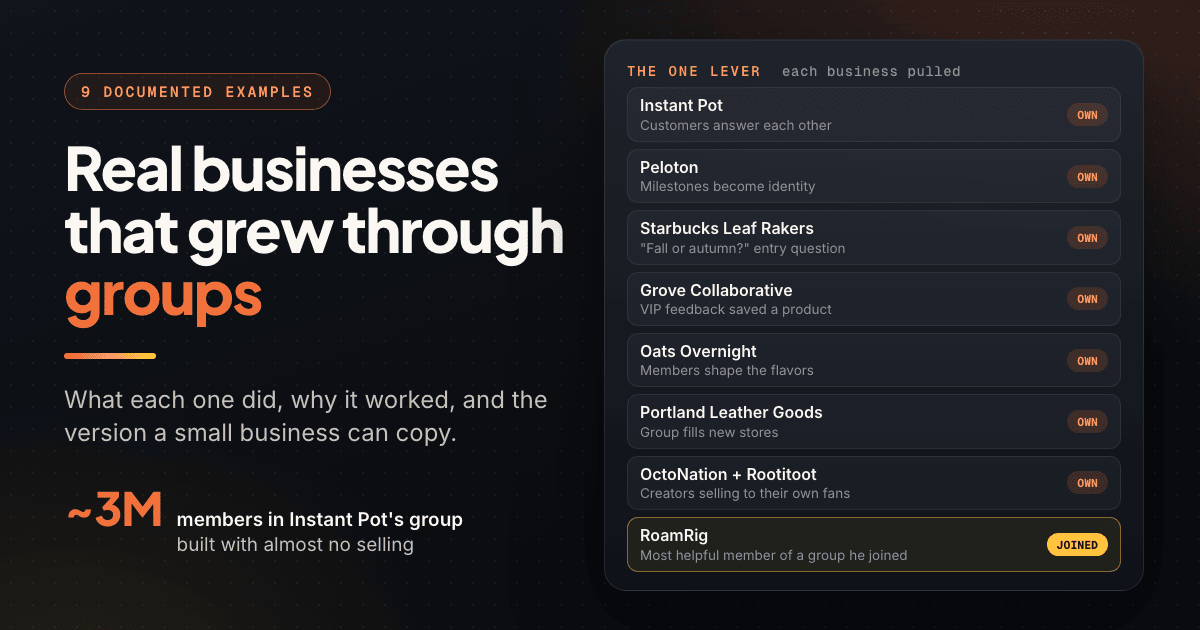
Every example below fits one of two models, and mixing them up is the most common reason small businesses decide groups do not work. Owning a group means you run the room: you set the rules, approve members, and build an asset that compounds over years. Marketing in groups you joined means you are a guest in someone else's room, where your job is to be the most useful person there.
The owned model is slower but builds an audience you control (the case for it is in why you should create your own Facebook group). The joined model works in weeks because the audience already exists. The strongest small businesses run both.
| Example | Model | The one lever they pulled | Size (date, source) |
|---|---|---|---|
| Instant Pot Community | Owned | Customers support each other | Roughly 3M (2024, HubSpot / Modern Retail) |
| Official Peloton Member Page | Owned | Shared identity and milestones | Roughly 430K to 500K (2024) |
| Starbucks Leaf Rakers Society | Owned | Gated, invite-feel entry | 26K+ (Oct 2018, Marketing Dive) |
| Grove Collaborative, The Pantry | Owned | Small VIP product feedback loop | Not disclosed (2024) |
| Oats Overnight VIP group | Owned | Members shape the product line | About 82K (2024, Modern Retail) |
| Portland Leather Goods | Owned | Group drives store turnout | 210K+ (Mar 2026, Axios) |
| OctoNation | Owned | Shop inside a trusted group | Not stated (Nov 2021, Meta) |
| Rootitoot Instant Pot Recipes | Owned (creator) | Founder answers everything | About 92K (Feb 2020, The Ringer) |
| RoamRig | Joined | Most helpful member in a niche group | About 15K (Jan 2023) |
Member counts here are snapshots from each source's date, not live figures. Groups grow, shrink and get pruned. Treat them as a sense of scale, not a benchmark to hit.
Brands Using Facebook Groups Without Selling in Them #
These four are the best-documented brands using Facebook groups, and each shows a different mechanism.
Instant Pot: customers became the support desk #
What they did: Instant Pot launched the Instant Pot Community group in August 2015. By March 2017 it had over 400,000 members, and founder Robert Wang told MarTech there was no special growth secret beyond a link on InstantPot.com. NBC News counted more than 750,000 members in November 2017, Engadget about 1.8 million in February 2019, and both HubSpot and Modern Retail put it at roughly 3 million in 2024.
Why it worked: Members ask how to convert a recipe or fix a burn warning, and other members answer. The brand stayed in the background: HubSpot notes it rarely promotes products in the group beyond occasional giveaways, while three or four moderators handled spam and ran educational posts. That fits Wang's approach to let the product speak for itself; the same NBC report says Instant Pot sold 215,000 units on Amazon Prime Day 2016. No source credits those sales to the group directly, but it is where the word of mouth lived.
Copy this: Build the group around the problem your product solves, not your brand. Answer one "how do I" question a day until members answer each other, then step back and moderate.
Peloton: a reason to stay, and a moderation bill #
What they did: Since 2015 Peloton has pointed members to the Official Peloton Member Page as the place for all community discussion, according to Pelo Buddy. It passed 300,000 members in June 2020; HubSpot listed about 430,000 and Modern Retail described it as nearing 500,000 in 2024.
Why it worked: Peloton's blog frames the group as a place for milestones and encouragement. Getting hundreds of congratulations on a 100th ride turns a subscription into an identity, which is a reason to keep paying. The cost showed up in 2020, when bullying complaints pushed Peloton to pre-approve every post and admit it "could have done more to create a safe space."
Copy this: Run a weekly milestone thread (first order, tenth visit) and congratulate every post. Write your rules and moderation plan before 1,000 members, not after the first fight.
Starbucks Leaf Rakers Society: exclusivity built into the door #
What they did: In August 2018 Starbucks' social team created a closed group for fall fans. Applicants had to answer one question, whether they prefer "fall" or "autumn", per Restaurant Business. The rules started with "No hatin' on fall" and asked that product talk stay Starbucks-focused. By October 2018 it had over 26,000 members, and Starbucks' VP of loyalty marketing told Marketing Dive the company "spent zero dollars on this" and that members had driven more than 1 million conversations.
Why it worked: A playful question filters for people who care, and asking to join makes getting in feel worth something. Econsultancy observed that Starbucks barely posted; members did the talking, giving the brand a running feed of candid opinions.
Copy this: Write one fun membership question a real fan answers instantly and a spammer skips. A bakery could ask "Sourdough or brioche?"
Portland Leather Goods: a group that fills physical stores #
What they did: In 2020 the company's social director noticed a long comment thread under one of its ads; customers then started their own fan group, and in 2022 Portland Leather launched an official one, according to Axios. Modern Retail reported more than 122,000 members in its "Insiders" group in June 2024, and Axios reported more than 210,000 in March 2026.
Why it worked: Members post photos of their collections and staff post drops and sales. When a store opens, Axios reports, group members reliably show up, and the company credits the group for plans to open 10 more stores within a year.
Copy this: Notice where customers already talk to each other (ad comments, reviews) and give that conversation a home. Announce openings and restocks in the group first, so membership feels like early access.
Groups as a Product Lab: Grove Collaborative and Oats Overnight #
Two direct-to-consumer brands show a less obvious use: research and development with the people who pay you.
Grove Collaborative: a small VIP room that changed a product decision #
What they did: Grove runs The Pantry, an invite-only group for existing VIP subscribers, as reported by Modern Retail in June 2024. It keeps the group small by clearing out inactive members, runs polls on new scents and product names, and hosts AMAs. When Grove planned to drop its slow-selling Free and Clear scent, members with allergies pushed back, and the team kept it across all products. Feedback from the group is shared in a cross-department Slack channel.
Why it worked: A small, invested group gives honest answers surveys miss, and routing it to every department means feedback changes decisions. CMO Jennie Perry said the bigger value is peer to peer: customers swapping tips with each other.
Oats Overnight: members shape the menu #
What they did: Founder Brian Tate told Modern Retail that about 82,000 of the brand's roughly 260,000 subscribers are in its Facebook group, which generates around 2,500 comments a day, and that most of its roughly 45 flavors were developed through that feedback. He described the company as largely hands-off in the group.
Why it worked: People who helped choose a flavor have a reason to buy it and tell others they did.
Copy this (both): Before your next product, menu item or service package, post a two-option poll, share the result, and tell members when their pick ships. Fifty engaged customers will tell you more than a guess.
Grove prunes its group on purpose to keep conversation intimate. If you run an owned group, judge it by comments per post and member-started threads, not headcount. Our guide to growing a Facebook group covers membership questions and onboarding that keep quality high as you scale.
Small Creators Prove You Do Not Need a Brand Budget #
These two show the same mechanics working for a nonprofit fan group and a single home cook.
OctoNation: a shop inside a trusted group #
What they did: When Meta launched Shops in Groups in November 2021, it featured OctoNation, an octopus fan community run by a nonprofit, selling stickers, mugs and apparel to members. Founder Warren Carlyle said letting members buy in a familiar, trusted space "has significantly increased sales." At the time Meta said more than 1.8 billion people used Facebook Groups every month.
Why it worked: Fans buy from a community they belong to more readily than from a random store, because the purchase says "I am part of this."
Copy this: Offer members one simple product tied to the group's identity. Meta has reworked its shopping features since 2021, so check what selling options your group has today.
Rootitoot: one founder answering everything #
What they did: Ruth McCusker, a Canadian home cook, started "Rootitoot Instant Pot Recipes & Help" in 2018. The Ringer reported it grew from about 10,000 members in June 2018 to roughly 92,000 by February 2020. She answered recipe and troubleshooting questions at all hours, relied on volunteer moderators as it grew, and sold no merchandise; her self-published cookbook sold 6,000 copies in under six months.
Why it worked: Members trusted her because she had helped them personally, so the cookbook was a natural next step.
Copy this: Be the person who answers. After a few months, package your best answers into one paid thing (a guide, a class, a consult) and offer it plainly.
Marketing in Groups You Joined: The RoamRig Example #
Not every business needs to own a group. RoamRig is the clearest documented case of the second model. Owner Aaron Silidker installs lithium power systems in one camper van model, the Winnebago Revel, which he calls a niche within a niche within a niche. Marketing author David Meerman Scott described in January 2023 how Silidker grew the business by being active in a Revel owners group of about 15,000 members that he did not create.
He answers questions about fixing and upgrading Revel electrical systems with photos and video from his own van, and takes private calls even from people who never buy. In mid-2021 members voted him the most helpful person in the group. He does not post sales pitches; owners contact him for upgrades priced at $10,000 or more, and he now works with certified installers across North America.
Why it worked: In a group you joined, attention goes to whoever is most useful. Every good answer is a public portfolio piece seen by future buyers.
Copy this: Pick the 5 to 10 groups where your exact customers ask questions (our guide to finding Facebook groups to join for marketing shows how). Answer two questions a day with specifics, and only post offers where the rules allow them. For the line between helpful and spammy, see how to promote your business in Facebook groups without spamming.
Group admins have real tools to keep you out. Facebook's Admin Assist can automatically decline posts that contain links, come from accounts younger than a set age, or reshare outside content, as Social Media Examiner documents. Meta's spam policy also prohibits posting "at very high frequencies." Read each group's rules, vary your wording, and pace your posts.
The Repeatable Patterns Behind These Facebook Group Marketing Examples #
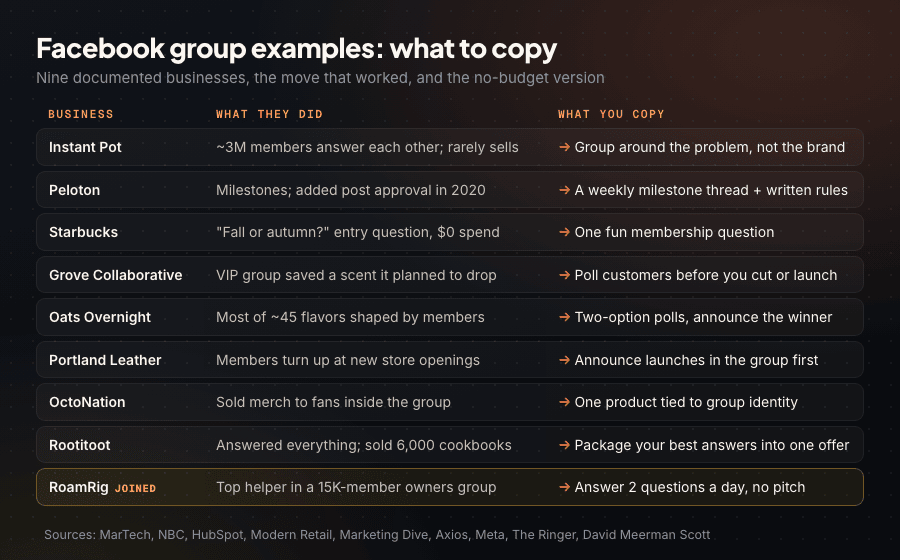
Strip away the brand names and the same six habits show up again and again. None requires a budget; all of them require showing up.
- Help first, sell rarely. Instant Pot rarely promotes in its group; RoamRig never pitches.
- Let members create the content. A group where only the owner posts is a Page with extra steps.
- Gate the door. Starbucks' fall-or-autumn question and Grove's invite-only Pantry filter for people who care.
- Run rituals. Recurring threads (milestones, weekly wins, polls) bring members back on a predictable day. Our group content calendar has templates.
- Close the feedback loop. Grove reversed a discontinuation and Oats Overnight builds flavors from member input. Tell members what changed because of them.
- Be consistent for years. Instant Pot's group took about three and a half years to go from launch to 1.8 million members. Every example is a long game.
What Did Not Work: The Honest Limits #
The examples also show where groups stop.
- A group is not a direct sales channel. Every brand above kept selling inside the group to a minimum.
- A big community does not fix the rest of the business. Instant Pot's parent company, Instant Brands, filed for Chapter 11 bankruptcy in June 2023 citing debt, tighter credit and higher interest rates, as ABC News reported, while its multi-million-member group was still active.
- Moderation is a real cost. Peloton moved to pre-approving every post; Instant Pot ran three or four moderators at a time.
- Joined groups can say no. Many groups ban promotion outright or auto-decline links.
- It is slow. None of these results came in a month. If you need sales soon, the joined model is the faster of the two.
For a broader view of why groups still beat Pages for organic reach despite these limits, read why Facebook groups matter more than ever.
Start This Week: A Plan for Both Models #
Here is what these businesses did, scaled to one owner with a few hours a week.
- Day 1: Choose your joined groups. List 10 to 20 groups where your customers ask questions. Note which allow promotional posts, and on which days.
- Day 2: Answer before you post. Reply to five real questions with specific, useful answers, RoamRig style. No links.
- Day 3: Create your owned group. Name it after the problem, not your brand, add one fun membership question and three rules. Our setup guide covers every setting.
- Day 4: Seed it. Invite 20 to 50 existing customers personally, and post one ritual thread (a milestone or "show us yours" post) plus one poll.
- Day 5: Schedule the joined-group rhythm. Plan one genuinely useful post per group per week, written differently for each group, and keep answering questions daily.
- Every week after: Close one feedback loop in your owned group ("you asked, we did"), and track which joined groups send replies, DMs and customers.
For how this fits into a full marketing plan with goals and KPIs, see the Facebook group marketing strategy for small business, and for turning that visibility into a steady pipeline, the Facebook group lead generation system.
Step 5 is where most owners fall off, because posting a varied update to 20 groups by hand eats an afternoon. PilotPoster schedules posts to every Facebook group you have joined from your own logged-in browser, with no Facebook API and no password. It can write a different version of each post per group, waits a human-like delay between groups, and its Safety Autopilot pauses posting if limits get close. That frees your time for the part no software should do: answering questions and running your own group.
Frequently Asked Questions #
What are some good examples of Facebook groups for business? #
Well-documented examples include the Instant Pot Community (roughly 3 million members in 2024), the Official Peloton Member Page, Starbucks' Leaf Rakers Society, Grove Collaborative's The Pantry, Oats Overnight's VIP group and Portland Leather Goods' Insiders group. Each built community around customers' interests rather than sales posts.
Do Facebook groups actually help businesses make money? #
Yes, mostly indirectly. Portland Leather Goods credits its group for store-opening turnout, and RoamRig wins $10,000-plus jobs by being helpful in a group it joined. Groups build trust, word of mouth and product insight; the sale usually happens elsewhere.
Should a business create its own Facebook group or join existing ones? #
Ideally both. Joined groups put you in front of buyers within weeks, while your own group builds an audience you control over years. If you only have time for one, start with joined groups and create your own once you have customers to invite.
Can I promote my business in Facebook groups I do not own? #
Only where the group rules allow it, often on specific days or threads. What works is answering questions and letting your reputation sell, as RoamRig did. Posting the same promo across many groups quickly gets declined or reported.
How big does a Facebook group need to be to help a business? #
Far smaller than the famous examples. Grove Collaborative deliberately keeps its VIP group small, and RoamRig built a business inside a group of about 15,000 people. A few hundred engaged local customers can be enough for a small business.
- Businesses grow through groups by owning one or by being the most useful member of groups they joined. Run both if you can.
- Instant Pot grew from about 400,000 members (2017) to roughly 3 million (2024) while rarely promoting in the group.
- Starbucks gated its Leaf Rakers Society with a fall-or-autumn question and spent zero dollars on it.
- Grove kept a scent it planned to drop after VIP feedback; Oats Overnight builds most flavors from its group.
- Portland Leather Goods (210,000-plus members, March 2026) uses its group as a launch audience for new stores.
- RoamRig won $10,000-plus jobs by answering questions in a 15,000-member group it did not own.
- The patterns: help first, member-created content, membership questions, rituals, feedback loops and years of consistency.
- Groups are not a direct sales channel, moderation costs real time, and joined groups can block promotion.
Related Reading #
- 6 Powerful Reasons to Create Your Own Facebook Group
- How to Promote Your Business in Facebook Groups Without Spamming
- Facebook Group Marketing Strategy: The Small Business Guide
- How to Grow a Facebook Group from 0 to 10,000 Members
- The Facebook Group Lead Engine for Small Businesses
- Community-Led Growth for Small Businesses: The Facebook Groups Playbook


