To revive a dead Facebook group, do not just start posting more. First diagnose whether it is truly dead or only dormant using Group Insights. Then post one low-effort binary question today to wake the notification feed, personally message your 10 to 20 most active past members to bring them back as seed commenters, run a small hype event in week two, and lock in weekly recurring themes so activity becomes a habit. Prune inactive and fake members so your engagement rate recovers, and keep the cadence going, because admin consistency is what actually keeps a group alive.
Almost every quiet group follows the same story. The admin got busy, posting slowed, the algorithm noticed, reach dropped, members lost the habit of checking in, and within a couple of months the group went silent. If that sounds familiar, the good news is that a dormant group is far easier to bring back than a new one is to build, because the members are already there.
This is a step-by-step plan to revive a dead Facebook group, starting with an honest diagnosis and ending with a 30-day sequence that turns a silent feed back into a community. It also covers the one case where starting over beats reviving, so you do not pour effort into a group that cannot come back.
First, Diagnose: Dead or Just Dormant? #
Before you touch anything, open your group's Insights and look at three things. This tells you what you are actually dealing with, because an inactive Facebook group and a truly dead one need different fixes.
- Active members trend: the count of people who viewed, posted, commented, or reacted in the last 28 days. If this is a fraction of your total members but not zero, the group is dormant, not dead. Dormant is very recoverable.
- Post reach: whether your recent posts reach any feeds at all. If a post still reaches a few hundred members but nobody engages, distribution is fine and the problem is your content and cadence. If reach itself has collapsed, you need to retrain the algorithm with consistent activity.
- Member quality: scan the member list for obvious fake or inactive accounts. A group of 8,000 with 30 comments a month often has a few thousand ghost accounts dragging the engagement rate down.
A group of 500 active people is worth far more than 8,000 ghosts. Facebook distributes group content based on how members interact, so a smaller engaged group gets pushed harder than a bloated silent one. Judge revival by the trend in active members, not the total headcount.
Why Facebook Groups Die in the First Place #
You cannot fix what you have not named. When Facebook group engagement dropped in your community, it was almost always one of these, and usually the first.
- The admin disappeared. This is the top killer. When you stop showing up, the algorithm deprioritizes the group and members lose the habit of opening it. Sporadic posting trains everyone, including Facebook, to ignore you.
- It drifted into a promo dump. Groups where every post is a pitch, from the admin or unchecked members, teach people to scroll past. Value stopped, so attention stopped.
- Spam went unmoderated. A feed full of unrelated links and self-promo signals that nobody is minding the room, and real members quietly leave.
- Passive members were mass-approved. Approving hundreds of join requests at once fills the group with people who joined on impulse and never engage, which drags the engagement rate down from day one.
Notice that three of the four are about consistency and moderation, not clever content. That is the real lesson, and it shapes the whole revival plan.
The instinct when reviving a group is to flood it with a backlog of posts to prove it is active. Resist it. Dumping ten posts in a day buries each one, annoys the members you just woke up, and can trip spam detection. One good post a day that you actually reply to beats a burst you abandon.
The 30-Day Resurrection Plan #
Here is the sequence. It moves from a single spark, to your loyal core, to an event, to a repeatable habit. Do not skip ahead; each step sets up the next.
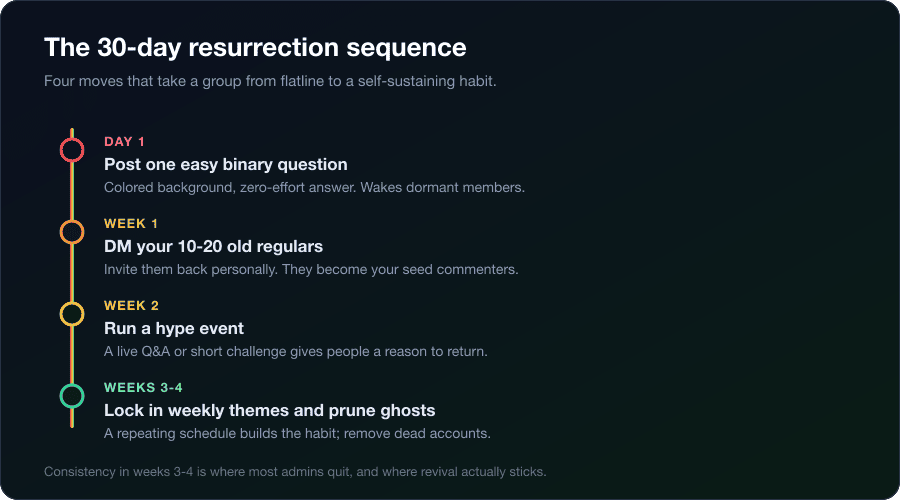
Day 1: Post one easy question #
Do this today. Post a single, lighthearted, binary question that takes two seconds to answer: "Coffee or tea to get through today?" or a this-or-that tied to your niche. Use one of Facebook's colored text backgrounds, because that native format gets pushed harder, and these viral-style questions land in members' notifications, which is exactly how you re-engage Facebook group members who have not opened the group in months. Then reply to every single answer to restart the conversation habit.
Week 1: Personally bring back your regulars #
Scroll back through old posts and find the 10 to 20 people who used to comment most. Send each one a short, genuine direct message: you are bringing the group back to life, you valued their input, and you would love their take on where it should go next. This does two things. It returns your most likely commenters, and it makes them feel like co-owners. Post a short public announcement too, telling existing members the group is active again and asking what they want from it.
Week 2: Run a hype event #
Give people a concrete reason to show up at the same time. A 30-minute live Q&A, a five-day challenge, an AMA with you or a guest, or the return of a segment members used to love. The event itself matters less than the shared moment, which rebuilds the sense that things are happening here again.
Weeks 3 and 4: Lock in weekly themes #
This is where revival either sticks or fades. Establish two or three recurring theme posts on fixed days, for example a Monday goal-setting thread and a Friday wins thread, so members learn to expect and anticipate them. A predictable rhythm is what turns a burst of activity into a durable habit. Start with two themes and add more only once they are consistently working. Our Facebook group content calendar templates give you a month of themes to pull from, and these 18 group post ideas keep them varied.
An empty comment section tells people not to bother. Seed the first comment on your own posts to break the ice, and reply to every response within the first hour. Early activity signals value to the algorithm and pulls the post into more feeds while it is fresh.
Prune the Ghosts #
This one feels backwards but it matters. Once the group is moving again, remove obvious fake accounts, long-dormant members who never engage, and spam profiles. Because Facebook judges your group by how the members interact, cutting dead weight raises your engagement rate and improves how far your posts travel. A leaner, active group outperforms a bloated silent one on every signal that matters. Tighten your join process at the same time: use membership questions to filter for genuine intent, and approve requests in small batches rather than hundreds at once.
Consistency Is the Whole Game #
Every step above works only if you keep showing up after the initial push. Admin disappearance is what killed the group the first time, so the real fix is a cadence you can actually sustain through busy weeks, not a heroic month followed by silence. The problem is that staying consistent by hand, writing and posting a themed prompt every day across the exact times members are online, is precisely the chore that made you fall off before.
This is where scheduling earns its place. PilotPoster is a web app plus Chrome extension that posts to your group through your own browser session, so you can schedule a week or a month of recurring theme posts in one sitting and let them run. Its Auto AI can vary each recurring prompt so your Monday thread is not word-for-word identical every week. The full setup is in our guide to Facebook group admin auto posting.
Automating the routine posts frees you to do the part only a human can: replying, welcoming, and moderating. That combination, a reliable content rhythm plus a present admin, is what keeps a revived group alive for good.
How to Tell the Revival Is Working #
Watch the leading indicators, not just the member count, so you know whether to keep going or change course. Check these weekly against where you started.
| Signal | Still struggling | Coming back to life |
|---|---|---|
| Active members (28 days) | Flat or falling | Trending up week over week |
| Comments per post | 0 to 2 | 5 or more and climbing |
| First-hour engagement | None | A few responses within the hour |
| Member-started posts | None; only you post | Members posting on their own again |
The last row is the one that matters most. A group is truly revived when members start posting without being prompted, because that means the habit has transferred from you to them. Until then, keep carrying the cadence yourself.
Then, and Only Then, Grow Again #
Do not invite new people into a quiet group. New members who arrive to a sparse, silent feed leave within minutes and send a negative signal to the algorithm. Once your group is visibly active again, with recent posts and real comments, reopen the doors. Point your existing audience to it, encourage members to invite the right people, and lean on your keyword-rich group name for organic discovery. The full playbook is in how to grow a Facebook group from 0 to 10,000 members.
When to Start Over Instead #
An honest plan admits when revival is the wrong call. Consider archiving and starting fresh if the group's topic has genuinely run its course, if the member base was built on spam or giveaways and has no real interest in your niche, or if the group's name and history point in a direction you no longer want. Starting over costs you the member count but frees you from a poisoned foundation. If the members once cared about the topic and simply drifted, revive. If they never cared, rebuild.
Frequently Asked Questions #
Why did my Facebook group die? #
Almost always because the admin stopped posting consistently. When activity slows, Facebook deprioritizes the group in members' feeds and people lose the habit of checking it, which creates a downward spiral. Promotional drift, unmoderated spam, and mass-approving passive members are the other common causes.
Should I delete an inactive Facebook group or start over? #
Revive it if members once genuinely cared about the topic and simply drifted away, since those people are far easier to re-engage than new ones are to recruit. Start over only if the niche is dead, the member base was built on spam or giveaways with no real interest, or the group's name and history no longer fit your direction.
How long does it take to revive a Facebook group? #
You can see the first signs of life within a day from a single well-placed question, but rebuilding a durable habit takes about 30 days of consistent activity. Expect real momentum to return in the third and fourth weeks, which is exactly when most admins give up too early.
Do inactive members hurt a Facebook group? #
Yes. Facebook distributes group content based on how members interact, so a large number of ghost or inactive accounts drags down your engagement rate and limits how far posts reach. Removing dead accounts usually improves distribution, which is why pruning is part of the revival.
- Diagnose before acting: most quiet groups are dormant, not dead, and dormant is very recoverable.
- Admin disappearance is the number one cause of group death, so consistency is the real fix.
- Restart with one easy binary question today to wake dormant members through their notifications.
- Personally message your 10 to 20 most active past members; they become your seed commenters.
- Run a hype event in week two, then lock in weekly recurring themes so activity becomes a habit.
- Prune ghost and inactive members to raise your engagement rate and improve post reach.
- Only reopen growth once the group is visibly active again, or new members will bounce.
- Start over instead of reviving only when the niche is dead or the member base never cared.