
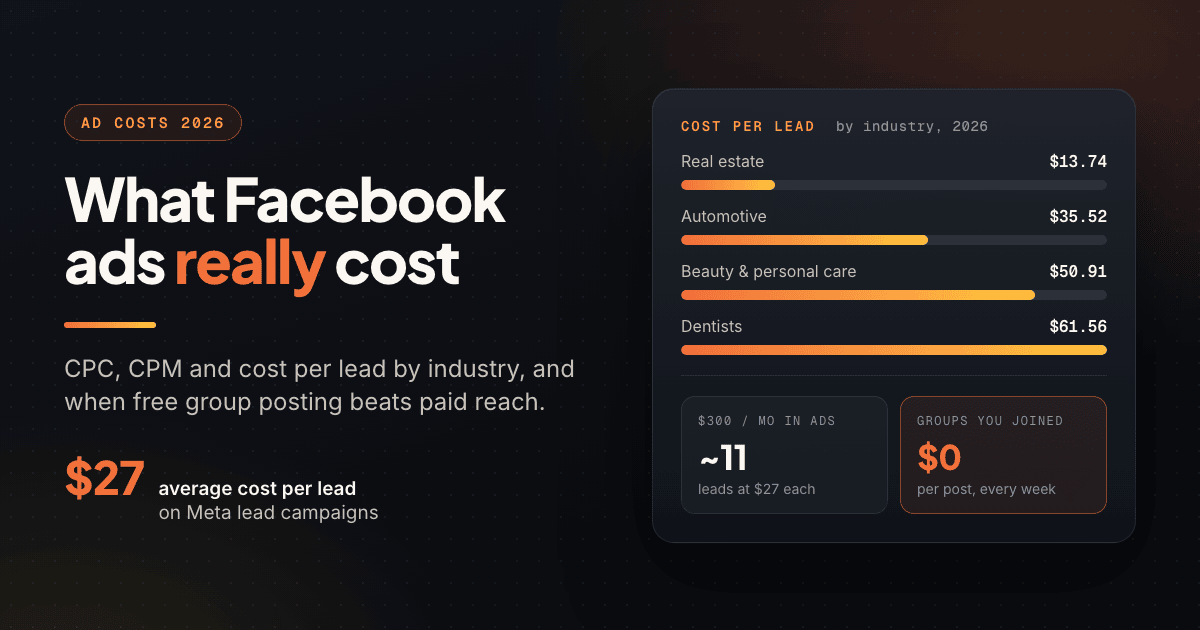
In 2026, Facebook ads cost about $0.60 per click on traffic campaigns, $1.80 per click on lead campaigns, and $27.39 per lead on average, according to the 2026 LocaliQ and WordStream benchmarks. CPM (cost per 1,000 impressions) usually lands between roughly $6 and $20 depending on the source, industry and season. Cost per lead swings from about $12 in career and employment to $61.56 for dentists, and Meta says its average price per ad rose 12% year over year in both Q1 and Q2 2026. A $300 monthly budget typically buys around 7 to 11 leads. The honest verdict: ads are worth paying for when you retarget warm audiences or scale an offer that already sells, but as a small business's only channel they are an expensive way to rent attention.
Ask how much Facebook ads cost and you hear anything from "$1 a day" to "$3,000 a month or don't bother." Neither helps you plan. You need the price of a click and a lead in your industry, what a realistic budget buys, and the costs no benchmark report shows.
Here are those numbers with the math shown and sources cited. We also make a case most ad-cost articles skip: posting consistently in groups you have joined gives always-on visibility that ads deliver only while the meter runs.
How Much Do Facebook Ads Cost in 2026: The Headline Numbers #
The most widely cited 2026 data comes from WordStream and its sister brand LocaliQ, which publish the same benchmark study. It covers 1,377 US traffic campaigns and 452 US lead campaigns measured through June 30, 2026. Here are its averages, with the prior year in brackets:
| Metric | 2026 average | 2025 | What it means |
|---|---|---|---|
| Traffic campaign CPC | $0.60 | $0.70 | Cost of a website-visit click |
| Traffic campaign CTR | 1.93% | 1.71% | Share of viewers who click |
| Lead campaign CPC | $1.80 | $1.92 | Pricier clicks from likely form-fillers |
| Lead conversion rate | 8.54% | 7.72% | Share of clicks that become leads |
| Cost per lead (CPL) | $27.39 | $27.66 | Spend divided by leads |
CPM is the number with the widest spread. Bïrch (formerly Revealbot) puts typical Facebook CPMs at roughly $6 to $20, settling "in the low teens" outside busy seasons, while AdManage's analysis of more than $3 billion in spend found a global median of about $19.81 from January 2025 to January 2026. For planning, assume $10 to $20 per 1,000 impressions and treat anything lower as a bonus.
Clicks and leads got slightly cheaper in the benchmark even though Meta charged more per ad, because click-through and conversion rates rose faster than prices. Good news if your ads are strong; bad news if they are average.
How Facebook Ad Pricing Actually Works #
Facebook ads have no price list. Every time someone opens Facebook or Instagram, Meta runs an auction for the ad slots in front of them, combining your bid, how likely that person is to take your chosen action, and the ad's quality. A relevant ad can beat a bigger budget.
CPM, CPC and CPL Are Three Views of the Same Spend #
Most campaigns are billed per impression, so CPM is what you really pay; CPC and CPL are outcomes. At a $15 CPM and a 1.5% click rate, each click costs $1. If 8% of clickers submit a form, each lead costs $12.50. Better click or conversion rates cut CPL even if CPM stays put.
What Drives Your Cost Up or Down #
- Objective. Optimizing for leads or purchases costs more per impression than reach, because Meta targets a smaller pool of likely buyers.
- Audience. Narrow or high-value audiences (homeowners, business owners) cost more because more advertisers bid on them.
- Placement. Feed, Stories and Reels are priced differently; automatic placements usually lower average cost.
- Creative. Ads people hide or scroll past get pricier delivery. Ads people engage with get cheaper.
- Season. Q4 is expensive as retailers flood the auction. AdManage's data shows real estate CPMs peaking near $40.76 in November against a yearly median of $29.85.
- Industry. Dentists and home services pay more per lead because each customer is worth more.
Facebook Ads Cost by Industry: CPC and Cost Per Lead #
Averages hide a 5x spread between industries. These figures come from the 2026 LocaliQ benchmarks for US lead campaigns. Traffic CPC is the cost of a click on a traffic campaign; lead CPC and CPL come from lead campaigns.
| Industry | Traffic CPC | Lead CPC | Cost per lead |
|---|---|---|---|
| Dentists & Dental Services | $0.61 | $5.70 | $61.56 |
| Beauty & Personal Care | $0.50 | $2.97 | $50.91 |
| Home & Home Improvement | $0.63 | $2.18 | $42.95 |
| Personal Services | $0.67 | $1.62 | $38.09 |
| Automotive (For Sale) | $0.70 | $2.01 | $35.52 |
| Physicians & Surgeons | $0.61 | $1.68 | $32.14 |
| Health & Fitness | $0.64 | $1.84 | $27.11 |
| Education & Instruction | $0.70 | $1.72 | $26.31 |
| Sports & Recreation | $0.59 | $1.08 | $15.49 |
| Real Estate | $0.55 | $1.27 | $13.74 |
| Career & Employment | n/a | $0.73 | $12.30 |
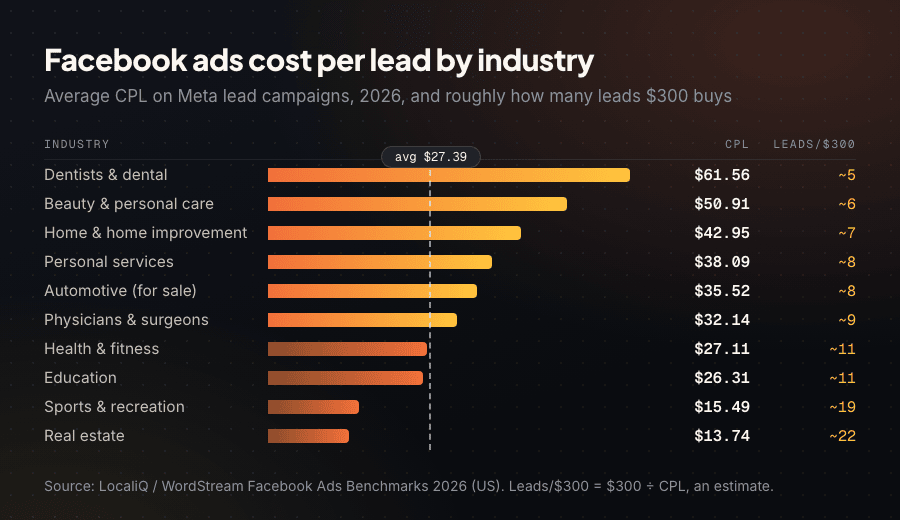
Traffic clicks are cheap everywhere ($0.34 to $0.86 across the study). The difference appears at the lead stage: a dental lead costs about 4.5 times a real estate lead, so budget from the CPL column.
Focus Digital's July 2026 report on 138 North American Meta campaigns found a spend-weighted average CPL of about $42, with real estate at $51.90 instead of LocaliQ's $13.74 and home services at $45.50. Different samples, weighting (Focus Digital weights by spend) and lead definitions explain the gap. Treat $27 to $42 as the realistic all-industry range and your own first month of data as the only number that counts.
Meta Confirms Ads Are Getting More Expensive #
The benchmark studies measure what advertisers pay per result. Meta's own earnings measure what it charges per ad, and that number is climbing. In its Q1 2026 results, Meta reported that average price per ad rose 12% year over year while ad impressions grew 19%. In Q2 2026, average price per ad rose another 12% with impressions up 14%. If your results per dollar held steady this year, your ads got better; the auction did not get cheaper.
Facebook Ads Cost Per Day and Per Month: What Your Budget Buys #
Meta lets you start very small. Its minimum budget rules set a floor of about $1 a day in USD for ads charged per impression and roughly $5 a day for ads charged per click or engagement, and a cost-per-result goal needs a daily budget of at least five times that target. Those are the amounts the system accepts, not the amounts that produce useful data.
The table below estimates what common budgets buy at 2026 benchmark rates. The math: impressions = budget ÷ CPM × 1,000 (using a $10 to $20 CPM); clicks = budget ÷ $0.60 traffic CPC; leads = budget ÷ $27.39 to $42 CPL. A month is 30.4 days. These are estimates, and a lead campaign and a traffic campaign are separate campaigns, so you get the clicks or the leads from a given dollar, not both.
| Budget | Monthly spend | Impressions | Traffic clicks | Leads |
|---|---|---|---|---|
| $5 per day | ~$152 | 7,600 to 15,200 | ~253 (about 8 a day) | ~4 to 6 |
| $10 per day | ~$304 | 15,200 to 30,400 | ~507 (about 17 a day) | ~7 to 11 |
| $300 per month | $300 | 15,000 to 30,000 | ~500 | ~7 to 11 |
| $1,000 per month | $1,000 | 50,000 to 100,000 | ~1,667 | ~24 to 37 |
Plug in your industry: a home improvement company at $42.95 per lead gets about 7 leads from $300. A real estate agent gets about 22 at LocaliQ's $13.74, or about 6 at Focus Digital's $51.90. Treat your first month as a test, not a forecast.
Meta's delivery system needs about 50 optimization events in a 7-day window to exit the learning phase and stabilize. At a $27.39 CPL, 50 leads a week costs roughly $1,370 a week, or about $196 a day. A $10-a-day lead campaign will sit in "Learning limited" with less stable costs. Small budgets still work, just less predictably than benchmarks suggest.
The Hidden Costs That Never Appear in a Benchmark #
Ad spend is the visible cost. These quietly add to it.
- Creative. Ads wear out once the same people have seen them several times, so you need fresh images or video every few weeks, from a designer or your own evenings.
- Testing budget. Running two or three versions to find a winner means part of every early budget goes to losers.
- The learning phase. Costs are less stable while Meta learns, and big edits can restart it.
- Management fees. Agencies typically charge a percentage of spend, a monthly retainer, or both. Credo's agency pricing survey (last updated in 2022) listed 10% to 15% of spend for larger accounts plus an onboarding fee of around $2,000, and an agency's monthly minimum can exceed a small business's whole ad budget.
- Lead handling. A $27 lead is worth $0 if nobody calls it back quickly, and form leads are often lower intent than inbound calls.
Boosted Posts vs. Ads Manager #
"Boost post" turns an existing post into an ad with simplified controls, and its default goal often buys engagement: reactions that rarely become customers. Ads Manager gives you every objective, lead forms, A/B testing and custom audiences.
If you do use Boost, switch the goal to website visits, messages or leads before you pay, and pick a specific local radius instead of the default audience. A boost that buys 400 likes from people outside your service area is the classic wasted $50.
When Facebook Ads Are Worth the Money #
Ads are a precise tool that works brilliantly in a few situations and poorly as a default. Paying is usually right in these cases.
- Retargeting warm audiences. People who visited your site, watched your videos or messaged your Page cost more per impression but convert far better because they know you.
- Scaling an offer that already sells. Ads amplify a working offer; they rarely fix a weak one.
- Events and deadlines. A grand opening or a dated workshop needs reach inside a short window. Organic builds slowly; ads deliver this week.
- Tight local radius targeting. A restaurant, gym or trade business can reach nearly everyone within a few miles, including people in no local group.
Ads work worst as the only way a small business gets seen, because visibility ends the day the budget does. That is where groups come in.
Facebook Groups vs. Ads: The $300 a Month Comparison #
Groups run on different economics: no auction, no CPM. A post in a group you have joined reaches members based on how active the group is and how people respond, and the tenth group costs exactly what the first did, the time to post. For a local business, the right 30 to 50 neighborhood, buy-and-sell and recommendation groups often have a combined membership in the tens of thousands.
It is not a free lunch. Many groups ban promotion, allow it only on certain days, or hold posts for approval, and results depend on whether your post is genuinely useful. Nobody publishes a credible "cost per lead from groups" benchmark, so we will not invent one. We can compare cost, time and how reach works.
A Worked Example for a Local Service Business #
A home cleaning or HVAC business has $300 a month for Facebook and two options.
| Plan A: $300/month in ads | Plan B: posting in 40 joined groups weekly | |
|---|---|---|
| Cash cost | $300 | $0 manually, or $47 with PilotPoster |
| Time cost (estimate) | 1 to 2 hours a month on creative and results | Manual: 40 posts × ~3 min = ~2 hours a week (8.7 a month). Automated: ~1 hour a week |
| What you get | ~7 to 11 leads at $27.39 to $42 CPL (home services nearer 7) | About 173 posts a month in front of members who live in your area |
| How reach works | Bought in an auction; stops when the budget stops | Earned per post; depends on rules, activity and post quality; compounds as members recognize you |
| What to measure | CPL, cost per booked job, frequency | Post approval rate, comments, DMs and leads per group, then monthly cost ÷ leads |
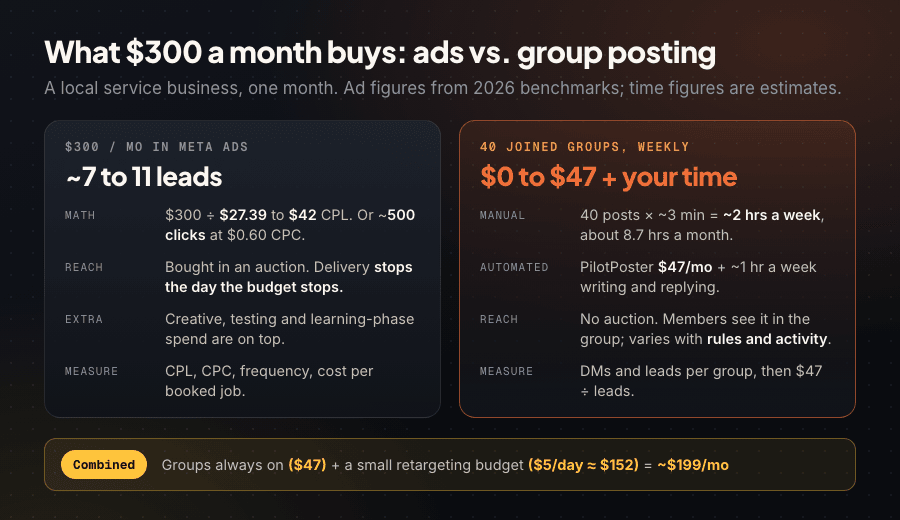
Be honest about time: 8.7 hours a month valued at $40 an hour is about $348, more than the ad budget. Posting by hand also invites the mistake most likely to get posts declined, pasting identical text into every group within minutes. See Facebook group posting limits for safe pacing.
To judge Plan B fairly, run it for 8 to 12 weeks and log every lead with its source group. Monthly cost divided by leads gives a cost per lead to set beside the ad number. The tracking setup is in how to measure Facebook group marketing ROI, and the free Facebook engagement calculator helps you spot which groups actually respond. Picking the right groups matters more than the number; how to find Facebook groups for marketing walks through vetting them.
PilotPoster is a web dashboard plus Chrome extension that schedules and publishes posts to every Facebook group you have joined, posting organically from your own logged-in browser with human-like delays between groups. It writes a different version of each post per group, adds your link as the first comment, and shows a success rate for every group. At $47 a month (try it for $0 for a day), the 2 hours a week of manual posting becomes one planning session.
API-based schedulers cannot do this: Meta removed group publishing from its API on 22 April 2024, so they reach Pages only. PilotPoster posts where API tools can't, into every group you have joined.
The Combined Plan: Groups for Reach, Ads for Retargeting #
The strongest setup uses each for its best job: groups for always-on organic visibility, a small ad budget to retarget the people that visibility warms up.
- Post weekly in your 30 to 50 best groups. Mix helpful posts and proof with an occasional offer. The guide to getting leads from Facebook groups covers the content mix.
- Send some traffic to your website with the link in the first comment. See why links in the first comment work.
- Install the Meta Pixel on your site. Every group member who clicks through joins a website-visitor audience you can retarget.
- Spend $5 to $10 a day retargeting those visitors with a clear offer: a quote, a booking, a dated discount.
- Review monthly. Compare cost per lead from each, cut dead groups, and raise ad spend only on offers that convert.
Total: $47 for automated group posting plus about $152 in retargeting ($5 a day), around $199 a month, less than the ads-only plan with visibility running every week. If you want the wider free-channel playbook (profile, Reels, Marketplace), read Facebook marketing without ads.
How to Lower Your Facebook Ad Costs #
- Match the objective to the result. Paying for engagement when you want leads buys cheap likes.
- Use instant forms with one qualifying question. In-app lead forms usually cost less per lead than a landing page; a question like "What is your postcode?" filters out low intent.
- Stop stacking narrow interests. A location plus a broad audience often beats five layered interests.
- Refresh creative when frequency climbs past three or four and click rates fall, instead of raising the budget.
- Consolidate ad sets so fewer, better-funded ad sets exit learning faster.
- Change one thing at a time. Big budget jumps and audience swaps can reset learning.
- Time your spend. Non-retailers can spend lighter in November and December and heavier in January.
- Retarget before you prospect. Build warm audiences cheaply with organic posting, then pay to follow up.
- Measure cost per customer. A $3 click that books a $400 job beats a $0.40 click that never calls.
Frequently Asked Questions #
How much do Facebook ads cost per month for a small business? #
There is no fixed price because you set the budget. At 2026 benchmark rates, $150 a month buys roughly 250 traffic clicks or 4 to 6 leads, $300 buys about 500 clicks or 7 to 11 leads, and $1,000 buys about 1,667 clicks or 24 to 37 leads, depending on your industry.
How much do Facebook ads cost per day? #
Meta accepts budgets from about $1 a day for impression-based ads and around $5 a day for click-based ads. A practical starting point for a local business is $5 to $10 a day, which works out to roughly $152 to $304 a month and about 8 to 17 traffic clicks a day at the 2026 average of $0.60 per click.
Is $5 a day enough for Facebook ads? #
$5 a day is enough for retargeting a small warm audience or promoting a local event, but it is thin for cold lead generation. At $27 to $42 per lead it buys roughly 4 to 6 leads a month, and the campaign will not leave the learning phase.
What is a good cost per lead on Facebook ads? #
The 2026 LocaliQ and WordStream average is $27.39, while Focus Digital measured about $42, so anything under $30 is solid for most industries. What counts as good depends on your customer value: a $60 dental lead is cheap if one in five becomes a $2,000 patient.
Why are my Facebook ads so expensive? #
The usual causes are the wrong objective, an audience that is too narrow, tired creative that people scroll past, a budget too small to exit the learning phase, or running in Q4. Prices are also rising across the board: Meta reported a 12% year-over-year increase in average price per ad in both Q1 and Q2 2026.
Are Facebook groups better than Facebook ads for small businesses? #
They do different jobs. Groups give always-on organic visibility in communities where your customers already gather, for the cost of your time or a PilotPoster plan, but results depend on group rules and post quality. Ads give fast, targeted reach that stops when you stop paying. Most small businesses do best combining the two.
- 2026 benchmarks: about $0.60 per traffic click, $1.80 per lead-campaign click and $27.39 per lead (LocaliQ / WordStream).
- Plan on a CPM of $10 to $20; Q4 pushes it higher.
- Cost per lead runs from $12.30 to $61.56 by industry, and another study puts the average near $42.
- Meta's average price per ad rose 12% year over year in Q1 and Q2 2026.
- $300 a month buys roughly 500 clicks or 7 to 11 leads.
- Hidden costs: creative, testing, the learning phase (about 50 results a week) and agency fees.
- Ads pay off in retargeting, scaling proven offers, deadline events and tight local targeting.
- Group posting has no auction or CPM but costs time (about 8.7 hours a month by hand) and depends on group rules.
- Best setup: groups for always-on reach, $5 to $10 a day for retargeting.


