
For most small businesses, Facebook is the better main platform and Instagram the better showcase. Instagram wins for visual product brands selling to under-35s: its posts reach about 3.20% of followers versus 1.25% for Facebook Pages (Socialinsider, August 2026). Facebook wins for local services, B2B and most service businesses because it reaches more US adults (71% vs 50%, Pew 2025), handles links and local intent better, and has groups, where customers already gather and ask for recommendations, something Instagram has no equivalent for. The practical split: make Reels once and share them to both apps, and run Facebook groups as your main organic engine.
Most guides to Facebook vs Instagram for small business compare two profiles: a Facebook Page against an Instagram account, plus ads on one or the other. Framed that way, Instagram often looks like the winner. Its posts reach more followers, its Reels travel to strangers, and it suits anything that photographs well.
That framing leaves out the part of Facebook that matters most to a small business: groups. Almost 1.8 billion people use Facebook Groups every month (Meta, October 2024), and many of them sit in local and niche groups asking exactly the questions your business answers. Below is an honest side-by-side on audience, formats, local intent, ads, reach and effort, then a pick by business type and a weekly split that uses each app for what it does best.
Facebook vs Instagram for Small Business at a Glance #
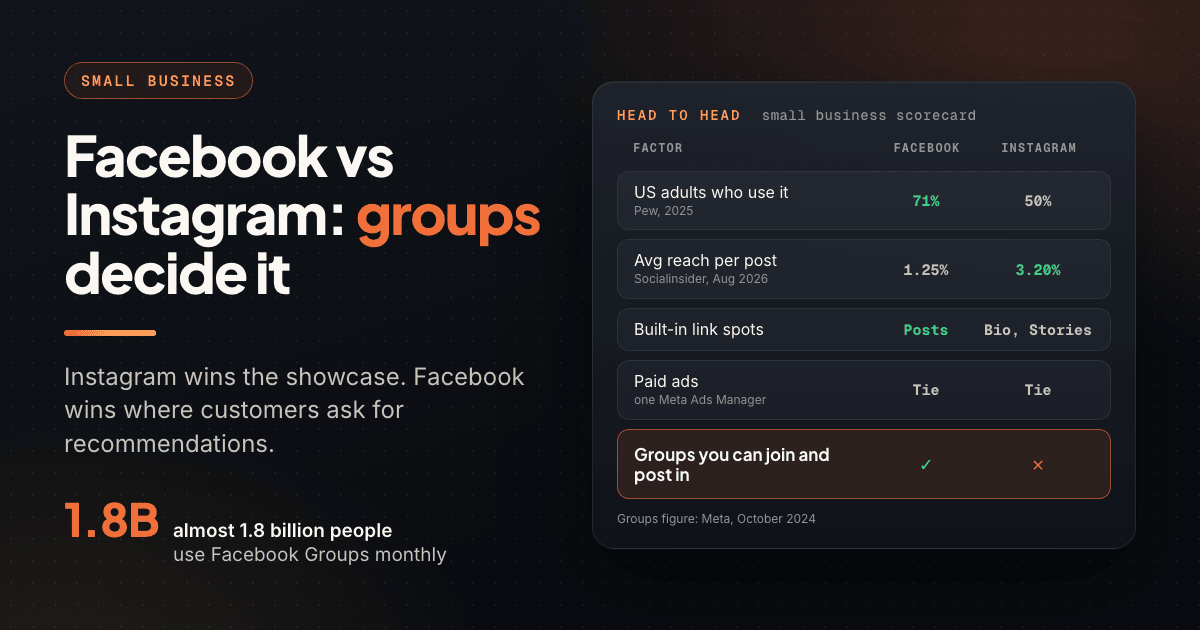
How the two compare on the factors that decide where your hours should go, with sources in each section below.
| Factor | Edge | ||
|---|---|---|---|
| US adults who use it | 71%, highest at ages 30 to 49 | 50%, highest at ages 18 to 29 | |
| Strongest formats | Reels, photos, text, events, link posts | Reels, carousels, Stories | Instagram for visuals |
| Average organic reach per post | 1.25% of Page followers | 3.20% of followers | |
| Average engagement rate | 0.15% of followers | 0.48% of followers | |
| Where links work | Posts, comments, events, groups, Page | Profile website field, Story link sticker | |
| Local intent | Groups, Events, Marketplace | Location tags, Explore | |
| Paid ads | Meta Ads Manager | Same Meta Ads Manager | Tie |
| Communities you can join and post in | Groups, millions of them | ✕ No equivalent | |
| Effort to stay visible | Moderate when groups carry the load | High; needs steady video |
Who You Reach on Each Platform #
Both apps are enormous. Instagram passed 3 billion monthly users in September 2025 (CNBC), and Meta counts 3.60 billion daily active people across all its apps (Meta, July 2026). For a US business, the more useful question is who uses each app, which Pew's 2025 survey (published November 2025) answers:
| US adults | ||
|---|---|---|
| All adults | 71% | 50% |
| Ages 18 to 29 | 68% | 80% |
| Ages 30 to 49 | 80% | 62% |
| Ages 50 to 64 | 74% | 40% |
| Ages 65+ | 57% | 19% |
| Rural | 71% | 37% |
| Urban | 71% | 55% |
Instagram leads only among adults under 30. Facebook reaches a majority of every age group and is equally strong in cities and rural towns, while Instagram falls to 37% of rural adults. About half of US adults visit Facebook every day (Pew, 2025). If your customers are homeowners, parents, retirees or anyone outside a big metro, more of them are on Facebook.
Owners tend to choose the app they personally scroll. Ask instead how old your typical customer is and where they live: a bridal boutique selling to 27-year-olds and a gutter cleaner selling to 55-year-old homeowners should not run the same plan.
Formats and Discovery: Where Instagram Genuinely Wins #
Instagram's advantage on reach is real. As of August 2026, the average Instagram account reached 3.20% of its followers per post, against 1.25% for Facebook Pages, across 872,075 posts in Socialinsider's reach study (September 2026). Engagement tells the same story: 0.48% of followers on Instagram in 2025 (Socialinsider, February 2026) versus 0.15% on Facebook Pages (Socialinsider, March 2026).
Carousels (0.55%) and Reels (0.52%) are Instagram's strongest formats, and Instagram head Adam Mosseri credited messaging, Reels and recommendations for most of the app's recent growth (TechCrunch, September 2025). Recommended Reels reach people who have never heard of you. For a brand whose product sells on looks, such as jewelry, cakes, interiors, fashion or tattoos, that discovery is worth a lot.
Instagram also supports shopping. Approved businesses that mainly sell physical goods can connect a product catalog and tag products in their posts (Instagram Help).
Where Instagram is weaker is the click. Its built-in link spots are the website field on your profile (Instagram Help) and the link sticker in Stories (Meta Business Help). Facebook takes a link in a post, a comment, an event or a group post. Link posts are Facebook's lowest-engagement Page format (0.05%, Socialinsider), so many marketers put the link in the first comment, but it works everywhere you post.
Local Intent: Where Facebook Pulls Ahead #
Instagram is where people browse. Facebook is where people in a town ask for things. Search any neighborhood group for "recommend" and you will find threads like "Can anyone recommend a roofer who actually shows up?" with dozens of replies naming businesses: customers ready to hire.
Meta builds around that behavior. In October 2024 it began testing a Local tab that pulls "the best local content from across Facebook" out of Marketplace, Groups and Events, including local groups and "recommendations about neighborhood hot spots" (Meta Newsroom). Instagram has location tags and Explore, but no shared space where neighbors post a request and other neighbors answer with a business name. For the playbook by business type, see how local businesses use Facebook groups.
Ads: Closer to a Tie Than You Think #
Facebook and Instagram ads come from the same system. You build both in Meta Ads Manager, and Advantage+ placements spreads one campaign across Facebook, Instagram, Messenger and more "with just one setting" (Meta). Meta recommends keeping all placements on.
That makes "Facebook or Instagram for ads" a false choice; the real decision is whether to pay and how much. For current cost per click and cost per lead by industry, see how much Facebook ads cost in 2026. For most small businesses the better order is organic first, then a small retargeting budget once an offer is already selling.
Organic Reach and Effort: What Each Platform Really Costs #
Instagram's higher reach is paid for in content. The average profile in Socialinsider's 2025 sample published about 20 posts a month (8 Reels, 5 carousels, 7 images), and Reels need filming, editing and a strong first second.
A Page-only Facebook plan is worse: Socialinsider's average Page posted 39 times a month in 2025, and a typical post reached 1.25% of followers, about 25 people for a 2,000-follower Page (our estimate). If the comparison stopped at Pages and profiles, Instagram would win on organic. It does not stop there.
The Facebook Advantage Instagram Has No Equivalent For: Groups #
On Instagram, your audience is your followers plus whoever the algorithm sends you, and you must build it before it pays. On Facebook, you can join groups where your customers already gather and post to members who have never followed you: a 30,000-member neighborhood group, a local parents group, an industry group for property managers. The audience exists on day one.
The scale is large. Meta reports almost 1.8 billion monthly Groups users and 25 million monthly active public groups (Meta, October 2024), and said most people on Facebook belong to at least 15 active groups (Meta, October 2022).
Instagram's nearest features are different tools. Broadcast channels are a one-to-many messaging tool where a creator posts to their own followers (Meta, February 2023), and group chats are private conversations you have to start. Neither lets a new business walk into a room of 20,000 local homeowners and answer a question just asked.
Why groups are the highest-return organic play #
- Intent: members ask for recommendations and advice, so a helpful post or reply lands at the moment of need.
- No audience to build first: you post to the group's members, not only your own followers.
- Repeatable: a weekly post in 10 to 20 relevant groups is a habit, not a viral bet.
- Works as your Page: Pages can request to join groups, where admins allow Pages (Facebook Help).
- Compounds: members who saw your posts tag you when someone asks next time.
Groups do not replace your Page, which holds your reviews, hours and ads account (see Facebook groups vs Pages for business). The point here is narrower: groups are why Facebook beats Instagram for most small businesses, and most Facebook vs Instagram comparisons leave them out.
Read each group's rules and pinned posts first, use the promo day or weekly thread if there is one, write each post fresh for that group, and reply to comments. Admins welcome members who help; they decline members who only drop links. The full routine is in Facebook marketing without ads.
Facebook or Instagram for Small Business: Pick by Business Type #
"Lead with" is where most of your weekly hours should go.
| Business type | Lead with | Instagram's job | Facebook's job |
|---|---|---|---|
| Local services (cleaners, lawn care, plumbers, contractors) | Before-and-after Reels as proof | Weekly posts and recommendation replies in local groups; Page for reviews | |
| Restaurants, cafes, salons | Both | Reels and Stories of food or finished work | Specials on local groups' promo days; Events for special nights |
| Visual product brands (jewelry, fashion, decor, custom cakes) | Main channel: carousels, Reels, product tags | Niche hobby and buy/sell groups; Reels shared from Instagram | |
| B2B and professional services (accountants, agencies, coaches) | Light presence for credibility | Owner and industry groups where clients ask questions | |
| E-commerce with practical products | Demo Reels and creative testing | Niche groups where the problem is discussed; retargeting ads |
The short version: if your product is the picture and your buyer is under 35, lead with Instagram. Almost everyone else should lead with Facebook, and specifically with groups.
The Practical Split: Make Reels Once, Let Groups Drive Facebook #
You do not need two content plans: run one production line and two distribution channels.
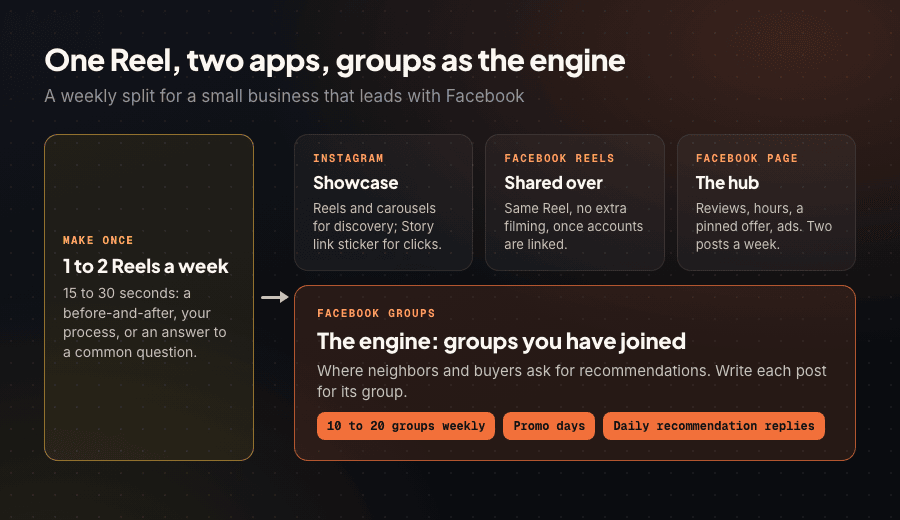
- Film one or two Reels a week. Fifteen to 30 seconds of a before-and-after, your process, or an answer to a common question. Post on Instagram and share to Facebook; Instagram can share reels to Facebook per reel or automatically once your accounts are linked in Accounts Center (Instagram Help).
- Post into 10 to 20 groups you have joined. A tip, a photo of a finished job, or an offer on promo day, worded for each group. This is your Facebook engine.
- Answer recommendation threads. Ten minutes a day searching your groups for your service keyword.
- Keep the Page as the hub. Hours, reviews, a pinned offer, two posts a week.
- Use Instagram Stories for the click. A link sticker to your booking page or shop when you run an offer.
- Review monthly. Ask every new customer "where did you find us?" and move hours toward the channel that answers most often.
Writing fresh copy for 15 groups every week is the step most owners drop. PilotPoster is a web app plus Chrome extension that schedules posts to the Facebook groups you have joined (not only ones you admin) from your own logged-in browser, with no Facebook API and no stored password. Its AI rewrite gives each group its own version, it can post in groups as your Page, Safety Autopilot holds the posting limits you set, and a recurring campaign repeats your weekly offer. Johan, who runs a lawn care business in New Braunfels, Texas, posts to local groups with it and reported 14 new lawn jobs in March. More on how local businesses use it.
Frequently Asked Questions #
Is Facebook or Instagram better for small business? #
For most small businesses, Facebook: it reaches more US adults (71% vs 50%), is stronger with customers over 30 and in rural areas, and has groups where customers ask for recommendations. Instagram is the better lead channel for visual product brands whose buyers are mostly under 35.
Should a small business be on both Facebook and Instagram? #
Yes, but not with equal effort. Make short videos once and share them to both apps, then put your extra hours into the platform that fits your customers. For most local and service businesses that means posting in Facebook groups, with Instagram as a showcase.
Which has better organic reach, Facebook or Instagram? #
Comparing accounts, Instagram: Socialinsider found average reach of 3.20% of followers on Instagram versus 1.25% for Facebook Pages in August 2026. That comparison excludes Facebook groups, where you post to members who do not follow you; no independent study measures group reach, so track your own results.
Is Instagram good for local businesses? #
It works well as a portfolio, especially for restaurants, salons and anything visual. Local buying questions happen mostly in Facebook community groups, so local businesses usually get more enquiries from Facebook.
Do Facebook ads also run on Instagram? #
Yes. Both are managed in Meta Ads Manager, and Advantage+ placements runs one campaign across Facebook, Instagram and other Meta placements. You can limit an ad set to Instagram only.
Can I post the same content on Facebook and Instagram? #
For Reels and photos, yes; Instagram can share them to Facebook automatically once your accounts are linked. For group posts, write a fresh version per group, because members of overlapping groups notice identical copy.
- Facebook reaches 71% of US adults and Instagram 50% (Pew, 2025); Instagram leads only among adults under 30.
- Instagram wins account-level organic: 3.20% average reach vs 1.25% for Facebook Pages (Socialinsider, August 2026).
- Visual product brands selling to younger buyers should lead with Instagram.
- Ads are a tie: one Meta Ads Manager runs both apps.
- Facebook groups are the advantage Instagram has no answer for: almost 1.8 billion monthly users in 25 million active public groups (Meta, 2024).
- Local services, B2B and most service businesses should make groups their main Facebook channel and use the Page as a hub.
- Make Reels once, share them to both apps, and spend the saved hours in groups you have joined.


